Schools and Trauma
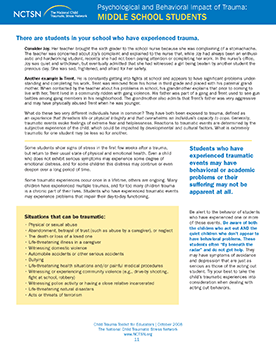
Focuses on partnering with schools to enhance mental health and trauma-informed services designed to inform both school personnel and mental health professionals about the impact of traumatic events.
The following resources on child trauma were developed by the NCTSN. To find a specific topic or resource, enter keywords in the search box, or filter by resource type, trauma type, language, or audience.
Focuses on partnering with schools to enhance mental health and trauma-informed services designed to inform both school personnel and mental health professionals about the impact of traumatic events.

Offers information on childhood traumatic grief. This fact sheet provides descriptions of childhood traumatic grief, normal and typical grief, and what to do for childhood traumatic grief for teachers and school personnel.

Ofrece información sobre el duelo traumático infantil. Este folleto informativo define lo que es del duelo traumático infantil, el duelo típico y normal y describe qué pueden hacer los maestros y el personal de la escuela ante el duelo traumático.

Describes how young children, school-age children, and adolescents react to traumatic events and offers suggestions on how parents and caregivers can help and support them.

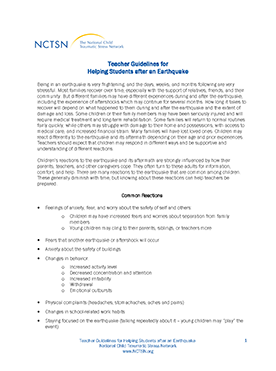
Offers teachers guidance on helping students after an earthquake. This fact sheet describes common reactions students may have, how teachers and school staff can help, as well as engage in self-care after an earthquake.
Is the fifth appendix for the Psychological First Aid Field Operations Guide (PFA).

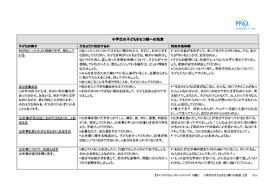
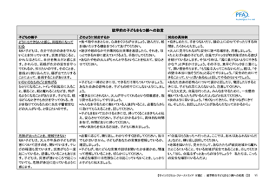
Provides parents with common reactions after a disaster, ways to respond to those reactions, and examples of things you can say to your preschool-age child. This is the Japanese version 就学前児童を助けるための親のヒント

Is a handout from Psychological First Aid Field Operations Guide (PFA).
Presents a process for threat assessment and management in an educational setting. This webinar addresses the process of assessing risks of a particular individual or group of individuals and the design and implementation of management strategies to reduce those risks.
Focuses on describing and advocating for creating trauma-informed child-serving systems including juvenile justice, child welfare, healthcare, mental health, school, and law-enforcement.
Provides information necessary to assess and treat PTSD in preschool children, school-aged children, and youth following a disaster. This webinar discuss developmental issues, parental issues, assessment, and treatment.
Provides a foundation for understanding children in disasters. This webinar discusses evaluation and treatment services for traumatized children, school support services, PFA in unusual situations, resilience, and vicarious trauma.