NCTSN Impact Newsletter: Spring 2019
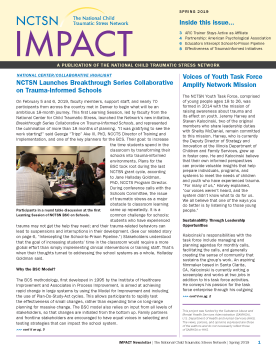
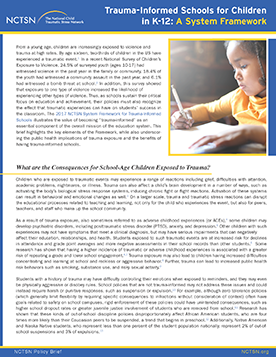
Has a special focus on schools. This edition of the newsletter includes a look at the Breakthrough Series Collaborative on Trauma-Informed Schools.
The following resources on child trauma were developed by the NCTSN. To find a specific topic or resource, enter keywords in the search box, or filter by resource type, trauma type, language, or audience.

Has a special focus on schools. This edition of the newsletter includes a look at the Breakthrough Series Collaborative on Trauma-Informed Schools.
Presents Joshua, whose mom abandoned him when he was a few days old. For the first three years of his life, Joshua lived with his maternal grandmother and her partner. When Joshua began preschool, his teachers had some concerns about his overall hygiene and care.

Brings to life the story of Rosie, a young girl who is struggling after the death of her mother. This video walks you through Rosie's story and illustrates how a parent can provide solace and support to a child after the death of a loved one.
Presents Adam, a 15-year-old Caucasian male who grew up in the suburbs outside of Chicago with his mother, father, and two sisters. His family is pretty well off financially and he and his siblings all attend private school, have personal tutors, and enjoy horseback riding and soccer.
Depicts a moment when Rose initially directs her feeling of being victimized toward her therapist. Rose expresses that therapist’s contact with her mother and school has increased the stigma and vulnerability she feels, and her sense that she’s not getting the support she needs.

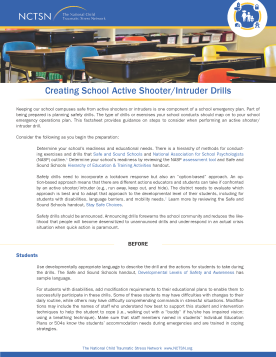
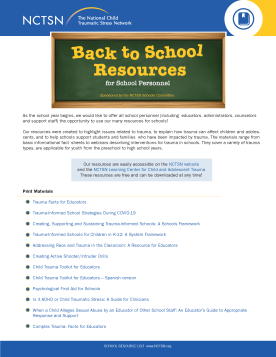
Provides information to schools about how to create a trauma-informed active shooter/intruder drill. This fact sheet outlines the steps to take before, during, and after for students, school staff, and parents.

is a list of NCTSN products that are useful for school staff and personnel.

Highlights the key elements of the 2017 NCTSN System Framework for Trauma-Informed Schools, while also underscoring the public health implications of trauma exposure and the benefits of having trauma-informed schools. Updated March 2021.
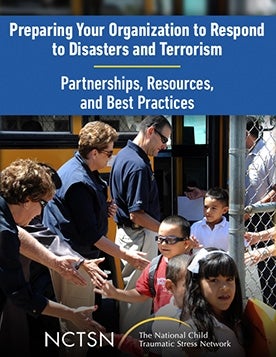
Provides strategies for establishing and expanding partnerships, discusses considerations for networking in rural and frontier communities, and highlights the role of health care coalitions and schools.
Focuses on Michael (12-years old) and Trisha (16-years-old), who live with their mother Monica in a single-parent household. Five years ago, their father Neil was incarcerated after violently attacking and nearly killing Monica while the children were upstairs in their bedrooms.
Presents the first therapy session of Samantha, a 15-year-old African American girl who lives in public housing in an urban area rife with violence and drug use.
Depicts a youth who is referred to therapy after several weeks of unexplained sickness. This webinar shows a youth who was already seeing a therapist to work on recent difficulties in school and conflicts with his parents.