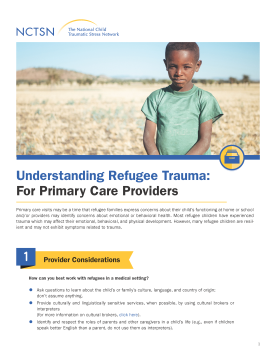
Understanding Refugee Trauma: For Primary Care Providers
Outlines different considerations that primary care providers need to take into account when working with refugee youth and their families.

The following resources on child trauma were developed by the NCTSN. To find a specific topic or resource, enter keywords in the search box, or filter by resource type, trauma type, language, or audience.

Outlines different considerations that primary care providers need to take into account when working with refugee youth and their families.

Offers tips for media professionals covering traumatic events. This fact sheet discusses safety, managing exposure, interviewing children, and helping families with children.

Outlines different considerations that mental health professionals need to take into account when working with refugee youth and their families.
Outlines different considerations that school personnel need to take into account when working with refugee youth and their families. This fact sheet describes the school, classroom, individual, and family considerations that school staff should understand when working with this population.
Provides a glossary of terms for healthcare providers to better understand the concepts within trauma-informed integrated care.

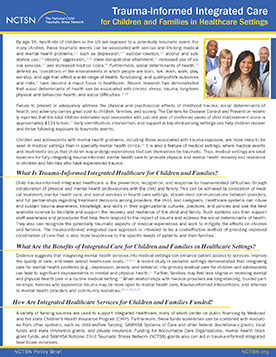
Provides policymakers and other stakeholders an overview of trauma-informed integrated care and its importance for children who have experienced trauma.

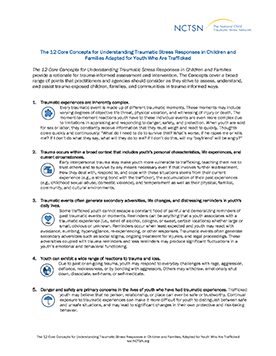
Outlines and describes a range of points that practitioners and agencies should consider as they strive to assess, understand, and assist youth who are trafficked.

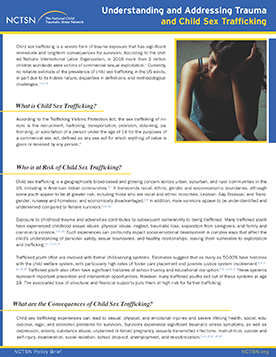
Provides policymakers and other stakeholders with an overview of child sex trafficking and its relationship to child trauma, as well as policy-relevant and child trauma-focused recommendations to assist them in their response to child sex trafficking. Updated March 2021.

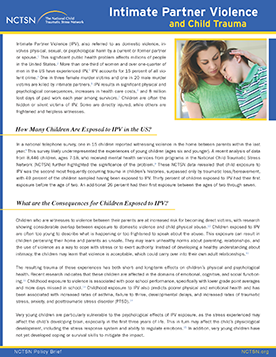
Provides policymakers and other stakeholders with an overview of intimate partner violence (IPV) and its relationship to child trauma, as well as policy-relevant and child trauma-focused recommendations to assist them in their response to intimate partner violence.

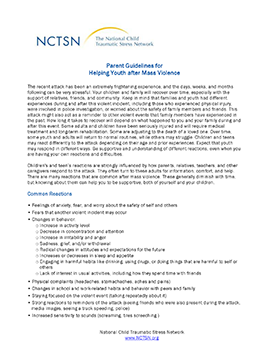
Offers parents guidance on helping their children after a mass violence event. This fact sheet describes common reactions children may have, how parents can help them, and self-care tips after a violent event.

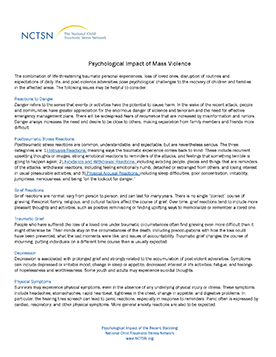
Provides parents and providers with information about the psychological impact of a mass violence event.

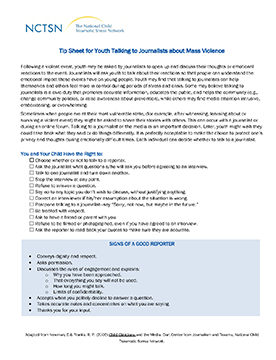
Provides guidance to youth, parents, caregivers, and others who work with youth about talking to the media after a mass violence event. This fact sheet details the rights of a child or adolescent when speaking with the media, as well as the signs of a good reporter.