A traumatic event is a frightening, dangerous, or violent event that poses a threat to a child’s life or bodily integrity. Witnessing a traumatic event that threatens life or physical security of a loved one can also be traumatic. Traumatic experiences can include singular and repeated events. Examples of experiences that may be traumatic include abuse and neglect, disasters and terrorism, family or community violence, traumatic separation, serious accidents or illness, and experiencing hate. Children who suffer from child traumatic stress are those who have been exposed to one or more traumas over the course of their lives and develop reactions that persist and affect their daily lives after the events have ended. Traumatic reactions can include intense and ongoing emotional upset, depressive symptoms or anxiety, behavioral changes, problems forming attachments, loss of previously acquired skills, attention and academic difficulties, nightmares, difficulty sleeping and eating, and physical symptoms, such as aches and pains. The NCTSN has resources for parents and caregivers, providers, educators, and more to learn about the fundamentals of trauma and child traumatic stress.

Understanding Stress vs. Trauma
Highlights the differences between stress and trauma by explaining their unique causes, effects, and timelines, helping caregivers, educators, and providers respond with the appropriate support.

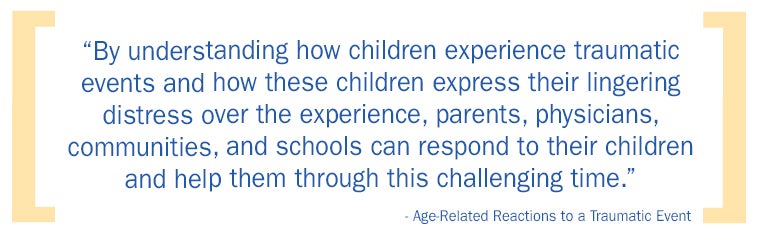
Age-Related Reactions to a Traumatic Event
Describes how young children, school-age children, and adolescents react to traumatic events and offers suggestions on how parents and caregivers can help and support them. Also available in Spanish, Dari, Pashto, Ukranian, Russian, German, Japanese, Arabic, ASL, and Polish.

Trauma and Your Family
Offers parents and caregivers information about trauma. This fact sheet defines traumatic stress and describes how common it is, how it can impact a family, and things a family can do to cope with traumatic stress.
Family Resilience and Traumatic Stress: A Guide for Mental Health Providers
Provides information on family resilience. This fact sheet discusses a family's ability to maintain or resume effective functioning, including care of its members following potentially traumatic events.
Core Curriculum on Childhood Trauma: An Introduction and Overview
Provides an introduction and overview to the NCTSN Core Curriculum on Childhood Trauma (CCCT). This fact sheet offers information on the CCCT including its strengths-based approach, learning objectives, its elements, and its case studies. It also provides information on the 12 Core Concepts for Understanding Traumatic Stress Responses in Children and Families, problem-based learning, and instructional tools.
The 12 Core Concepts: An Online Interactive Course
Offers interactive online lessons that lead you through the 12 Core Concepts for Understanding Traumatic Stress Responses in Children & Families. The Core Concepts are conceptual lenses used to better understand childhood trauma, its causes, effects, and strength-based systems approaches to case conceptualization and intervention planning. These lessons can assist NCTSN sites and members to understand foundational principles of childhood trauma.
Trauma and Loss Reminders
Provides information about how traumatic events often generate secondary adversities such as family separations, financial hardship, relocations to a new residence and school, social stigma, ongoing treatment for injuries, physical rehabilitation, and legal proceedings. These changes can tax the coping resources of the child, family, and broader community and can create challenges to adjustment and recovery. Children’s exposure to trauma reminders and loss reminders can serve as additional sources of distress. Secondary adversities, trauma reminders, and loss reminders may produce significant fluctuations in trauma survivors’ posttrauma emotional and behavioral functioning.
Trauma and Development: How to Think Development
Offers information about how to work with children and use a developmental lens. Thinking developmentally involves taking note of the particular age when a trauma exposure occurs, theorizing about what current developmental tasks it may disrupt, and which developmental competencies a child may fail to acquire and master. It also requires considering how an inadequate set of developmental competencies, coupled with poor coping skills and risky behavior, can cascade forward to impede a child’s ability to successfully work on and achieve developmental tasks further down the road.
Complexity of the Traumatic Experience
Discusses how every traumatic event is made up of traumatic moments that may include varying degrees of objective life threat, physical violation, and witnessing of injury or death. Trauma-exposed children experience subjective reactions to these moments such as feelings, thoughts, physiological responses, and concerns for the safety of others. Accompanying this, children may consider a range of possible protective actions, not all of which they can or do act on.
|


