


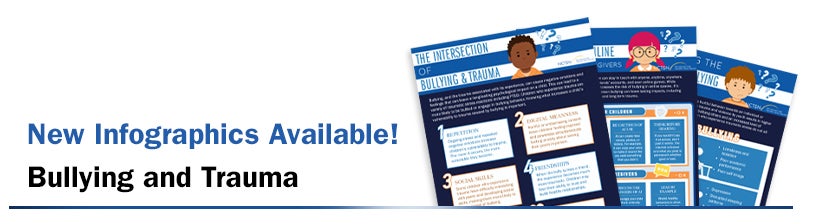
New Infographics Available! Bullying and Trauma
These infographics offer information about bullying, trauma, and staying safe online.The Complexity of Bullying
Explores the complex relationship between bullying and trauma. Highlights how both targets and perpetrators can be affected by their environments and how these experiences shape emotional and behavioral responses.
Staying Safe Online
Offers practical tips for children and caregivers to stay safe online, recognize the risks of cyberbullying and AI misuse, and promote healthy, responsible digital habits.
Bullying and Trauma
Highlights the intersection between bullying and trauma and offers ways adults can help children feel safe and supported.


Hurricane Preparedness for New and Expectant Parents
Helps new and expectant parents prepare for hurricanes by outlining practical steps to protect their health, baby, and birth plan. It includes planning tools, safety tips, and emotional coping strategies to reduce stress before, during, and after a storm.
Disaster Birth Plan
Helps expectant parents and their care teams plan for labor and delivery during hurricanes or severe storms. This tool can be used to outline key contacts, medical details, and backup birth locations so you can stay informed, supported, and safe.
New Italian Translations Available! Complex Trauma and Sexual Abuse Resources
These resources, now available in Italian, cover topics of youth safety, complex trauma, and sexual abuse.Staying Safe While Staying Connected: Facts and Tips for Teens (in Italian)
Preventing Acquaintance Rape: A Safety Guide For Teens (in Italian)
Coping with the Shock of Intrafamilial Sexual Abuse: Information for Parents and Caregivers (in Italian)
Complex Trauma: Facts for Caregivers (in Italian)
Child Sexual Abuse Fact Sheet: For Parents, Teachers, and Other Caregivers (in Italian)
Assessment of Complex Trauma by Parents and Caregivers (in Italian)
Affiliate Spotlight: Q&A with Brian C. Miller, PhD, Developer of CE-CERT
New web feature on NCTSN.org! Dr. Brian C. Miller discusses the development of CE-CERT (Components for Enhancing Career Experience and Reducing Trauma) and how professionals and organizations can use CE-CERT to build resilience and improve engagement

Rising to the Challenges of Trauma-Exposed Work and Revitalizing Well-Being
New web feature on NCTSN.org! Cambria Rose Walsh discusses the challenges of trauma-informed work and the development of Rise & Revitalize, a program that addresses burnout, secondary trauma, and moral distress.

New UCLA PTSD Reaction Index Automated Platform Now Available
Behavioral Health Innovations is pleased to announce the UCLA PTSD Reaction Index for DSM-5 Automated Platform. The Platform allows for electronic administration of the UCLA PTSD measures, with automated scoring and display of results for each administration and tracking of test results over repeated assessments. The new digital Platform ensures streamlined electronic administration and scoring, tracking scores over repeated administrations, maintenance of patient records in an electronic format, and ongoing updates and support.

The PC-CARE Learning Center
The PC-CARE (Parent Child Care) Learning Center is a (FREE) website to help caregivers learn effective strategies for managing difficult child behaviors.
NCMEC Back-to-School 2025: Tools to Help Keep Kids Safe Online
From the National Center for Missing and Exploited Children, NCMEC Back-to-School 2025 offers tools for families, educators, and professionals to keep kids safe online, plus ready-to-share social media posts on the latest online safety topics to raise awareness.
Alliance for Inclusion & Prevention ITTS Training Resources for Practicing Clinicians
The Institute for Trauma Treatment in Schools provides training resources for professionals in trauma-informed care. Course 1 focuses on examining trauma, how it affects youth, and strategies for treating trauma within a school context. Course 2 focuses on how to apply your knowledge of trauma treatments in a school setting, and offers courses aimed at examining how trauma affects a number of different specific populations that you might encounter in your work.
RECENT JOURNAL PUBLICATIONS
Intergenerational Continuity of Childhood Sexual and Physical Abuse: Using Network Analysis to Explore Risk, authored by Stephanie Gusler, Adrienne Whitt, Ginny Sprang, and Jessica Eslinger, used network analysis to explore the interconnection between risk factors associated with the continuity of sexual and physical abuse. The experience of childhood physical and sexual abuse has been consistently associated with a number of deleterious effects that extend across the lifespan, which has increased research interest in the risk for intergenerational continuity of abuse (i.e., a parent with a history of abuse who has a child who also experiences abuse). Although a number of potential risk factors have been posited or examined individually, prior literature often fails to account for associations among these risk factors, which limits intervention and prevention efforts. In the present study, secondary data were analyzed from 410 mother–child dyads. These data came from a deidentified clinical database of families with substantiated cases of child maltreatment. Results showed that intergenerational continuity of sexual abuse was present for 8.5% of the sample, and intergenerational continuity of physical abuse was present for 7.8% of the sample. Mothers’ substance use disorder and greater symptoms of hostility were directly associated with the intergenerational continuity of sexual abuse. No factors aside from the mother’s and child’s experience of physical abuse were directly associated with intergenerational continuity of physical abuse, in the network analysis. However, multiple patterns of risk emerged as indirectly connected to the intergenerational continuity of both sexual and physical abuse, which emphasized the importance of maternal mental health and adversity across the lifespan. Future research and clinical implications are discussed.
Looking for Trainings?
Visit the NCTSN Training Page on LinkedIn
Not on our mailing list? Click here to sign up.
This project was funded by the Substance Abuse and Mental Health Services Administration (SAMHSA), US Department of Health and Human Services (HHS). The views, policies, and opinions expressed are those of the authors and do not necessarily reflect those of SAMHSA or HHS.


