Disasters such as hurricanes, flooding, and wildfires can lead to many adversities for children and families, including displacement, loss of home, changes in schools, economic hardship, loss of community and social supports, and even the injury and death of loved ones. Extreme weather events and disasters have severe physical and psychological effects on children and families. It is essential to take steps to prepare. Families, businesses, schools, and communities can put strategies in place to minimize negative outcomes, improve psychological wellbeing, and foster recovery after a disaster. Being prepared for emergencies reduces anxiety and promotes confidence and strength in children and families. The NCTSN has resources to help families and communities affected by disasters along with resources for improving emergency preparedness.

Family Preparedness Wallet Card
This card provides space for families to list important telephone numbers and other information that could be useful in the case of an emergency. Each member of the family should carry these cards with them at all times in case an event occurs and all family members are not together. Also available in Spanish, Armenian, Korean, Russian, and Vietnamese.

Family Preparedness: Thinking Ahead
This guide accompanies the Family Preparedness Wallet Card. It helps families develop a safety plan so that they may be prepared in the event of disasters. Also available in Spanish, Armenian, Korean, Russian, and Vietnamese.
Psychological First Aid (PFA) Online
Psychological First Aid is an evidence-informed approach for assisting children, adolescents, adults, and families in the immediate aftermath of a disaster or terrorism. This 5-hour interactive course helps participants learn the core actions of PFA and describes ways to apply them in different post-disaster scenarios and with different survivor needs. This course is for individuals new to disaster response who want to learn the core goals of PFA, as well as for seasoned practitioners who want a review. It features innovative activities as well as considerations for implementing PFA within different cultural contexts and with children at varying developmental levels.

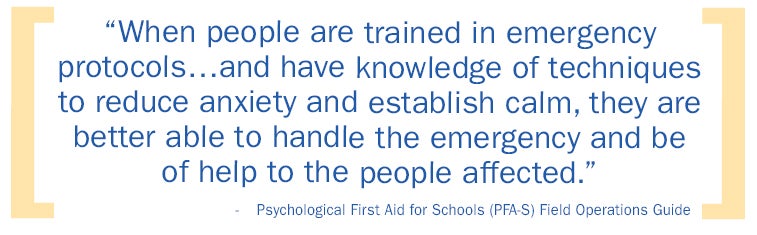
Psychological First Aid for Schools (PFA-S) Field Operations Guide
This guide provides educators, school administrators, and staff with recommendations and considerations for reducing distress in the immediate aftermath of an emergency. PFA-S is designed to foster short-term and long-term coping after an emergency and is appropriate for all ages. The guide can mitigate the development of long-term challenges in recovery by helping identify individuals who need additional support and connecting them with those services.
Skills for Psychological Recovery (SPR) Online
Skills for Psychological Recovery is an evidence informed modular approach to help children, adolescents, adults, and families in the weeks and months following disaster and trauma, after PFA has been utilized. This course aims to help providers learn how to teach survivors the skills to manage distress and cope with post-disaster stress and adversity. SPR is comprised of skills-building components from mental health treatments that have been found helpful in a variety of post-trauma situations. Research suggests that a skills-building approach is more effective than supportive counseling. SPR is appropriate for developmental levels across the lifespan and is culturally informed.
Simple Activities for Children and Adolescents
This resource offers activity ideas to parents and caregivers whose families may be sheltering in place, evacuated to a new location, or whose routines have been disrupted due to an extreme weather event, disaster, or emergency. Also available in Spanish.
A Toolkit for Child Welfare Agencies to Help Young People Heal and Thrive During and After Natural Disasters
This toolkit helps child welfare agencies support children and youth during and after natural disasters. It is designed for child welfare staff, supervisors, and administrators who work with and on behalf of children, youth, and families who experience a natural disaster. The information and resources included in the toolkit provide evidence- and trauma-informed guidance for promoting positive outcomes for children and youth who experience natural disasters. Also available in Spanish.
A Toolkit for Juvenile Justice Agencies to Help Young People Heal and Thrive During and After Natural Disasters
This toolkit helps juvenile justice agencies support children and youth during and after natural disasters. It is designed for juvenile justice staff, supervisors, and administrators who work with and on behalf of children, youth, and families who experience a natural disaster. The information and resources included in the toolkit provide evidence- and trauma-informed guidance for promoting positive outcomes for children and youth who experience natural disasters. Also available in Spanish.
Preparing Your Organization to Respond to Disasters and Terrorism
This webinar provides current recommendations for partnering with local organizations; regional and federal resources available after a disaster or terrorism event; and strategies for staging response activities to address intermediate and long-term recovery. This series is designed to help child- and family-serving providers best position themselves to support their community following catastrophic events.
Help Kids Cope
This mobile app helps parents talk to their kids about the disasters they may face and know how best to support them throughout—whether sheltering-in-place at home, evacuating to a designated shelter, or helping your family heal after reuniting. This app is also a great resource for teachers and other professionals involved in children's lives. Available in both iOS and Android.
|


