


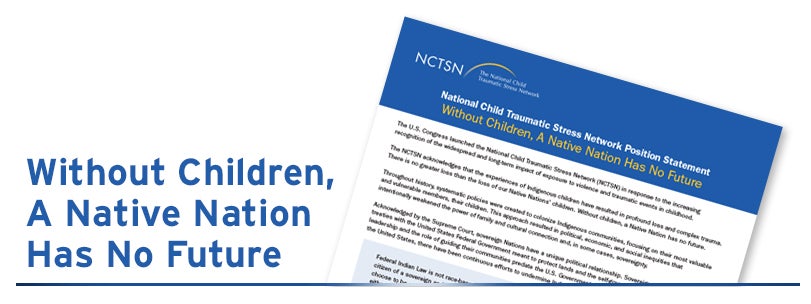
Without Children, A Native Nation Has No Future
Acknowledges that the experiences of Indigenous children have resulted in profound loss and complex trauma. Prior to the passage of the Indian Child Welfare Act (ICWA) of 1978, Indigenous children were systematically removed from the care and custody of their parents, their families, and their communities.


Rise of Anti-Asian American and Pacific Islander Hate:
Brief on Historical Trauma in AAPI Communities and How We Got Here
Provides information pertaining to the history of anti-Asian American and Pacific Islander (AAPI) hate. This resource explores the historical trauma caused by these events, leading up to the rise of anti-AAPI hate statistics that increased at the beginning of COVID-19. A second resource on how to talk to children about anti-AAPI hate will be released later this month.

New Episode of the I Don’t Know How Parent Series: I Don't Know How to Talk to My Child About Being Safe Online
Includes discussions from providers who work with families on vulnerabilities to exploitation and staying safe online as well as personal experiences faced by those who struggle to talk to their children about being safe.


Bounce Back Now App in English and Spanish
Bounce Back Now (BBN) is a free app designed to help you improve your emotional recovery after a disaster or other major life stressor. BBN can help you track your emotional recovery and provides coping exercises (e.g., breathing, relaxation, mindfulness) and guided activities to help you manage stress, anxiety, mood, and sleep. By practicing these skills over time, you may feel less stress and be able to return to your daily activities.

Mental Health and Our Changing Climate: Impacts, Implications, and Guidance
This guide from the American Psychological Association and ecoAmerica addresses the effect of climate change on mental health. It explores the connection between mental and physical health, suggests ways to address the challenges posed by climate change, and ends with recommendations for individuals and communities.
RECENT JOURNAL PUBLICATIONS
Screening for & Responding to Suicidality Among Youth Presenting to a Children’s Advocacy Center (CAC), authored by Lindsay Shepard, Kristine Campbell, Kara Byrne, Brian Thorn, and Brooks Keeshin, discusses the correlation between youth presenting at a CAC and risk for suicidality. Youth presenting to a CAC for a forensic interview are at increased risk for suicidality, but no data exist for suicidality or suicide screening and response at the time of the forensic interview. The current study applied a suicide and traumatic stress screening and response protocol, the Care Process Model for Pediatric Traumatic Stress (CPM-PTS), with youth (11–18 years) presenting for a forensic interview to one of 16 participating CAC locations from 2018–2020.46.2% of youth screened for traumatic stress and suicidality (N = 1651) endorsed thoughts of suicide or self-harm in the past two weeks, and 13.6% were assessed as high risk for suicide. High symptoms of traumatic stress increased the risk of suicidal thinking as well as of high-risk suicidality. CAC workers, both clinicians and non-clinicians, facilitated screening and provided prevention response. Suicide screening and response at the CAC at the time of the forensic interview appears important and feasible.

The Implementation of Narrative Exposure Therapy (NET) for Transgender and Gender Diverse Adolescents and Young Adults, authored by Jamie Julian, Jordan Held, Karen Hixson, and Bridgid Conn, outlines the limited information available regarding the use of trauma modalities within the transgender and gender diverse community (TGD) to address gender-based trauma, including discrimination and invalidation, particularly for adolescents and young adults (AYA). The purpose of this paper is to describe a novel treatment approach to addressing post-traumatic stress disorder (PTSD) symptoms within TGD AYA, inclusive of gender-based trauma. Preliminary outcomes from two case studies indicate the strength of Narrative Exposure Therapy (NET) when working with TGD AYA who face multiple traumatic events and continue to experience invalidation. NET shows promise as an effective brief intervention to reduce PTSD symptomology and increase resiliency in TGD AYA.
Looking for Trainings?
Visit the NCTSN Training Page on LinkedIn
Not on our mailing list? Click here to sign up.
This project was funded by the Substance Abuse and Mental Health Services Administration (SAMHSA), US Department of Health and Human Services (HHS). The views, policies, and opinions expressed are those of the authors and do not necessarily reflect those of SAMHSA or HHS.


