


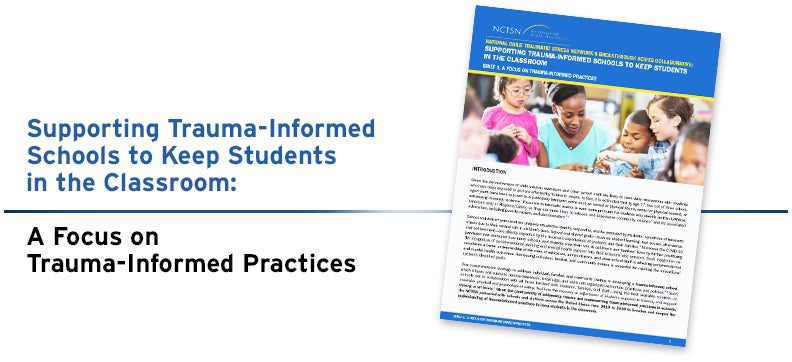
Supporting Trauma-Informed Schools to Keep Students in the Classroom: A Focus on Trauma-Informed Practices
Describes a number of promising trauma-informed practices that were tested and implemented in five school- and district-based sites during the National Child Traumatic Stress Network’s Breakthrough Series Collaborative: Supporting Trauma-Informed Schools to Keep Students in the Classroom. This brief includes a look at the six essential domains developed and addressed as part of the Collaborative Change Framework, practices to test within each domain, and the demonstration of promise for those practices.


New translations are now available!
● Talking to Children about War available in Hungarian● PFA: For Displaced Children and Families available in Norwegian, Italian, and Polish
● Understanding Refugee Trauma: For Primary Care Providers available in Ukrainian
● Understanding Refugee Trauma: For Mental Health Professionals available in Ukrainian
● Understanding Refugee Trauma: For School Personnel available in Russian and Italian
● Working Effectively with Military Sources: 10 Concepts All Providers Should Know available in Russian
● Childhood Traumatic Grief: Youth Information Sheet available in Ukrainian and German
● Childhood Traumatic Grief: Information for School Personnel available in Ukrainian

Want reminders for upcoming webinars? Sign up here!

New Online Course! Trauma ScreenTIME
Provides free online training on how to screen children for trauma. Developed by the Child Health and Development Institute in collaboration with consumers and national experts from the NCTSN based on current research and best practices. The ScreenTIME course is appropriate for child-serving staff and administrators in various settings (schools, primary care, juvenile justice, child welfare, behavioral health), with a particular focus on those who are not clinically trained. The course shows how to develop a screening process, conduct brief trauma screening and connect families with their preferred supports and services.

Trauma-Informed Educator Training Series: An Interactive Digital Curriculum for K-12 Educators
Supports K-12 educators on how to be trauma-informed when interacting with students and families/caregivers. The training consists of four ~60-minute sessions, covering topics including reframing your mindset when faced with challenges, addressing traumatic events in the community, being a trauma-informed mandated reporter, and addressing trauma with students, families and caregivers.
Polaris Human Trafficking 101 Course
Provides information on what human trafficking is and isn’t, what makes victims vulnerable and how traffickers operate, and how to support survivors and prevent trafficking in the first place. The course includes six short training modules, survivor stories, and quizzes designed to deepen your understanding of the issue.
RECENT JOURNAL PUBLICATIONS
Authored by Cody G. Dodd, Francesca Kassing, Lauren M. Alvis, Ryan M. Hill, & Julie B. Kaplow, Prevalence and Correlates of Externalizing Behaviors Among Youth Seeking Treatment Following Trauma Exposure examines the extent of co-occurrence between EXTs, trauma exposure, and posttraumatic stress symptoms (PTSS) for trauma-exposed youth. To examine the extent of their co-occurrence, this study reports the rates and correlates of youth EXTs relative to clinically elevated PTSS in a sample of youth referred to a trauma and grief specialty clinic. Self- and caregiver-report measures were obtained from 260 youth ages 7–19 years (M = 11.92, SD = 3.21; 53.5% female) during a pretreatment assessment. The sample was divided into 4 groups according to the youths’ PTSS and EXT score elevations, and these groups were then compared according to rates of youth depressive symptoms, youth suicidal ideation, and caregiver strain.

Written by Adrienne Whitt-Woosley, Ginny Sprang & Jessica Eslinger, The Impact of COVID-19 and Experiences of Secondary Traumatic Stress and Burnout examines the relationships between multiple COVID-19 related stressors and experiences of secondary traumatic stress (STS) and burnout (BO). This sample (N = 550) of professionals and caregivers from a foster care system in the United States completed an online survey regarding their experiences of COVID-19 related stress in multiple domains (disruptions in routines, income/employment, food access, medical/mental health care access, access to social support, worries about COVID, family conflict/violence, and COVID diagnoses). The survey also included established measures of STS and BO.
Looking for Trainings?
Visit the NCTSN Training Page on LinkedIn
Not on our mailing list? Click here to sign up.
This project was funded by the Substance Abuse and Mental Health Services Administration (SAMHSA), US Department of Health and Human Services (HHS). The views, policies, and opinions expressed are those of the authors and do not necessarily reflect those of SAMHSA or HHS.


