


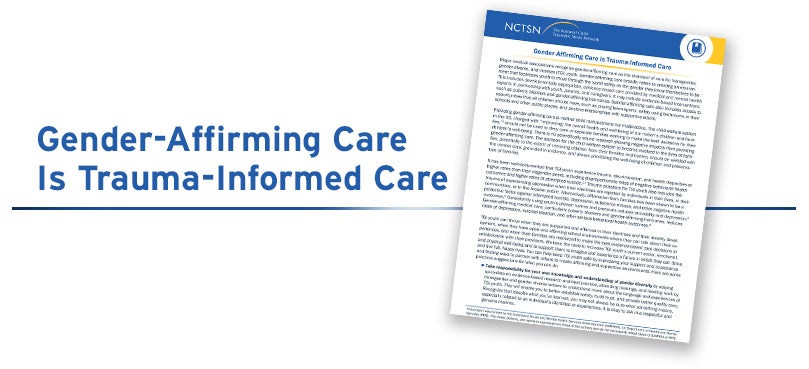
Gender-Affirming Care Is Trauma-Informed Care
Discusses how gender-affirming care is trauma-informed care and offers tips for showing support and acceptance for transgender, gender diverse, and intersex (TGI) youth.


New translations are now available!
● Age-Related Reactions to a Traumatic Event available in Japanese● After a Crisis: Helping Young Children Heal available in Norwegian and Romanian
● Helping Military Children with Traumatic Grief: Tips for Parents available in Russian
● Understanding Child Trauma and Resilience for Military Parents and Caregivers available in Russian
● Helping Teens with Traumatic Grief: Tips for Caregivers available in Russian and Ukrainian
● Helping School Age Children with Traumatic Grief: For Caregivers available in Russian and Ukrainian
● Helping Young Children with Traumatic Grief: Tips for Caregivers available in Russian and Ukrainian
● PFA: Parent Tips for Helping Infants and Toddlers after Disasters available in Russian and Ukrainian
● PFA: Parent Tips for Helping Preschool-Age Children after Disasters available in Russian and Ukrainian
● PFA: Parent Tips for Helping School-Age Children after Disasters available in Russian
● PFA: Parent Tips for Helping Adolescents available in Russian and Ukrainian
● PFA: Tips for Adults available in Russian and Ukrainian
● PFA Mobile: Android Version available in Ukrainian
● Childhood Traumatic Grief: Information for Parents and Caregivers available in Ukrainian
● Understanding Refugee Trauma: For Primary Care Providers available in Russian
● Understanding Refugee Trauma: For School Personnel available in Russian

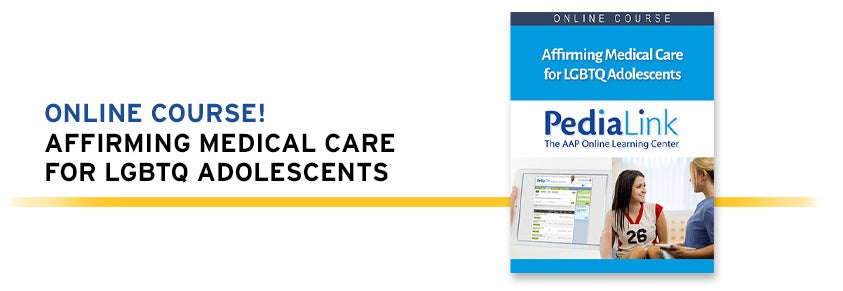
Online Course! Affirming Medical Care for LGBTQ Adolescents
Defines LGBTQ and gender identity and identifies risk factors faced by LGBTQ youth. The course showcases ways to be more inclusive of LGBTQ youth when providing healthcare services, to apply STI screening recommendations for this population. It also introduces resources for LGBTQ youth and their families.

Health Care Toolbox — Providing Trauma-Informed Care in Child Welfare
Health Care Toolbox, a Center for Pediatric Traumatic Stress (CPTS) website, now has information and resources to help healthcare staff provide trauma-informed care in child welfare.
Online Course! For Healthcare Professionals: Pediatric Medical Traumatic Stress and Working with the Child Welfare System
Provides information to enhance your skills in trauma-informed care and learn tips for working effectively with the child welfare system as a healthcare professional.
RECENT JOURNAL PUBLICATIONS
Authored by Sarah Ascienzo, Ginny Sprang & David Royse, My Bad Experiences Are Not The Only Things Shaping Me Anymore”: Thematic Analysis Of Youth Trauma Narratives aims to understand how youth with poly-trauma histories appraise and make meaning of their traumatic experiences within the trauma narrative and processing components of Trauma-focused Cognitive Behavioral Therapy (TF-CBT), and to explore the results of the meaning-making process. Thematic analysis was employed to explore the trauma narratives of youth (N = 16) ages 8 – 16 that were created during TF-CBT. Participants experienced a mean of 5.38 types of trauma that predominantly included various forms of child maltreatment. With regard to how youth appraise and interpret their traumatic experiences, four themes emerged, including I Am Not Safe, which denotes a lack of physical and psychological safety; It’s My Fault, which symbolizes misattributions of responsibility; I Am Changed, which captures alterations in systems of meaning; and Why Did This Happen to Me?, which denotes the struggle to comprehend why the traumatic events occurred and their significance. With regard to the products of the meaning-making process, three themes emerged, including Now I Know, which denotes reappraisals; I Am Safe/r, which signifies increases in perceptions of safety, and I Can Do It, which includes the participant’s perceptions of growth. Results from this study provide a deeper understanding of youth’s experiences during these components of treatment, and illuminate the meaning-making process. Findings can help guide clinical-decision making, and highlight the importance of explicitly attending to specific components of the meaning-making process during trauma narration and processing.

Overview of Child Maltreatment written by Katelyn Donisch & Ernestine C. Briggs presents an overview of child maltreatment, including ways of defining and assessing maltreatment, particularly with respect to the severity and chronicity of maltreatment experiences. The effects of maltreatment on child, adolescent, and adult functioning will be examined, including psychological, behavioral, and physical health domains. Risk factors for and the larger context in which child abuse and neglect occurs will also be discussed, with emphasis on parental and caregiver, familial, and neighborhood risk factors. It also includes recommendations for future research and practice to continue to advance the understanding of, and intervention for, this profound public health problem.
Looking for Trainings?
Visit the NCTSN Training Page on LinkedIn
Not on our mailing list? Click here to sign up.
This project was funded by the Substance Abuse and Mental Health Services Administration (SAMHSA), US Department of Health and Human Services (HHS). The views, policies, and opinions expressed are those of the authors and do not necessarily reflect those of SAMHSA or HHS.


