The National Child Traumatic Stress Network
Published on The National Child Traumatic Stress Network (https://www.nctsn.org)

Home > Child Welfare Professionals

In any given year, approximately one million children come to the attention of the US child welfare system. Many are victims of abuse or neglect, live with caregivers who are impaired, and/or deal with school and community violence as a fact of life. Identification and early intervention are crucial to helping children traumatized by maltreatment and other stresses. The National Child Traumatic Stress Network has developed tools and materials for building skills and increasing knowledge about childhood trauma to help child welfare administrators, caseworkers, frontline staff, mental health personnel, and caregivers understand and respond to the needs of traumatized children. In addition to the NCTSN resources highlighted below, Child Welfare Professionals can learn more about creating trauma-informed Child Welfare Systems in the Trauma-Informed Care section of this website.

NCTSN Resource

NCTSN Trauma-Informed Organizational Assessment (TIOA) Course [1]

Type: Special Resource

Helps organizations assess their current practices in the context of serving children and families who have experienced trauma. It is an important part of an organizational transformation process to create trauma-informed organizations.

view [1]
NCTSN Resource

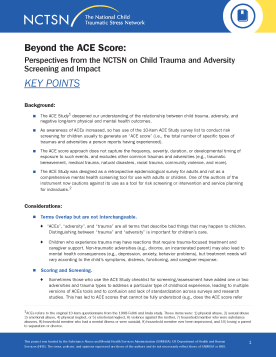
Beyond the ACE Score: Perspectives from the NCTSN on Child Trauma and Adversity Screening and... [2]

Type: Fact Sheet

Highlights key points for providers, family advocates, and policymakers to understand about Adverse Childhood Experiences (ACEs) and child trauma. This resource was adapted from...

view [2]
NCTSN Resource

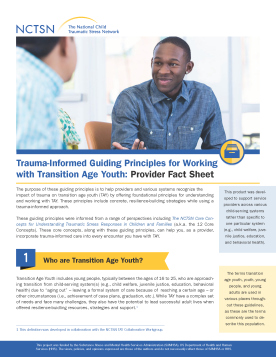
Trauma-Informed Guiding Principles for Working with Transition Age Youth: Provider Fact Sheet [3]

Type: Fact Sheet

Offers information for providers supporting transition age youth with trauma-informed guiding principles to inform their work.

view [3]
NCTSN Resource

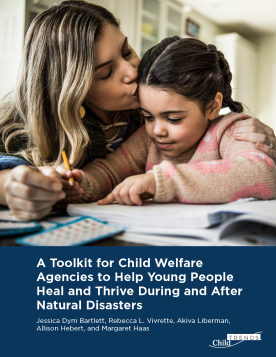
A Toolkit for Child Welfare Agencies to Help Young People Heal and Thrive During and After... [4]

Type: Special Resource

Helps child welfare agencies support children and youth during and after natural disasters. This toolkit is for child welfare staff, supervisors, and administrators who work with and on behalf of children, youth, and families who experience a natural disaster.

view [4]
NCTSN Resource

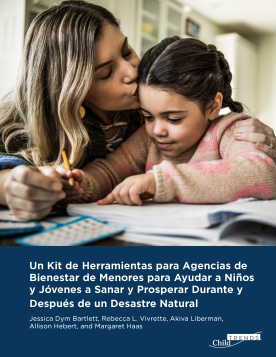
Un Kit de Herramientas para Agencias de Bienestar de Menores para Ayudar a Jóvenes a Durante y... [5]

Type: Special Resource

Ayuda a las agencias de bienestar infantil a apoyar a los niños y jóvenes durante y después de los desastres naturales.

view [5]
NCTSN Resource

Using Implementation Science When Delivering the RPC [6]

Type: Podcast

Features Jared Martin, a Research Associate with the Chadwick Center for Children and Families at Rady Children’s Hospital-San Diego, describing the use of implementation science to accomplish the goal of sustainability in conversation with Lorena Avitea, LCSW, a Trauma Informed Systems Specialis

view [6]
NCTSN Resource

Recommendations for Trauma-Informed Care Under the Family First Prevention Services Act [7]

Type: Special Resource

Outlines recommendations for how jurisdictions can understand Family First’s policy requirements for trauma-informed approaches and ensure that implementation of the law meets the trauma-related needs of children, youth and families.

view [7]
NCTSN Resource

Understanding Refugee Trauma: For Child Welfare [8]

Type: Fact Sheet

Provides information about refugee trauma for those working in or with the child welfare system.

view [8]
NCTSN Resource

NCTSN Impact Newsletter: Summer 2018 [9]

Type: Newsletter

Includes articles that range from a report on teen suicide screening and intervention to new resources for bringing an LGBTQ lens to trauma-informed care.

view [9]
NCTSN Resource

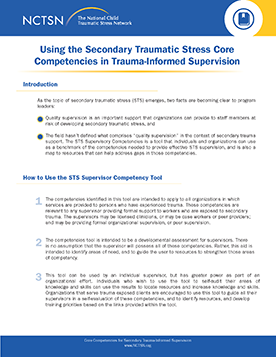
Using the Secondary Traumatic Stress Core Competencies in Trauma-Informed Supervision [10]

Type: Fact Sheet

Discusses the importance of quality supervision that organizations can provide to staff members at risk for secondary traumatic stress (STS).

view [10]
NCTSN Resource

Child Advocacy Center (CAC) Directors' Guide to Quality Mental Healthcare [11]

Type: eLearning Course

Helps Children’s Advocacy Center (CAC) directors deliver the highest quality care to children and families.

view [11]
NCTSN Resource

Traumatic Separation in Children and Adolescents [12]

Type: Webinar

Describes the impact of traumatic separation, attachment, and attachment disruption on children and adolescents.

view [12]

Pages

  • FIRST [13]
  • PREVIOUS [13]
  • 1 [13]
  • 2
  • 3 [14]
  • 4 [15]
  • 5 [16]
  • NEXT [14]
  • LAST [16]

Source URL:https://www.nctsn.org/audiences/child-welfare-professionals?page=1

Links
[1] https://www.nctsn.org/resources/nctsn-trauma-informed-organizational-assessment-course [2] https://www.nctsn.org/resources/beyond-the-ace-score-perspectives-from-the-nctsn-on-child-trauma-and-adversity-screening-and-impact-key-points [3] https://www.nctsn.org/resources/trauma-informed-guiding-principles-for-working-with-transition-age-youth-provider-fact-sheet [4] https://www.nctsn.org/resources/a-toolkit-for-child-welfare-agencies-to-help-young-people-heal-and-thrive-during-and-after-natural-disasters [5] https://www.nctsn.org/resources/a-toolkit-for-child-welfare-agencies-to-help-young-people-heal-and-thrive-during-and-after-natural-disasters-sp [6] https://www.nctsn.org/resources/using-implementation-science-when-delivering-the-RPC [7] https://www.nctsn.org/resources/recommendations-for-trauma-informed-care-under-the-family-first-prevention-services-act [8] https://www.nctsn.org/resources/understanding-refugee-trauma-child-welfare [9] https://www.nctsn.org/resources/nctsn-impact-newsletter-summer-2018 [10] https://www.nctsn.org/resources/using-secondary-traumatic-stress-core-competencies-trauma-informed-supervision [11] https://www.nctsn.org/resources/child-advocacy-center-cac-directors-guide-quality-mental-healthcare [12] https://www.nctsn.org/resources/traumatic-separation-children-and-adolescents [13] https://www.nctsn.org/print/899 [14] https://www.nctsn.org/print/899?page=2 [15] https://www.nctsn.org/print/899?page=3 [16] https://www.nctsn.org/print/899?page=4