
Beginning the new school year can be challenging for students who have experienced trauma. Children's reactions to trauma can interfere considerably with learning and behavior at school, especially when adapting to a new environment. Schools serve as a critical system of support for children. Building a safe, consistent, and supportive environment in schools can help children cope and heal. Administrators, teachers, and staff can help reduce the effects of trauma on children by recognizing trauma responses, accommodating and responding to students in the classroom who have experienced trauma, and referring children to outside professionals when necessary. Learning about a student’s experiences can be challenging for educators and staff, and can lead to secondary traumatic stress. It is essential for educators and staff to take care of themselves, and for schools to maintain a trauma-informed structure for the entire community. The National Child Traumatic Stress Network has developed tools and materials to help educators, school staff, and administrators provide trauma-informed support in schools for students and school personnel.

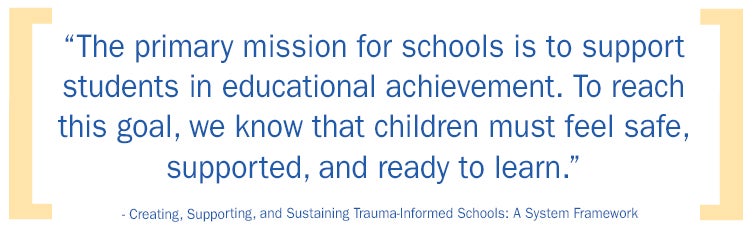
Creating, Supporting, and Sustaining Trauma-Informed Schools: A System Framework
Presents a tiered approach to creating a trauma-informed school environment that addresses the symptoms of traumatic stress. This framework offers a vision of a trauma-informed school, adhering to the “4 Rs”: (1) realizing the widespread impact of trauma and pathways to recovery; (2) recognizing traumas signs and symptoms; (3) responding by integrating knowledge about trauma into all facets of the system; and (4) resisting re-traumatization of trauma-impacted individuals by decreasing the occurrence of unnecessary triggers (i.e., trauma and loss reminders) and by implementing trauma-informed policies, procedures, and practices.

Supporting Trauma-Informed Schools to Keep Students in the Classroom:
A Focus on Trauma-Informed Practices
Helps schools assess what level of partnering currently exists within their school community, areas that require enhancement, and strategies for implementing these enhancements. This tool is for administrators and staff to drive further conversation about family-school partnerships. It builds on the NCTSN Trauma-Informed Schools Framework and is aligned with SAMHSA’s 6 Principles of Trauma-Informed Care: safety; trustworthiness and transparency; peer support and mutual self-help; collaboration and mutuality; empowerment, voice, and choice; and cultural, historical, and gender issues.

Secondary Traumatic Stress Core Competencies for Trauma-Informed Support and Supervision:
Cross-Disciplinary Version
Identifies the core competencies that STS-informed supervisors in any discipline should have. This fact sheet defines terms, outlines benchmarks for each competency, and offers supervisors guidance on ways to better support their staff.
A Trauma-Informed Resource for Strengthening Family-School Partnerships
Presents five expert trauma therapists about their experiences and reflective processes while working with children and families who have experienced developmental trauma and come from complex backgrounds in terms of race, ethnicity, culture, and identity. In addition, Dr. Rocio Chang moderates commentary with Dr. Maureen Allwood, Dr. Ernestine Briggs-King, and Dr. Russell Jones. They discuss the importance of open conversations related to the roundtable topics as well as the impacts of recent events that have brought racism to the forefront.
Building Relationships as a Foundation of Trauma-Informed Practices in Schools
Highlights useful strategies for and classroom examples of relationship-building and its positive impact on trauma-informed practice change in schools. In this video, teachers share guidance on practicing empathy, patience, and engagement to build trust and strengthen relationships with their students and create and affirm psychological safety in their classrooms.
Looking at Strategies in the Classroom to Support Students
Shares principles and examples of creating meaningful changes in the classroom that form an environment where children feel safe and willing to take risks. This video highlights successful efforts such as Morning and Threshold Greetings to welcome students, Calm Corners, and an approach to identify and support academically at-risk students.
Secondary Traumatic Stress for Educators
Describes risk factors for and signs of secondary traumatic stress in educators, as well as techniques for prevention and self-care.
Child Sex Trafficking: A Fact Sheet for Educational Professionals
Offers information regarding child sex trafficking to educational professionals. This factsheet defines child sex trafficking, a child's vulnerability to it depending on different factors, its relation to trauma, and what educational professionals need to know and can do to support children who have or are experiencing childhood sex trafficking.
Addressing Race and Trauma in the Classroom: A Resource for Educators
Helps educators understand how they might address the interplay of race and trauma and its effects on students in the classroom. The guide outlines recommendations for educators and offers a list of supplemental resources. It should be implemented in accordance with individual school policies and procedures.
Is it ADHD or Child Traumatic Stress? A Guide for Clinicians
Provides definitions of child traumatic stress and Attention-Deficit Hyperactivity Disorder (ADHD) and explains how symptoms can overlap, as well as summarizes some of the differences between the two. This fact sheet describes how child traumatic stress can sometimes be mistaken for ADHD because of the overlap between ADHD symptoms and the effects of experiencing trauma. Understanding these differences can help parents and providers assess and treat children appropriately and more effectively.
Psychological First Aid for Schools (PFA-S) Field Operations Guide
Provides guidance on responding to disaster, violence, or terrorism events using the Psychological First Aid intervention. This version gives school administrators, educators, and staff practical assistance to meet immediate needs and concerns, reduce distress, and foster adaptive coping in the wake of a disaster. The manual includes in-depth information about each of the eight core actions and accompanying handouts for administrators, school staff, educators, students, and parents and caregivers.
|


