
Community trauma is shared trauma that affects an entire community or an event that has structural and social traumatic consequences. Violence that affects youth and leads to community trauma can include individual and group conflicts. Common types of community violence are shootings in public areas like schools and communities, wars and violence in foreign countries or violent civil unrest in US cities, and terrorist attacks. Community violence can happen suddenly and without warning. Consequently, youth and families who live with community trauma often have heightened fears that harm could come at any time and experience the world as unsafe and terrifying. This experience of collective distress takes away a sense of safety and control from children and families. In addition, although some types of trauma are accidental, community violence is an intentional attempt to hurt one or more people. The NCTSN has resources to help children and families heal in the face of community trauma.

Community Violence and Civil Unrest: Youth Responses to Complex Harm and Collective Healing
Features a conversation about creating awareness regarding youth responses to community violence, civil unrest, and societal history of marginalization and racial trauma. This webinar shares creative strategies and develops practices to help youth challenge these perpetual traumas through trusting relationships, radical healing, and supported action.

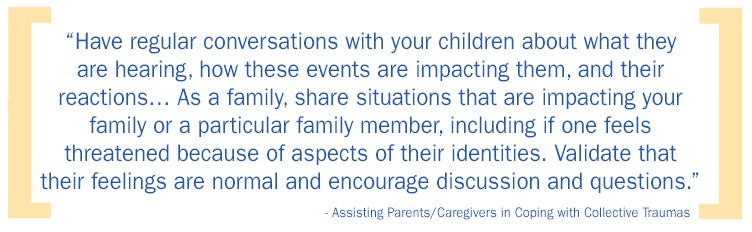
Assisting Parents/Caregivers in Coping with Collective Traumas
Offers strategies to help parents/caregivers cope with collective traumas. This fact sheet also provides guidance on what parents/caregivers can do to care for their children as they cope.

The Power of Parenting: Helping Your Child After a Family Homicide Loss
Offers parents and caregivers information to help support their children after the loss of a family member due to homicide. This fact sheet highlights common reactions and experiences of children handling a family homicide loss, the importance of respecting and acknowledging grief, ways to help your child, seek professional support, as well as a list of resources to provide additional guidance for parents and caregivers.
Helping Youth after Community Trauma: Tips for Educators
Lists common reactions educators might see in the students with whom they work and suggestions on how they may help after community trauma. This tip sheet describes how traumatic events, such as a natural disaster, school violence, or the traumatic death of a peer or educator, can affect students’ learning, behavior, and relationships.
Talking to Children about War
Offers information for caregivers on how to talk to children about war. This fact sheet includes the potential impact and considerations when talking to children about war, how to start the conversation, understanding media coverage, and how to foster resilience. Also available in Ukrainian, Russian, German, Japanese, Hungarian, and Polish.
Psychological First Aid Guide for Child Advocacy Center Supervisors
Provides information for supporting the staff in a children’s advocacy center (CAC) setting who have been exposed to critical incidents and may have concerns about their physical or psychological safety. Providing support after critical incidents can also decrease the risk of secondary traumatic stress (STS) or becoming emotionally overwhelmed. The guidance is directed toward supervisors and leaders in CACs regardless of professional training or background. Provides a descriptive overview of concepts and practices for any supervisor to employ when a critical incident has occurred in a CAC. It defines the immediate response of the supervisor (hence the “first aid” in the concept) as well as continuous support over the first 30 days.
Community Violence: Reactions and Actions in Dangerous Times
Helps youth recognize that community violence does not have to dominate their lives if they understand their reactions to it, understand how to keep themselves safe, and understand how to make positive choices in dangerous times.
Secondary Traumatic Stress: A Fact Sheet for Organizations Employing Community Violence Workers
Provides community violence workers with information about secondary traumatic stress (STS). This fact sheet discusses how to identify STS, how workers experience STS, organizational responsibility to address STS in community violence workers, understanding who is at risk for STS, and strategies to prevent or reduce STS.
Talking with your Children about Islamophobia and Hate-Based Violence
Discusses Islamophobia and hate-based violence against Muslims with children. This fact sheet highlights, for parents and caregivers, strategies that can be used to facilitate effective conversations, age-specific guidelines, and actions families and communities can take before an event occurs.
Talking to Children about Hate Crimes and Anti-Semitism
This fact sheet outlines how to discuss antisemitism with children, including how to start the conversation, how to gently correct inaccurate information, understanding common reactions children may have after mass violence, how to answer questions directly, how to be a positive role model, and empowering children and teens.
Talking to Youth about Anti-Asian American and Pacific Islander Hate
Provides an understanding of why it is important to talk to children about race-based hate, how to recognize signs of traumatic stress and its impact, how to begin a conversation with youth about anti-AAPI hate, and what can be done in response.
Talking to Children When Scary Things Happen
This partner-in resource offers guidance on talking with children and youth when scary things happen. This fact sheet includes information on checking in with yourself, clarifying your goal, providing information, reflecting, asking helpful questions, going slow, labeling emotions, validating, and reducing media exposure. Also available in Spanish.
Talking to Teens When Violence Happens
This partner-in resource offers guidance on talking with teens when violence happens. This fact sheet includes information on checking in with yourself, clarifying your goal, providing information and options, reflection, asking helpful questions, going slow, labeling emotions, validating, and monitoring media and social media exposure. Also available in Spanish.
|


