


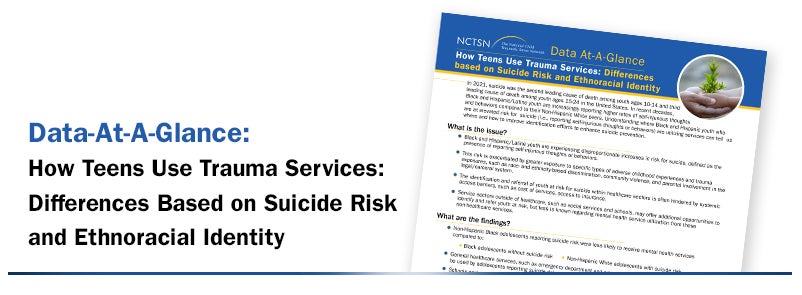
Data-At-A-Glance: How Teens Use Trauma Services: Differences Based on Suicide Risk and Ethnoracial Identity
Provides information about suicide risk and ethnoracial identity. Black and Hispanic/Latine youth are experiencing disproportionate increases in risk for suicide, defined as the presence of reporting self-injurious thoughts or behaviors. This risk is exacerbated by greater exposure to specific types of adverse childhood experiences and trauma exposures, such as race- and ethnicity-based discrimination, community violence, and parental involvement in the legal/carceral system. This Data-At-A-Glance discusses what the issue is, what the findings are, and what you can do.


New Translation: Childhood Traumatic Grief: Information for Parents and Caregivers (in Italian)
Provides information to parents and caregivers on Childhood Traumatic Grief. This fact sheet outlines how children grieve, what Childhood Traumatic Grief is, who develops Childhood Traumatic Grief, the signs a child might have Childhood Traumatic Grief, and what parents or caregivers can do to help. Now available in Italian.
New Translation: Childhood Traumatic Grief: Information for School Personnel (in Italian)
Offers information on why school personnel are important for grieving students. This fact sheet outlines how children grieve, what Childhood Traumatic Grief is, who develops Childhood Traumatic Grief, what traumatic stress reactions in Childhood Traumatic Grief can look like, the signs a student might have Childhood Traumatic Grief, and what school personnel can do to help their students. Now available in Italian.
New Translation: Helping Young Children with Traumatic Grief: Tips for Caregivers (in Italian)
Outlines the feelings of young children struggling with the death of someone meaningful and offers suggestions on what caregivers can do to help. Now available in Italian.
New Translation: What is Complex Trauma: A Resource Guide for Youth and Those Who Care About Them (in Italian)
Offers information about complex trauma, how it can impact youth, both good and harmful coping strategies, and ways to improve. This guide is for youth who have experienced complex trauma or who know someone who has. Clinicians, caregivers, and other adults can also use the guide to have conversations with youth about what complex trauma is. Now available in Italian.

New Online Course: Trauma ScreenTIME Early Childhood Course
The Trauma ScreenTIME Early Childhood Course is a free online training course on how to screen young children ages 0-6 for trauma. The course is intended for anybody who works with young children, including classroom teachers, home visitors, clinicians, and others. It was developed by the Child Health and Development Institute in collaboration with families and national experts based on current research and best practices, and shows how to develop a screening process, conduct brief trauma screening, and connect families with their preferred supports and services.

Now Available as a Video! Trinka and Sam: The Rainy Windy Day
Developed in partnership with the South Carolina Infant Mental Health Association, this video offers parents and caregivers a way to talk with their children about hurricanes. This story describes some of Trinka's and Sam’s reactions to a hurricane and talks about how their parents help them express their feelings and feel safer.

On Our Way Back Home
This video, created by Grace Miranda-Villalobos, explores the impact that art therapy can have for displaced families. The storybook-inspired video follows a family that is forcibly displaced from their home and their journey toward strengthening their resilience. This video incorporates topics such as displacement trauma, family attachment, trauma-informed services, and healing during the resettlement process.
Parents Under Pressure: The U.S. Surgeon General Advisory on the Mental Health and Well-Being of Parents
This Surgeon General's Advisory highlights the stressors that impact the mental health and well-being of parents and caregivers, the critical link between parental mental health and children's long-term well-being, and the urgent need to better support parents, caregivers, and families.
RECENT JOURNAL PUBLICATIONS
The Developmental Consequences of Early Exposure to Climate Change-Related Risks, authored by Jorge Cuartas, Dana C. McCoy, Isabella Torres, Lindsey Burghardt, Jack P. Shonkoff, and Hirokazu Yoshikawa, presents a new framework on how climate change-related risks can threaten human development. The climate crisis encompasses a constellation of risks that threaten human livelihoods, well-being, and survival globally. The framework in this study is based on bioecological and dynamic systems perspectives, and on evidence for conceptualizing how the distinctive dual time frame of both acute (e.g., extreme weather events) and chronic (e.g., ecological degradation) climate change-related risks experienced prenatally and early in life across multiple ecological contexts can threaten human development. This study concludes with a call to developmental researchers, practitioners, and policymakers to invest more efforts in understanding and addressing the climate crisis and its developmental consequences to ensure a sustainable future for all.
COVID-19 Pandemic Quarantines and Mental Health Among Adolescents in Norway, authored by Johanne H. Pettersen, Laurie J. Hannigan, Kristin Gustavson, Ingunn O. Lund, Rebecca M. Pearson, Pia Jensen, Ragnar Nesvåg, Ragnhild E. Brandlistuen, and Helga Ask, investigates the associations of public health measures and quarantine experiences with mental distress among Norwegian adolescents to explore if certain vulnerability factors moderate these associations. This longitudinal cohort study used repeated measures to capture variations in mental distress explained by the stringency of public health measures and quarantine experiences. In this study, 7787 participants were included in the analysis (4473 female [57%]; mean [SD] age, 17.0 [0.6] years). Stringent public health measures, recent quarantine, and frequent quarantine were associated with higher levels of mental distress. The associations between public health measures and mental distress were not moderated by sex, age, prepandemic anxiety or depression, or genetic liability for mental health conditions. Frequency of quarantine appeared to be more strongly associated with mental distress among younger adolescents, those with parents with lower education, and those with lower genetic risk for depression. These findings emphasize the need for targeted support strategies to better protect adolescent well-being during future crises. Adolescents who experienced increased mental distress during the COVID-19 pandemic may be at risk of continued mental health problems and in need of ongoing support.
Looking for Trainings?
Visit the NCTSN Training Page on LinkedIn
Not on our mailing list? Click here to sign up.
This project was funded by the Substance Abuse and Mental Health Services Administration (SAMHSA), US Department of Health and Human Services (HHS). The views, policies, and opinions expressed are those of the authors and do not necessarily reflect those of SAMHSA or HHS.


