


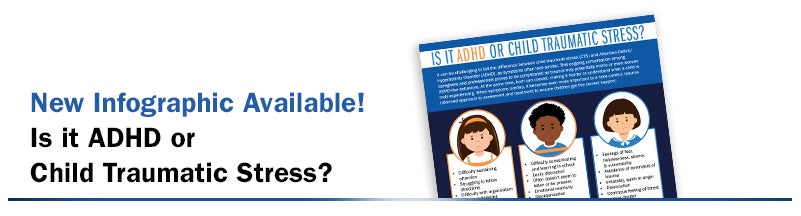
New Infographic Available! Is it ADHD or Child Traumatic Stress?
Compares the overlapping symptoms of attention-deficit/hyperactivity disorder (ADHD) and child traumatic stress (CTS). Explains how a trauma-informed approach can help caregivers and professionals give the right support.


Updated Intervention Fact Sheets Now Available!
These updated fact sheets offer key information related to some of the interventions developed and used by members of the NCTSN. The new format includes information about the model, its evidence, adaptability and accessibility, and providing, supervising, training, and sustaining the model. These two new intervention fact sheets, Attachment and Biobehavioral Catch-up (ABC) and Trauma Systems Therapy for Refugees (TST-R) clearly highlight key information in an informative and user-friendly format.

New National Academies of Sciences, Engineering, and Medicine Report:
School Active Shooter Drills: Mitigating Risks to Mental, Emotional, and Behavioral Health
Active shooter drills have become a standard practice in nearly all U.S. schools, yet their potential impact on students and educators has received limited attention. School Active Shooter Drills: Mitigating Risks to Mental, Emotional, and Behavioral Health explores how these drills are conducted and how to reduce potential harm while supporting school safety. Developed by a committee of experts in education, school safety, public health, pediatrics, child and adolescent development, psychiatry, psychology, neuroscience, public policy, and criminology, this report provides an in-depth review of current practices and offers guidance. The report provides suggestions for implementing practices that promote prevention and preparedness while supporting well-being, and foster learning environments where students and staff feel safe, capable, and supported.

Mental Health Providers & Juvenile Justice Resource Guide
This resource from The Center for Trauma Recovery and Juvenile Justice gives mental health providers practical guidance about the juvenile legal system, as well as a trauma informed approach to working with youth and families who are faced with the challenges of navigating that system. This resource also highlights the intersection between mental health and juvenile legal system involvement, including the need for shared resources and interdisciplinary training and communication among professionals. It further provides community-based mental health professionals, as well as those working within the juvenile legal system, with foundational information about both the system and youths’ experiences within the system, so that they might better support, serve, and advocate for their clients.
Preventing Burnout in Early Childhood Professionals: Practical Self-Care Strategies
Understanding the common causes and exploring ways to address burnout in early childhood education can help you effectively manage or even prevent it. This resource provides an overview of common causes of burnout, along with providing self-care tips for early childhood educators and professionals.

Getting Started with CAC Partnerships: A Guide for Military Partners
The purpose of this resource guide is to help military partners start building their partnerships with local Children’s Advocacy Centers (CACs) to improve collaboration and coordination of services for military families and support implementation of the national memorandums of understanding. By following the six steps outlined in this guide, military partners will be well-positioned to harness the power of CAC partnerships as part of a strong coordinated community response for military families.
A Parent’s Guide to Fostering Safer Online Practices on Snapchat & Beyond
This guide, created by Safe and Sound Schools in partnership with Snap. Inc., provides resources that empower parents, caregivers, and educators to help foster safer online environments for students. It includes tips on how to approach sensitive conversations with teens, guides for talking about digital safety, prompts to help teens process their feelings about social media, and information on where to report and seek help for digital bullying, unwanted contact, and other concerning behavior.
RECENT JOURNAL PUBLICATIONS
A Qualitative Analysis of Young Adults’ Beliefs about Bullying: Exploring Associations with Social Anxiety and Post-Traumatic Stress, authored by Belinda Graham and Anke Ehlers, aimed to explore beliefs about bullying, self, and other people among young adults who were bullied that may be associated with ongoing anxiety and distress related to those experiences. Semi-structured interviews with 20 people, aged 18–29 years, who had experienced bullying were analyzed using thematic analysis. The sample was split, by current symptoms of social anxiety and post-traumatic stress related to bullying, into a lower symptoms group (n = 12) and a higher symptoms group (n = 8). Participants reported multiple types of bullying, including online. Four superordinate themes were identified in negative beliefs related to bullying experiences: personal deficiency (i.e. victimization was due to own low value or undesirable traits), social threat (i.e. wariness of others due to their negative motives or traits), acceptance is fragile (i.e. being accepted by others is transient and requires effort), and minimizing (i.e. downplaying severity and impact of past experiences). These were evident in both groups but were more frequently endorsed in the higher symptoms group. Negative appraisals related to bullying can persist into young adulthood and may influence social interactions and mental health. Interventions targeting these beliefs could mitigate negative outcomes and bolster resilience among individuals affected by bullying. Further research should explore these themes to inform effective therapeutic strategies for young adults who have been bullied.
Early Childhood Trauma and Its Long-Term Impact on Cognitive and Emotional Development: a Systematic Review and Meta-Analysis, authored by Linlin Fan and Tinghu Kang, sought to synthesize the evidence around the long-term impact of human childhood trauma on domains of cognition and emotion to inform interventions and public health strategies. Childhood trauma has profound, long-term effects on cognitive and emotional development. 465 studies were reviewed from PubMed, Cochrane Library, and Google Scholar, and 9 studies were included after duplicates were removed and inclusion and exclusion criteria were applied. All 9 studies were aimed at low-income people in the United States. Data on study design, trauma types, and cognitive/emotional outcomes were extracted. Random-effects meta-analysis and subgroup analyses (processing speed, attention, working memory, emotion regulation, executive function) were conducted using R software. Childhood trauma was associated with significant deficits in: Attention (SMD = 2.37, 95% CI: [5.75, 10.50]) Working memory (SMD = 3.55, 95% CI: [2.18, 9.28]) Emotion regulation (SMD = 1.25, 95% CI: [1.12, 3.62]) Executive function (SMD = 1.61, 95% CI: [0.06, 3.28]) Processing speed showed smaller deficits (SMD = −0.48, 95% CI: [−1.91, 0.94]).The pooled effect size (SMD = 1.57, 95% CI: [−0.12, 3.26]) highlighted trauma’s pervasive impact. Childhood trauma disproportionately impairs attention and working memory. These findings point to the importance of early screening, trauma-informed care and targeted interventions to ameliorate the long-term consequences of trauma. Methodological variability should be addressed to inform prevention and treatment strategies in future research, as well as resilience factors explored.
Looking for Trainings?
Visit the NCTSN Training Page on LinkedIn
Not on our mailing list? Click here to sign up.
This project was funded by the Substance Abuse and Mental Health Services Administration (SAMHSA), US Department of Health and Human Services (HHS). The views, policies, and opinions expressed are those of the authors and do not necessarily reflect those of SAMHSA or HHS.


