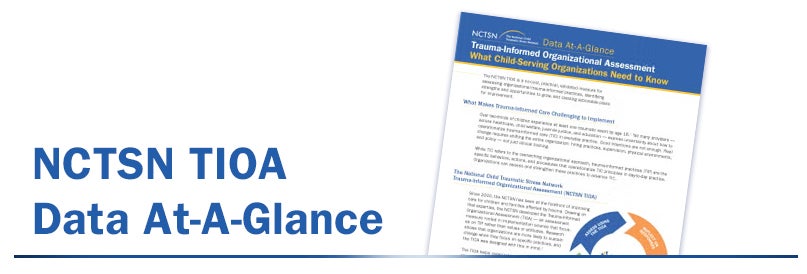
NCTSN TIOA Data At-A-Glance
Introduces the NCTSN Trauma-Informed Organizational Assessment (TIOA), highlighting key research findings, core domains of measurement, and how organizations can use the TIOA to create meaningful, sustainable change.

Implementation: an NCTSN Video Series - Season Two
The NCTSN Video Series on Implementation was created by members of the National Child Traumatic Stress Network (NCTSN) to share lessons learned as organizations seek to implement trauma-informed practices or system change efforts. The series consists of short videos on various implementation topics. There are now five new videos available on topics such as identifying the right trauma-focused intervention, attending to trust and power to improve implementation, pre-implementation readiness, and more.
New Spanish Translation Available! Supporting Families with Large Community Events
Provides information for parents and caregivers about how to support their family when a large community event is happening in their city or town.
New Online Course - Trauma ScreenTIME Juvenile Justice Course
The Trauma ScreenTIME Juvenile Justice Course is a free online training course on how to screen youth involved with the juvenile justice system for trauma. The course is intended for anybody who works in juvenile justice settings, including probation officers, detention officers, and other professionals in this setting (no clinical background required). It was developed by the Child Health and Development Institute in collaboration with families and national experts based on current research and best practices, and shows how to develop a screening process, conduct brief trauma screening, and connect youth with supports and services.
Trafficking Workforce Wellbeing Toolkit:
Strategies and Resources to Address Secondary Traumatic Stress (STS) and Related Impacts
The National Center on Child Trafficking (NCCT) is a collaboration of professionals with expertise in child trauma and human trafficking who develop and deliver trauma-informed interventions and resources to improve the lives of children impacted by trafficking and support the professionals who serve them. This Toolkit is a product of that bridging of child trauma and trafficking expertise, drawing especially on the trauma knowledge and resources of the National Child Traumatic Stress Network and the University of Kentucky Center on Trauma and Children as well as the trafficking expertise of partners of the National Center on Child Trafficking. The lead authors met with consultants, advisory board members, and professionals in the anti-trafficking field prior to and throughout the Toolkit development process. Resources were selected for their overall quality, empirical foundation, and ease of access.
Calm & Connected: A Guide to Personalized Grounding and Mental Health
This curriculum from One Circle Foundation is designed to promote youth mental health and well-being through self-discovery, creative expression, and personal growth. This 12-session Unity Circle® guide helps youth understand that there are many ways to be unique—unique ways of exploring, communicating, and healing.
RECENT JOURNAL PUBLICATIONS
Preparing Social Workers to Respond to Emergencies and Human-Made Disasters: Introducing Essential Elements of Disaster Mental Health in MSW Education, authored by Christine Montgomery, introduced disaster mental health (DMH) training into MSW education by developing, implementing, and evaluating a learning module for specialized practice courses to strengthen future social workers’ capacity to respond to disasters. The United States is experiencing increased numbers of disasters; extreme weather events such as hurricanes, tornadoes and wildfires along with human-made disasters such as mass shootings and bombings. These disasters impact individuals, families, and whole communities with emergent basic needs such as temporary shelter, food and water, as well as psychological needs such as acute stress, grief and hopelessness (Halpern et al., 2019). Social workers are called to action as first responders and to aid in the ongoing healing process, yet most do not have pre-event training. The project was evaluated using an online, self-report, post-module survey. This preliminary data from this study support the introduction of key concepts and skills in disaster mental health for MSW coursework. The responses also indicated participants’ pedagogical strategies and future course interests, with most identifying this content as an appropriate venue for practice courses; an option of an elective in DMH, and/or the need for inter-professional education. The results could inform future curriculum decisions and offerings within MSW and post-MSW education.
Looking for Trainings?
Visit the NCTSN Training Page on LinkedIn
Not on our mailing list? Click here to sign up.
This project was funded by the Substance Abuse and Mental Health Services Administration (SAMHSA), US Department of Health and Human Services (HHS). The views, policies, and opinions expressed are those of the authors and do not necessarily reflect those of SAMHSA or HHS.