


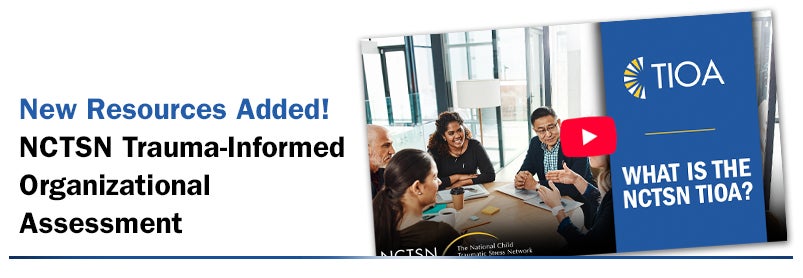
New Resources Added! NCTSN Trauma-Informed Organizational Assessment
Developed by the NCCTS in collaboration with NCTSN members, the TIOA aligns with the NCTSN’s definition of a Trauma-Informed Child and Family Service System. The TIOA measures an organization’s trauma-informed practices and acts as an organizational intervention to guide improvements. After six years of testing and collaborating with over 60 organizations, we’re excited to share newly refined resources based on real-world TIOA implementations, highlight key successes and lessons from sites that have strengthened their practices, and introduce a new approach to embedding trauma-informed care into an organization’s DNA for lasting impact.


Hesitations & Motivations for Participating in Implementation Projects: Assessing Readiness & Fit
Explores strategies used to engage child trauma service organizations in the NCTSN Breakthrough Series Collaborative (BSC) on Trauma-Informed Suicide Prevention and Healing, emphasizing the importance of organizational readiness and fit.

Pediatric Medical Traumatic Stress Toolkit for Health Care Providers (in Korean)
Offers a compendium of tools to guide medical professionals in effectively assessing and treating medical traumatic stress in children and families. This toolkit helps providers address the emotional, as well as the physical side of trauma. It is anchored by the D-E-F Protocol for trauma-informed care, which helps providers respond to Distress, offer Emotional support, and ensure Family-centered care for traumatized children and families. This toolkit includes guidebooks on implementing trauma-informed care, with case studies and examples, as well as complimentary patient handouts for children and parents with evidence-based tips and activities. Now available in Korean.

New Videos: Learn to Stop Child Abuse
National Children’s Alliance presents two brief educational videos on the topic of identifying and preventing child sexual abuse. With interviews from 10 nationally recognized experts from Children’s Advocacy Centers and top research institutions, in 40 minutes you can gain a basic education on the signs of child sexual abuse, the effects it has on kids, the knowledge to put a stop to it, and how kids get better.

Digital For Good: Helping Kids Stay Safe Online
In this podcast episode from Safe and Sound Schools, Michele Gay talks with Kim Karr—co-founder of Digital4Good—about the real impact of digital citizenship, student empowerment, and practical online safety. From fake accounts to digital addiction, discover how schools can equip students to lead the charge in creating safer, more positive online communities.

RECENT JOURNAL PUBLICATIONS
Bounce Back Now! Protocol of a Population-Based Randomized Controlled Trial to Examine the Efficacy of a Web-based Intervention with Disaster-Affected Families, authored by Kenneth J. Ruggiero, Tatiana M. Davidson, Jenna McCauley, Kirstin Stauffacher Gros, Kyleen Welsh, Matthew Price, Heidi S. Resnick, Carla Kmett Danielson, Kathryn Soltis, Sandro Galea, Dean G. Kilpatrick, Benjamin E. Saunders, Josh Nissenboim, Wendy Muzzy, Anna Fleeman, and Ananda B. Amstadter, describes an innovative study design that evaluates a self-help Web-based resource, Bounce Back Now, with a population-based sample of disaster affected adolescents and families. Disasters have far-reaching and potentially long-lasting effects on youth and families. Research has consistently shown a clear increase in the prevalence of several mental health disorders after disasters, including depression and posttraumatic stress disorder. Widely accessible evidence-based interventions are needed to address this unmet need for youth and families, who are underrepresented in disaster research. Rapid growth in Internet and Smartphone access, as well as several web-based evaluation studies with various adult populations has shown that Web-based interventions are likely to be feasible in this context and can improve clinical outcomes. Such interventions also are generally cost-effective, can be targeted or personalized, and can easily be integrated in a stepped care approach to screening and intervention delivery. Unique features of this study design include the use of address-based sampling to recruit a population-based sample of disaster-affected adolescents and parents, telephone and web-based assessments, and development and evaluation of a highly individualized web intervention for adolescents. Challenges related to large-scale evaluation of technology-delivered interventions with high-risk samples in time-sensitive research are discussed, as well as implications for future research and practice.
Looking for Trainings?
Visit the NCTSN Training Page on LinkedIn
Not on our mailing list? Click here to sign up.
This project was funded by the Substance Abuse and Mental Health Services Administration (SAMHSA), US Department of Health and Human Services (HHS). The views, policies, and opinions expressed are those of the authors and do not necessarily reflect those of SAMHSA or HHS.


