


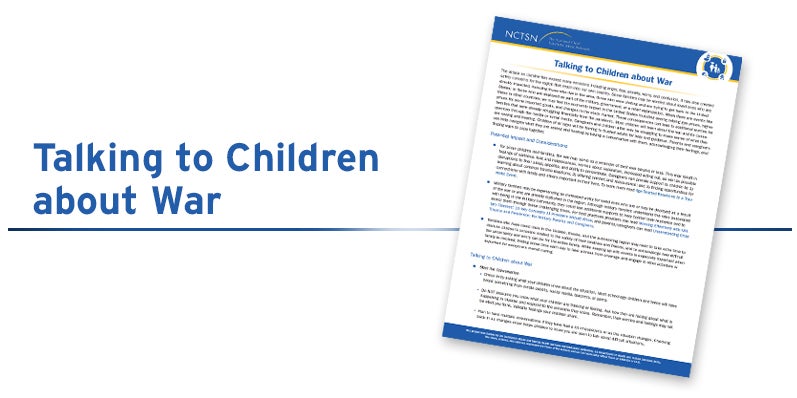
Talking to Children about War
Offers information for caregivers on how to talk to children about war. This fact sheet includes the potential impact and considerations when talking to children about war, how to start the conversation, understanding media coverage, and how to foster resilience. Also, now available in Ukrainian, Russian, German, and Japanese.


How Is the COVID-19 Summit Supporting the Long-Term Recovery of Our Nation's Children and Families?
Highlights the importance of supporting children and families during the COVID-19 pandemic. This report offers insight into how the NCTSN gathered Network expertise in some areas that impacted children and families the most during the pandemic. It also highlights the experience of the over 1,700 participants in the summit, including awareness-building and skill development, actions and strategies to better support children, youth, families, and workforce during this unprecedented time, and recommendations and next steps for this work
Después De Una Crisis: Cómo Sanan A Los Niños
Ofrece consejos a los padres sobre cómo ayudar a los niños pequeños, niños pequeños y niños en edad preescolar a sanar después de un evento traumático.
New translations now available!
- Coping in Hard Times: Fact Sheet for Youth High School and College Age available in Ukrainian.
- Age-Related Reactions to a Traumatic Event available in Ukrainian, Russian, and German.
- After a Crisis Helping Young Children Heal available in Ukrainian, Russian, and German.
- Traumatic Separation and Refugee and Immigrant Children: Tips for Current Caregivers available in Ukrainian and Russian.
Secondary Traumatic Stress: Understanding the Impact on Professionals in Trauma-Exposed Workplaces
Designed for all child-serving professionals who are exposed to details of traumatic events and/or individuals suffering from post-traumatic distress in the context of their work. Through the content in this course, participants will learn the risks associated with working with individuals suffering with traumatic stress symptoms, strategies to reduce the impact of secondary traumatic stress (STS,) and how to support wellness in staff. Finally, this course addresses how STS is an ethical mandate for organizations and individuals working in trauma-exposed environments.

Now Available on Demand! Part 2:
Applying Evidence-Based Treatments for Child Traumatic Stress Reactions to COVID-19-Related DeathsDescribes trauma-focused evidence-based treatments (EBT) for children and teens who develop traumatic stress reactions, with specific applications to familial deaths during COVID-19 for young children; American Indian and Alaskan Native families; Black and Latino/Latina adolescents with adjunct peer support components; and diverse youth provided via telehealth.

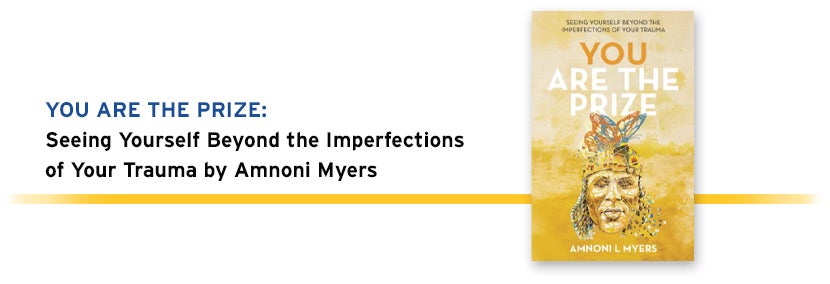
You Are the Prize: Seeing Yourself Beyond the Imperfections of Your Trauma by Amnoni Myers
Explores the journey and struggles in author Amnoni Myers’ life. She learned to succeed in a world full of intricacies and survive through dark moments as a child growing up in the foster care system. Despite negative statistics, Amnoni was always determined to create a different story than the one that was written about her. This is a must-read if you are interested in learning more about the personal experiences of children in the foster care system. Myers challenges the reader: How do I help young people navigate difficult transitions? What sustainable methods can I employ to help young people thrive in spite of their trauma?
Amnoni Myers is a first generation college graduate from Gordon College and The National Urban Fellows Program where she received her Masters degree in public administration. She has experienced early childhood trauma, loss of her biological family, and has been on a journey to understand her identity despite the challenges she’s faced along the way.

RECENT JOURNAL PUBLICATIONS
Written by Ernestine C. Briggs, Robert A. Murphy, Sherika N. Hill, Nida H. Corry, Valerie A. Stander, Angela M. Tunno, Jacqueline C. Pflieger, Sabrina M. Richardson & John A. Fairbank, Children’s Mental Health, Deployment, Parental Mental Health, and Family Dynamics: Findings from the Millennium Cohort Family Study examines how parental mental health impacts children’s psychosocial functioning, accounting for military deployment and moderating effects of gender of the service member (SM) and spouse (SP). Survey data from the Millennium Cohort Family Study were used to examine family demographic characteristics, deployment, parental mental health, social functioning, and family satisfaction as predictors of emotional and behavioral difficulties among children in the family. Analytic techniques ranged from descriptive statistics to hierarchical regression models. SP mental health was most influential on the behavioral and emotional outcomes of children in comparisons where neither, one of the, or both parents had mental health problems. Gender of the SP was a moderator of child outcomes. Male SPs with mental health problems were associated with an elevated risk for negative child outcomes, especially among families of female SMs. Contrary to expectations, parental deployment history was largely unrelated to children’s outcomes. Both parental social functioning and family satisfaction served as protective factors, buffering children from negative outcomes, even when parental mental health problems were present. Authors conclude that providing military families access to prevention and treatment services is warranted, especially for families with female SMs and male SPs serving in the role of primary caregiver.

Authored by Alison Salloum, Yuanyuan Lu, Henian Chen, Troy Quast, Judith A. Cohen, Michael S. Scheering, Kristen Salomon & Eric A. Storch, Stepped Care Versus Standard Care for Children after Trauma: A Randomized Non-inferiority Clinical Trial compares SC-TF-CBT to standard TF-CBT in a community-based non-inferiority trial. Trauma-focused cognitive−behavioral therapy (TF-CBT) is an evidence-based therapist-led treatment for children after trauma. Parents often experience barriers to treatment engagement, including cost. Stepped care TF-CBT (SC-TF-CBT) was developed as an alternative delivery system. Step One is a parent-led therapist-assisted treatment. Step Two provides therapist-led TF-CBT for children who did not benefit from Step One and require more intensive treatment.
Looking for Trainings?
Visit the NCTSN Training Page on LinkedIn
Not on our mailing list? Click here to sign up.
This project was funded by the Substance Abuse and Mental Health Services Administration (SAMHSA), US Department of Health and Human Services (HHS). The views, policies, and opinions expressed are those of the authors and do not necessarily reflect those of SAMHSA or HHS.


