Children and families become involved in the child welfare system because of suspected abuse or neglect. Children who are African American, Latino/a, and/or Native American are more likely to come to the attention of child welfare agencies and be taken from their homes and placed in foster or group care. These experiences — in combination with other stressors — can result in traumatic stress reactions and/or the development of Post-Traumatic Stress Disorder. Experiences and life changes that happen after child welfare involvement can also cause further trauma, disruption, and hardship. It is critical that child welfare professionals link families with trauma-informed treatment and services and integrate an understanding of trauma into their own practice. The NCTSN has resources to help child welfare administrators, caseworkers, frontline staff, mental health personnel, and caregivers understand and respond to the needs of children who have experienced trauma. They also offer resources to help providers mitigate the effects of secondary traumatic stress when providing care to these youth and families.

Child Welfare Trauma Training Toolkit
Supports caseworkers, supervisors, and all other levels of the child welfare workforce in implementing trauma-informed knowledge and skills in their daily interactions, professional services and organizational culture. The third edition of the Child Welfare Trauma Training Toolkit (CWTTT) incorporates two foundational trainings, a specialized skills training for supervisors and caseworkers, and a supervisor consultation series to enhance transfer of learning into day-to-day practice.

Resource Parent Curriculum (RPC) Online
Is a centralized resource for providers and resource parents who are using or interested in using Caring for Children Who Have Experienced Trauma: A Workshop for Resource Parents in their communities.
Resource Parent Curriculum (RPC) Training Modules
Complements the Resource Parent Curriculum (RPC). This course is for resource families who are considering attending a RPC training to help them determine whether it would be worth their time to attend an entire workshop. Families or facilitators can also complete the modules after a face-to-face workshop to reinforce their learning. Families can share the modules with those on their child’s service teams to help them understand the impact of trauma and the behaviors they may be seeing. RPC Facilitators may use these modules as pre-work for RPC sessions so that more in-person time can be spent on applying these concepts.
Birth Parents with Trauma Histories in the Child Welfare System Fact Sheet Series
Highlights the importance of understanding the serious consequences that trauma histories can have for birth parents and the subsequent potential impact on their parenting. Includes fact sheets for child welfare workers, parents, resource parents, court-based advocates, mental health professionals, judges, and attorneys.
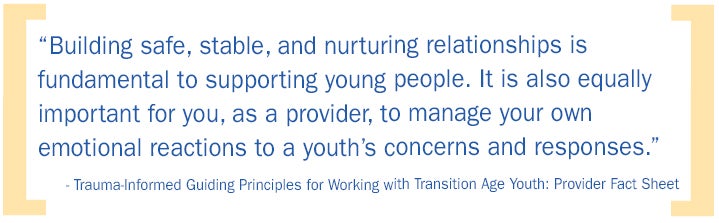
Trauma-Informed Guiding Principles for Working with Transition Age Youth: Provider Fact Sheet
Offers information for providers supporting transition age youth with trauma-informed guiding principles to inform their work. This fact sheet describes transition age youth and their unique experiences, and six trauma-informed guiding principles to better support youth in their journey and recovery.
Understanding Refugee Trauma: For Child Welfare
Provides information about refugee trauma for those working in or with the child welfare system. This fact sheet gives definitions to describe those who migrate to the US; potentially traumatic events that could occur before, during, or after migration; involvement in the child welfare system; how notions of safety, permanency, and well-being are shaped by culture; factors that could potentially elevate the risk of child welfare involvement; special considerations for child sexual abuse; barriers to service access and engagement; and system considerations.
Traumatic Separation in Children and Adolescents
Describes the impact of traumatic separation, attachment, and attachment disruption on children and adolescents. It also discusses supporting foster or adoptive children and youth coping with traumatic separation in out-of-home care and the impact of traumatic separation on birth parents.
Child Advocacy Center (CAC) Directors' Guide to Quality Mental Healthcare
Helps Children’s Advocacy Center (CAC) directors deliver the highest quality care to children and families. This Learning Center course offers resources you need to meaningfully address the NCA National Standards for Accreditation Mental Health Standard. Each module contains an easy-to-understand overview of the topic, expert interviews that further drill down into the material, and links to practical tools and resources.

Secondary Trauma and Child Welfare Staff: Guidance for Supervisors and Administrators
Gives supervisors and administrators in the child welfare system information on the importance of addressing secondary traumatic stress (STS). This fact sheet discusses how individuals experience STS, who is at risk, and strategies for prevention and intervention.
|


