


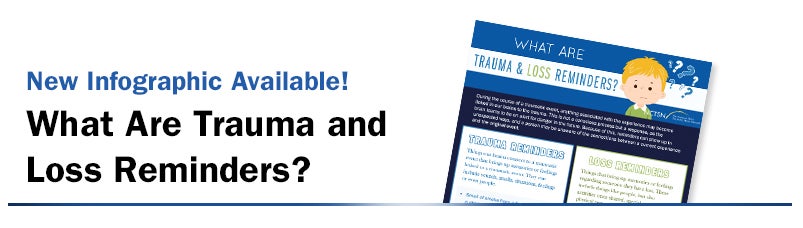
New Infographic Available! What Are Trauma and Loss Reminders?
Explains how everyday sights, sounds, and experiences can unexpectedly trigger memories or emotions tied to trauma or loss. Helps caregivers understand these reminders and recognize how they may show up differently for each child.


Updated Resource: Supporting Children and Teens Who Experienced Loss During This Holiday Season
Offers parents and caregivers strategies and ideas for supporting children and teens during the holiday season. This fact sheet provides tips that parents can use to talk to their children and teens about how they are feeling and changes to holiday celebrations and traditions. It also shares tips that families can use to make this holiday season still feel special, including creative ways in which families can stay connected to loved ones and friends. Ideas for self-care and additional resources are also included in the fact sheet.
New Core Curriculum on Childhood Trauma (CCCT) Webpages
These new CCCT webpages introduce the CCCT, explore the 12 Core Concepts for Understanding Child Traumatic Stress, and help to answer frequently asked questions.

Updated Intervention Fact Sheets Now Available!
These updated fact sheets offer key information related to some of the interventions developed and used by members of the NCTSN. The new format includes information about the model, its evidence, adaptability and accessibility, and providing, supervising, training, and sustaining the model. These three new intervention fact sheets, Trauma Focused Coping/Multimodality Trauma Treatment, Child-Parent Psychotherapy, and Care Process Model for Pediatric Traumatic Stress, clearly highlight key information in an informative and user-friendly format.

Holidays, Celebrations and Traumatically Bereaved Children Webinar
Introduces learners to the symptoms of Childhood Traumatic Grief (CTG) and Prolonged Grief Disorder (PGD). It explores how cultural and religious rituals, holidays, school events, and personal anniversaries can both support and challenge grieving children. Participants will learn practical ways parents, teachers, and other adults can offer meaningful support, and will be introduced to two evidence-based treatments, TF-CBT and TGCT-A, for helping children with PTSD and grief-related difficulties.

Pediatric Health Care Provider Resource: Early Childhood Development, Adversity, and Resilience
A new interactive, self-paced learning module from Harvard's Center on the Developing Child offers an overview of key science concepts related to early childhood development, including how children's earliest experiences impact their development and health; how early development of the brain and other organ systems affects lifelong health and well-being; toxic stress and its relationship to adverse childhood experiences (ACEs), trauma, and resilience; and more.
Child Health and Development Institute (CHDI) Kids Mental Health Training Portal
New Courses Now Available on CHDI's Kids Mental Health Training (KMHT) Portal. Developed in partnership with families and behavioral health experts, these new, no-cost professional development courses include Autism, Families, and Severe Behavior, Effective Family Engagement, Overview of Development Disabilities, and more. 18 courses are now available through the portal to child-serving professionals, and many offer continuing education credits.
Compendium of Infant and Early Childhood Mental Health Assessment Measures
The Compendium of Infant and Early Childhood Mental Health Assessment Measures was developed to provide clinicians with information about assessment measures related to clinical domains and categories of mental health disorders that occur in early childhood. This Compendium is intended to support clinician's use of clinical judgment in selecting measures most applicable to the child, their family, and culture as well as to the clinician's scope of training and practice setting.
RECENT JOURNAL PUBLICATIONS
Development and Performance of the National Child Traumatic Stress Network Trauma-Informed Organizational Assessment, authored by C. A. Purbeck, L. J. Liang, L. Glazkova, J. Agosti, J. H. Liu, and J. Halladay Goldman, explores properties of the National Child Traumatic Stress Network’s Trauma-Informed Organizational Assessment (TIOA), which evaluates 87 practices across nine domains. Theories of change in trauma-informed care emphasize the need go beyond individual transformation and act upon the organization-level. The National Child Traumatic Stress Network’s Trauma-Informed Organizational Assessment (TIOA), implemented within an implementation framework, is intended to assist with organization-level change. The TIOA uniquely incorporates the assessment of practices related to race and culture as well as partnerships with youth and families. In a sample of 23 child-serving organizations (N = 1,224), the TIOA demonstrated excellent internal consistency (Cronbach’s alpha >0.93) and good or moderate test-retest reliability. The TIOA was usable by staff in a range of settings, and few differences were seen in characteristics such as role in the organization or race. The TIOA provides actionable, organization-level recommendations to help identify strengths and areas for improvement, ultimately supporting environments where staff, children, and families thrive.
Addressing the Intersecting Vulnerabilities of Child Sex Trafficking and Substance Use: Implications for Counselors of Adolescents, authored by Caitlin Frawley, Bryce W. Hagedorn, and Niko Wilson, outlines important considerations for counselors, such as commercial sexual exploitation of children (CSEC) identification and screening, trauma-informed counseling practices, and psychoeducation resources to prevent future abuse. A large proportion of child victims-survivors of commercial sexual exploitation of children suffer from substance use disorders, with researchers revealing substance use rates between 70% and 92% among this population. Given that traffickers often exploit substance use as a tool of force, fraud, and coercion, counselors have a unique role in addressing the safety, health, and wellbeing of victim-survivors.
Looking for Trainings?
Visit the NCTSN Training Page on LinkedIn
Not on our mailing list? Click here to sign up.
This project was funded by the Substance Abuse and Mental Health Services Administration (SAMHSA), US Department of Health and Human Services (HHS). The views, policies, and opinions expressed are those of the authors and do not necessarily reflect those of SAMHSA or HHS.


