


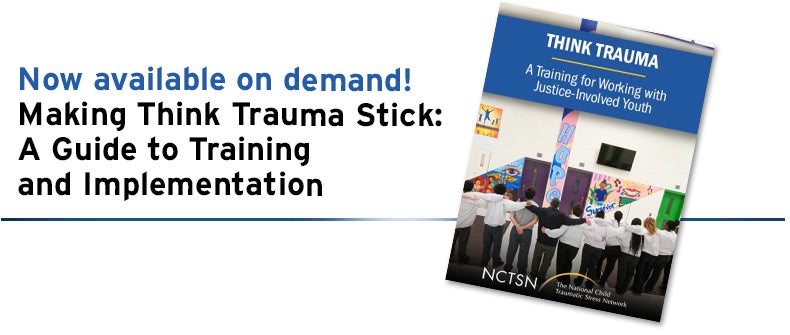
Now available on demand! Making Think Trauma Stick: A Guide to Training and Implementation
Walks through Making Think Trauma Stick: A Guide to Training and Implementation, developed by the National Child Traumatic Stress Network (NCTSN). This virtual guide helps support the process of implementation at your organization, introduces key factors and activities to engage in before, during, and after the whole Think Trauma training, and includes tips and questions to utilize along the way.


Bounce Back Now App
Developed by healthcare professionals at the Medical University of South Carolina, Boston University, and University of Nebraska, Bounce Back Now provides an effective recovery tool for disaster survivors worldwide. It helps users track their emotional recovery and offers coping tools to help manage stress, anxiety, mood, and sleep. Bounce Back Now also connects users to disaster crisis counseling and support specialists.


Addressing Addiction in Our Native American Communities
Addresses many issues facing Native American communities recovering from substance use disorders during COVID-19. Includes interviews from Native community members who are in recovery, showing how resilient they have been through the pandemic and in general. It also discusses how to stay healthy and sober through the pandemic and resources people can access, including those from the Health Resources and Services Administration (HRSA).
RECENT JOURNAL PUBLICATIONS
Equity-Focused, Trauma-Informed Policy Can Mitigate COVID-19’s Risks to Children’s Behavioral Health, written by Robey B. Champine, Jason M. Lang, and Anusha Mamidipaka, highlights ways in which COVID-19 has exacerbated deeply rooted health inequities, including trauma and adversity that children of color disproportionately experience. Trauma-informed and equity-focused approaches and policies can optimize child development, reduce health risks among children who are exposed to adversity and promote recovery and resilience.

Authored by Kathryn A. Hughesdon, Julian Ford, Ernestine C. Briggs, Julia S. Seng, Allison L. Miller, & Sarah Stoddard, Interpersonal Trauma Exposure and Interpersonal Problems in Adolescent Posttraumatic Stress Disorder addresses gaps in research by identifying associations between interpersonal versus noninterpersonal trauma exposure, interpersonal problems, and PTSD symptoms in a clinical sample of trauma-exposed adolescents. It hypothesized that (a) cumulative interpersonal trauma exposure would be associated with PTSD symptoms and with interpersonal problems, (b) interpersonal problems would mediate the association between interpersonal trauma and PTSD symptoms, and (c) noninterpersonal trauma would not be associated with interpersonal problems. Given the potential bidirectional nature of interpersonal problems and PTSD symptoms, in a separate analysis, it is hypothesized that (d) PTSD symptoms would mediate the association between interpersonal trauma and interpersonal problems.
Looking for Trainings?
Visit the NCTSN Training Page on LinkedIn
Not on our mailing list? Click here to sign up.
This project was funded by the Substance Abuse and Mental Health Services Administration (SAMHSA), US Department of Health and Human Services (HHS). The views, policies, and opinions expressed are those of the authors and do not necessarily reflect those of SAMHSA or HHS.


