


Psychological First Aid for Displaced Children and Families
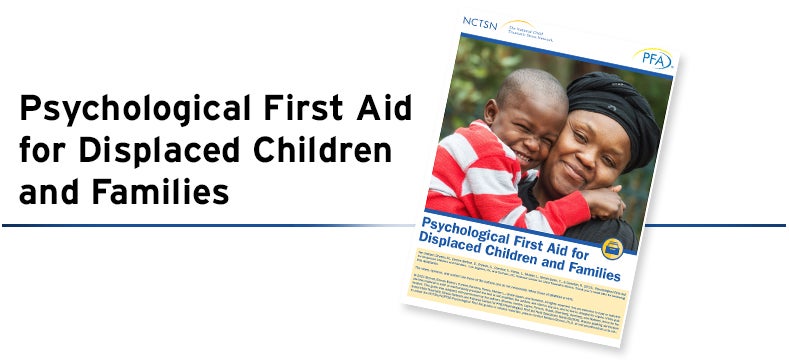
Is an evidence-informed flexible approach to assist displaced children and families immediately after arriving in the US. This approach includes a set of tools to assist staff in supporting displaced children and families through early transitions. Because each child and family comes with their own experiences and circumstances, it is important to tailor your interactions to meet their unique needs. Practice cultural competency and humility in every interaction (learn about cultural norms and the political, historical context from which the children and families came).


A Trauma-Informed Resource for Strengthening Family-School Partnerships
Helps schools assess what level of partnering currently exists within their school community, areas that require enhancement, and strategies for implementing these enhancements. This tool is for administrators and staff to drive further conversation about family-school partnerships. It builds on the NCTSN Trauma-Informed Schools Framework and is aligned with SAMHSA’s 6 Principles of Trauma-Informed Care: safety; trustworthiness and transparency; peer support and mutual self-help; collaboration and mutuality; empowerment, voice, and choice; and cultural, historical, and gender issues.

SGA Youth & Family Services presenta información sobre jóvenes inmigrantes no acompañados Proyecto de Jóvenes Migrantes No Acompañados en Chicago, Illinois. El personal comparte cómo tomando en cuenta las consideraciones culturales informa de manera más eficiente al equipo de trabajo al brindar servicios de trauma a jóvenes y familias Latinoamericanas.


Now available in Creole! Trinka and Sam the Day the Earth Shook
Ofri paran yo ak moun k ap bay swen yo yon fason pou yo pale ak pitit yo sou tranblemanntè. Liv sa a pou timoun dekri kèk nan reyaksyon Trinka ak Sam te genyen nan yon tranbleman tè, pale sou fason paran yo ede yo eksprime santiman yo epi santi yo pi an sekirite. Gen yon gid pou moun k ap bay swen ki disponib nan do liv la ki bay fason paran yo ka itilize istwa a ak pitit yo.

Child Trauma and COVID-19: An NCTSN Summit Supporting the Long-Term Recovery of our Nation’s Children and Families
Helps schools assess what level of partnering currently exists within their school community, areas that require enhancement, and strategies for implementing these enhancements. This tool is for administrators and staff to drive further conversation about family-school partnerships. It builds on the NCTSN Trauma-Informed Schools Framework and is aligned with SAMHSA’s 6 Principles of Trauma-Informed Care: safety; trustworthiness and transparency; peer support and mutual self-help; collaboration and mutuality; empowerment, voice, and choice; and cultural, historical, and gender issues.
Destrezas para la Recuperación Psicológica Curso
Tiene como objetivo ayudar a los sobrevivientes a adquirir destrezas para manejar la angustia y afrontar el estrés y la adversidad luego de un desastre. Este curso utiliza componentes para el tratamiento de salud mental que han demostrado ser útiles ante varias situaciones postraumáticas. Las investigaciones sugieren que un enfoque en el desarrollo de destrezas concretas es más efectivo que consejería enfocada solamente en apoyo (“supportive counseling”). SPR es apropiado para todo nivel de desarrollo a través de la vida y está informada culturalmente.

Tech into Care:
Created by the National Center for PTSD, Tech into Care is an initiative that teaches how to use technology to help provide the best care for Veterans. Many Tech into Care resources are focused on the National Center for PTSD mobile mental health apps. These apps help Veterans, Service members, and their friends and family stay engaged outside of in-person meetings and provide self-help, education, and support for PTSD and related issues.
SAMHSA’s “Talk. They Hear You.” Application
Helps parents and caregivers prepare for some of the most important conversations with their kids. It shows them how to turn everyday situations into opportunities to talk with their children about alcohol and other drugs, and it equips them with the necessary skills, confidence, and knowledge to start and continue these conversations as their kids get older. The app also helps prepare communities to engage student assistance professionals, school leaders, and families in supporting the needs of students who may be struggling with substance use, mental health, or school-related issues.
RECENT JOURNAL PUBLICATIONS
Authored by Saida M. Abdi , Alisa B. Miller, Naima Y. Agalab, & Heidi B. Ellis, Partnering with Refugee Communities to Improve Mental Health Access: Going from “Why Are They Not Coming” To “What Can I (We) Do Differently? highlights the need to develop methods that facilitate the engagement of refugee communities. Community-Based Participatory Research recommends the forming of equal and equitable partnerships with communities and stakeholders to enhance community capacity and ownership of the research process and outcomes (Israel et al., 1998). The present article shares one approach to operationalizing these principles with the Somali refugee community. It provides a road map of best practices in collaborating with communities and the importance of co learning and cultural humility to a successful partnership.

Tailoring Trauma-Focused Cognitive Behavioral Therapy (TF-CBT) for Youth with Intellectual and Developmental Disabilities: A Survey of Nationally Certified TF- CBT Therapists, written by Peter J. D’Amico, Juliet M. Vogel, Anthony P. Mannarino, Daniel L. Hoffman, Ernestine C. Briggs, Angela M. Tunno, Courtney C. Smith, Daniel Hoover, & Rebecca M. Schwartz seeks to characterize and assess the delivery of one of the most strongly supported child trauma treatments, Trauma-Focused Cognitive Behavioral Therapy (TF-CBT), to youth with DD. In June 2018, 391 TF-CBT therapists completed a self-report survey sent to all nationally certified TF-CBT therapists, which queried the experience and comfort of using TF-CBT with youth with DD and the types of treatment adjustments made for them. Twenty-five percent of respondents reported having a strong background working with DD, and 34% reported comfort treating youth with DD. As expected, there was an association between experience with DD and comfort level doing TF-CBT with youth with DD (X2 (1, 358) = 70.09, p < .001). Discomfort varied by DD subtype. Consistent with prior recommendations, respondents reported employing a variety of flexible strategies such as adaptations in session/treatment time (e.g., shortening sessions, lengthening course of treatment), treatment content (e.g., simplifying language and/or using visual aids), structure, and increasing caregiver involvement. Experience mattered; of those who reported making an adjustment, 74.1% had some extensive experience treating youth with DD as compared to 61.2% of those who didn’t report adjustments (X2 (1, 359) = 6.18, p = .013). Findings highlight the need for additional training and resources for increasing self-efficacy around TF-CBT treatment provision for youth with DD.
Looking for Trainings?
Visit the NCTSN Training Page on LinkedIn
Not on our mailing list? Click here to sign up.
This project was funded by the Substance Abuse and Mental Health Services Administration (SAMHSA), US Department of Health and Human Services (HHS). The views, policies, and opinions expressed are those of the authors and do not necessarily reflect those of SAMHSA or HHS.


