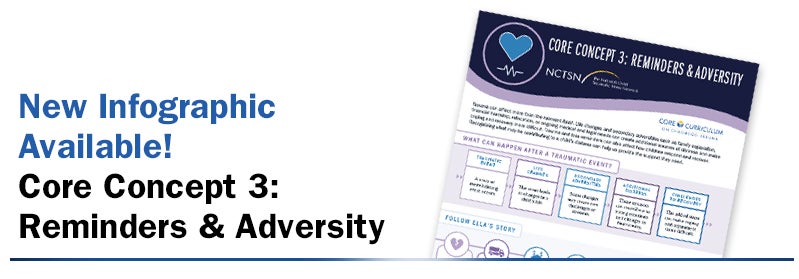
New Infographic Available! Core Concept 3: Reminders & Adversity
Explores Core Concept 3: Reminders & Adversities, one of the NCTSN’s research-based Core Concepts for Understanding Child Traumatic Stress. Explains how trauma can lead to life changes and additional stressors that make coping and recovery more difficult.

New Video Available! Core Concepts of Childhood Trauma - Reminders and Adversity
Meghan Graham from the NCCTS Disaster and Mass Violence program is joined by NCTSN member Ashley Brock-Baca to discuss Core Concept 3: Reminders and Adversity.
Remembering September 11, 2001: An NCTSN Video Series
In the 25 years since September 11, 2001, the lessons we learned in disaster response continue to shape trauma work, preparedness, and response. This series shares NCTSN members’ experiences and responses following the events of September 11.
CDC VetoViolence Healthy Relationships Toolkit
The Healthy Relationships Toolkit (HeaRT) is a CDC-developed model to prevent violence in adolescence that teaches 11 to 14-year-olds healthy relationship skills to prevent violence before it starts. HeaRT’s evidence-based approach includes seven components for individuals, peers, families, schools, and neighborhoods that work together to prevent dating violence and other risk behaviors. This website has everything you need to implement the components, including trainings, implementation guidance, program materials, and many other resources.
Strategies for Staying in Care: Enhancing Engagement and Improving Treatment Retention in Mental Health Services
This SAMHSA paper discusses intrinsic and extrinsic motivators of treatment, as well as patient nonadherence and disengagement from services, including the effects of perceived coercion, insight, and the therapeutic alliance. Models for maximizing treatment adherence will be discussed, with a spotlight on recovery-oriented cognitive therapy.
RECENT JOURNAL PUBLICATIONS
Declining Child Health in the United States — Addressing the Developmental Ecosystem, authored by Christopher B. Forrest and Neal Halfon, addresses a decline in child health the United States. In a recent study, which included 170 indicators, there were pervasive declines in children’s health over the past two decades. Infants, children, and adolescents in the United States are 80% more likely to die than their peers in other high-income countries. Rates of chronic physical, neurodevelopmental, and mental health conditions, including obesity, have increased, and children in the current generation tend to enter puberty earlier, have more trouble sleeping, and report more physical and emotional symptoms than those in the previous generation. Another analysis found that 77% of Americans 17 to 24 years of age would be ineligible to enlist in the U.S. military without a waiver, for reasons including obesity, mental health problems, and other medical conditions. It can no longer be assumed that American children will grow up to be as healthy as their parents.
The Presence of Others and the Possibility of Discovery During the Commission of Child Sexual Abuse Within Private Homes, authored by Nicole Colombino, Elizabeth L. Jeglic, Georgia M. Winters, Lillian A. Steedman, and Cynthia Calkins, examined whether the common assumption that Child Sexual Abuse (CSA) requires complete isolation holds true in private homes by integrating perspectives from both survivors and individuals who perpetrated CSA. CSA often occurs inside private residential settings, yet little is known about how the presence of others or physical barriers such as closed doors meaningfully influence whether abuse occurs or can be detected. Despite the common assumption that CSA requires complete isolation, situational crime prevention (SCP) predicts that the presence of others should reduce opportunity for abuse, yet the extent to which this holds in practice remains poorly understood. Using semi-structured interviews of CSA survivors (n = 61) and individuals incarcerated for CSA (n = 47), we explored whether others were present in the home during the CSA and whether physical barriers limited the possibility of observation. Someone else was home during the CSA in 64.7% of cases, and in more than half (52.6%) others were usually or always present. Where the location of that person was recorded, just over one in ten (11.5%) were in the same room as the abuse. In approximately half of the cases (50.5%), no physical barrier would have prevented observation of the CSA. These findings challenge the assumption that CSA within private homes depends upon complete isolation and highlight the need to reconsider how opportunity, visibility, and household dynamics are addressed in both prevention efforts and prosecutorial strategies.
Looking for Trainings?
Visit the NCTSN Training Page on LinkedIn
Not on our mailing list? Click here to sign up.
This project was funded by the Substance Abuse and Mental Health Services Administration (SAMHSA), US Department of Health and Human Services (HHS). The views, policies, and opinions expressed are those of the authors and do not necessarily reflect those of SAMHSA or HHS.