


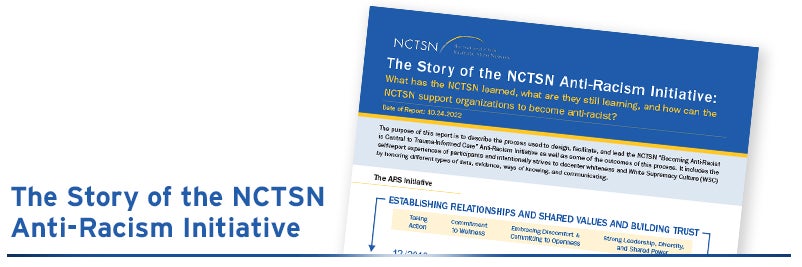
The Story of the NCTSN Anti-Racism Initiative
Tells the story of what the NCTSN has learned through the first Anti-Racist Summit Initiative, what they are still learning, and how the NCTSN can support organizations to become anti-racist. This report outlines the journey of the NCTSN Anti-Racism Summit starting with the background; discussing the process; what occurred before, during, and after the summit; its impact; participant experiences; lessons learned; and next steps.


New Fact Sheet Series for Caregivers on Supporting Children with Intellectual and Developmental Disabilities who have Experienced Trauma
These new fact sheets provide guidance for caregivers on how to choose trauma-informed care, understanding trauma responses in children with Intellectual and Developmental Disabilities (IDD), and engaging in self-care while parenting children with IDD.Trauma and Children with Intellectual and Developmental Disabilities:
Taking Care of Yourself and Your Family
Offers guidance on the importance of taking care of oneself while parenting children with IDD. This fact sheet discusses reactions caregivers may have to their child's negative experiences and traumas, acknowledges that taking care of oneself at times feels impossible, and self-care activities and tools.
Choosing Trauma-Informed Care for Children with Intellectual and Developmental Disabilities:
A Fact Sheet for Caregivers
Provides information for caregivers on choosing trauma-informed care for children with IDD. This fact sheet outlines how to find mental health care for children with IDD, what to ask when you contact a provider, how to determine if your child is getting the trauma-informed care they need, and discuss what partnership in trauma-informed care means.
Understanding Trauma Responses in Children with Intellectual and Developmental Disabilities and When to Seek Help
Outlines what responses to trauma could look like in children with IDD. This fact sheet discusses how a child with IDD might respond to traumatic or stressful experiences, how a caregiver's response to the child's behavior may influence recovery, what a trauma reminder is, common responses to a traumatic event, and when to seek help.

Make a Plan Form
Provides a form template for creating a Family Emergency Communication Plan. This form is designed for families to prepare for disaster events, and to know how to reconnect if separated in an emergency.

Healing Racial Stress Workbook for Black Teens: Skills to Help You Manage Emotions, Resist Racism, and Feel Empowered
Written by a team of experts in Black mental health and wellness, and grounded in cognitive behavioral therapy (CBT), this workbook offers evidence-based strategies to help Black teens manage emotions in the face of race-based stress due to microaggressions, implicit bias, overt racism, and vicarious racism. It also describes how to find strength in racial and cultural identity, and how to gain the skills needed to resist racism and thrive.

Mental Health Treatment Guidelines for Youth Who Have Experienced Trafficking and/or Commercial Sexual Exploitation: An 8-Webinar Series
This webinar series shares treatment elements and practice recommendations from The Consensus Guidelines for Mental Health Treatment with Youth Who Have Experienced Trafficking and Commercial Sexual Exploitation. The guidelines have been developed by a panel of experts with service delivery and/or lived experiences of trafficking, to better engage and support youth and families and tailor treatment to meet their needs.

Overuse of Social Media and Devices Top Parent Concerns as Kids Head Back to School
This article from Michigan Medicine at the University of Michigan discusses how two issues have climbed higher on parents' list of concerns as kids go back to school: the role of social media and the internet in children’s lives.
RECENT JOURNAL PUBLICATIONS
Supporting Mental Health Clinicians During the Pandemic, authored by Melissa Wasserman, Julian D. Ford & Arlene Lu Steinberg, describes how the APA COVID-19 Interdivisional Task Force established The Professional Support for Psychologists Working Group to identify practical ways to provide psychologists and other mental health professionals with direct support during the pandemic. The coronavirus pandemic has had a global impact, disrupting virtually every aspect of work, personal, family, and social life. Mental health professionals have been challenged to maintain professional boundaries and self-care while experiencing the direct impact of the pandemic on their own lives. The upsurge in pandemic-related distress has intensified symptoms experienced by ongoing clients and has added new clients in acute distress due to the pandemic. Many mental health professionals’ work stress has increased correspondingly. As part of the working group, virtual video support sessions were hosted in which mental health professionals (and trainees) could join to discuss the challenges they face and to give and receive support. Themes that emerged from these meetings include compassion fatigue/burnout, isolation, managing boundaries, and work-related concerns.

Striving for Equity in Community Mental Health: Opportunities and Challenges for Integrating Care for BIPOC Youth, authored Eric Rafla-Yuan, Shavon Moore, Hernán Carvente-Martinez, Phillip Yang, Lilanthi Balasuriya, Kamilah Jackson, Courtney McMickens, and Barbara Robles-Ramamurthy, explores some of the opportunities and challenges for integrating mental health care for youth who identify as Black, Indigenous, or Persons of Color (BIPOC). Children and adolescents are a vulnerable population, and for BIPOC youth, these vulnerabilities are magnified by the effects of structural, interpersonal, and internalized racism. Integration of psychiatric care into other medical settings has emerged as an evidence-based method to improve access to psychiatric care, but to bridge the gap experienced by BIPOC youth, care must extend beyond medical settings to other child-focused sectors, including local governments, education, child welfare, juvenile legal systems, and beyond. Intentional policy decisions are needed to incentivize and support these systems, which typically rely on coordination and collaboration between clinicians and other stakeholders. Clinicians must be trauma-informed and strive for structural competency to successfully navigate and advocate for collaborative systems that benefit BIPOC youth.
Looking for Trainings?
Visit the NCTSN Training Page on LinkedIn
Not on our mailing list? Click here to sign up.
This project was funded by the Substance Abuse and Mental Health Services Administration (SAMHSA), US Department of Health and Human Services (HHS). The views, policies, and opinions expressed are those of the authors and do not necessarily reflect those of SAMHSA or HHS.


