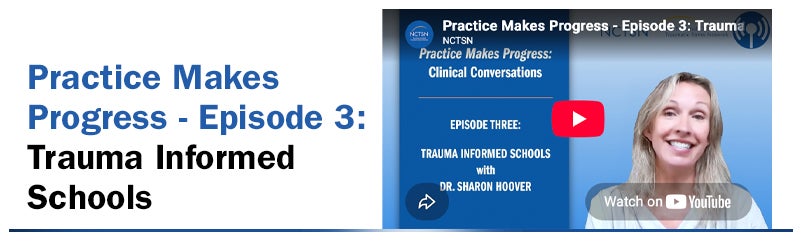
Practice Makes Progress - Episode 3: Trauma Informed Schools
NCTSN Affiliate Dr. Sharon Hoover speaks with National Center Co-Director Dr. Lisa Amaya-Jackson about trauma informed schools: what they look like, what they require, and how they can transform the daily experience of children who have been impacted by trauma.

In a Change Collaborative, Partnerships at Each Level Support Advancements
Shares findings from the NCTSN Change Collaborative on Trauma-Informed Suicide Prevention, highlighting how community partnerships, youth leadership, and trauma-informed approaches supported meaningful change in suicide prevention efforts. It examines the strategies and outcomes of participating teams and offers recommendations for strengthening future collaborative efforts.
The Returning to the Sacred Path: Supporting our Loved Ones at Risk for Suicide
This suicide prevention toolkit seeks to provide information, guidance and resources to address suicide risk for our loved ones in our American Indian and Alaska Native (AI/AN) Tribal and Urban Indigenous communities.
Science and Services Spotlight
Learn about the latest research and service innovations in supporting a trauma-informed juvenile justice system. Explore CTRJJ’s Science and Services Spotlight, a resource series for juvenile justice professionals, mental health professionals, advocates, community members, and youth and families.
Toolkit for Adapting Evidence-Based Interventions for Children and Families Impacted by Crisis and Conflict
In collaboration with partners, communities and developers of evidence-based mental health interventions, this toolkit provides practical guidance for practitioners and community-based organizations navigating the adaptation of interventions for forcibly displaced populations based on takeaways from pilots of adapted interventions and adaptation research and science.
RECENT JOURNAL PUBLICATIONS
The Role of Hippocampus-Based Developmental Changes in Pediatric Post-Traumatic Stress Disorder, authored by Jordan C. Foster, Elizabeth V. Goldfarb, and Dylan G. Gee, seeks to focus on hippocampus-dependent processes of contextual fear conditioning and generalization — specifically statistical learning, category-based induction, and schema learning — and describe their role in pediatric post-traumatic stress disorder. Current evidence-based psychosocial treatments for pediatric post-traumatic stress disorder are not successful for a substantial proportion of young patients. These treatments are mainly based on principles of cued fear reduction and cortico-amygdala circuitry, but overlook alterations in other forms of learning and memory that are centrally implicated in the etiology of this disorder. This synthesis of research on developmental changes supports the view that hippocampal structure and function, along with the related contextual fear-learning processes, are core neurobehavioral mechanisms underlying the onset and maintenance of this disorder in youth. Current and future knowledge of the developmental trajectories of these hippocampus-dependent higher-order learning and memory processes can help to augment the effects of existing clinical interventions.
Looking for Trainings?
Visit the NCTSN Training Page on LinkedIn
Not on our mailing list? Click here to sign up.
This project was funded by the Substance Abuse and Mental Health Services Administration (SAMHSA), US Department of Health and Human Services (HHS). The views, policies, and opinions expressed are those of the authors and do not necessarily reflect those of SAMHSA or HHS.