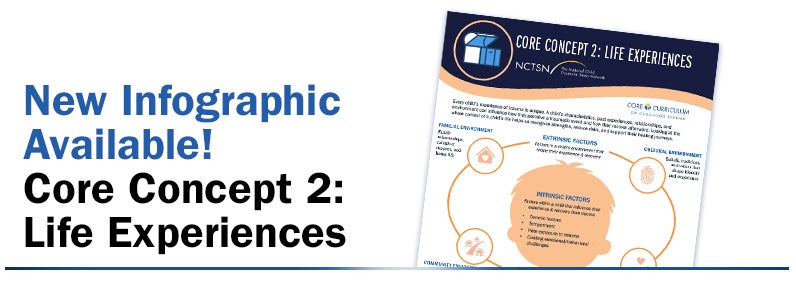
New Infographic Available! Core Concept 2: Life Experiences
Explores Core Concept 2: Life Experiences, one of the NCTSN’s research-based Core Concepts for Understanding Child Traumatic Stress. Illustrates how a child’s unique characteristics, relationships, culture, and environment shape their experience of trauma and recovery, emphasizing the importance of looking at the whole child.

New Video Available! Core Concepts of Childhood Trauma - Life Experiences
New video series from NCTSN! This video series explores the 12 Core Concepts for Understanding Traumatic Stress Responses in Childhood. In this video, NCTSN members Wanda Vargas and Sara Fernandez-Marcote discuss Core Concept 2: Life Experiences.
New Spanish Translations Available! Trauma Fundamentals Infographics
These infographics discuss fundamental topics in child trauma, including “What is Child Trauma?” and “What are Trauma and Loss Reminders?”¿Qué es el trauma infantil?
Muestra las diferencias entre el trauma agudo, crónico y complejo, y cómo cada tipo de trauma afecta de manera única a los niños(as). Destaca la importancia de reconocer su superposición para brindar una atención efectiva y con conocimiento de trauma.
¿Qué son recordatorios de trauma y pérdida?
Explica cómo ciertas imágenes, sonidos y experiencias cotidianas pueden despertar de manera inesperada recuerdos o emociones relacionados con el trauma o la pérdida. Ayuda a los cuidadores a comprender estos recordatorios y a reconocer cómo pueden manifestarse de manera diferente en cada niño(a).
Building Safer Schools Begins With a Comprehensive Approach
This web entry from Safe and Sound Schools discusses a comprehensive approach to school safety built through layers of thoughtful planning, strong relationships, shared responsibility, and a commitment to understanding the unique needs of every school community.
A Parent's Guide to Digital Safety
This guidebook is written specifically for parents of teens and preteens who are using, or considering using, social media platforms and other online technologies. These include popular apps like Instagram, TikTok, Snapchat, WhatsApp, and even AI. It explores helping kids navigate online risks and build healthy habits.
RECENT JOURNAL PUBLICATIONS
Reducing Stress After Trauma in Physically Injured Children: A Randomized Clinical Trial, authored by Linda Ewing-Cobbs, Shari L. Wade, Devi Miron Murphy, Kelly McNally, Hilary Hickingbotham, Amy E. Clark, Angela P. Presson, Heather T. Keenan, evaluated efficacy of the online therapist-assisted, trauma-focused Reducing Stress After Trauma (ReSeT) program in reducing PTSS in children after hospitalization for physical injury. Posttraumatic stress symptoms (PTSS) affect nearly 50% of children experiencing physical trauma. PTSS often persists after physical recovery and is associated with reduced health-related quality of life. A 2-arm randomized clinical trial with 1:1 assignment to the ReSeT program or usual care (UC) was conducted between 2021 and 2024 at 4 sites with level 1 trauma centers. Injured children ages 8 to 17 years were recruited from inpatient and short-stay units. The ReSeT program has 8 online psychoeducational modules containing 3 to 4 short interactive videos that children completed independently. Modules are followed by an electronic health session with a therapist to practice cognitive behavioral skills and desensitization using trauma narrative techniques. Parents received optional psychoeducational resources. Generalized linear regression, controlling for baseline scores, was used to examine group differences on the Child Posttraumatic Stress Disorder Scale (CPSS) scores obtained 10 weeks (primary outcome) and 6 months (secondary outcome) after randomization. Intention-to-treat analyses indicated significant reduction in combined CPSS scores in the ReSeT vs UC cohorts at 10 weeks, which was maintained at the 6-month follow-up. Findings of this randomized clinical trial show that the ReSeT program was an effective, brief, trauma-focused intervention for reducing PTSS after physical injury. It offers a potentially cost-effective, scalable program to address American College of Surgeons standards for psychological screening and treatment for children sustaining PTSS.
Looking for Trainings?
Visit the NCTSN Training Page on LinkedIn
Not on our mailing list? Click here to sign up.
This project was funded by the Substance Abuse and Mental Health Services Administration (SAMHSA), US Department of Health and Human Services (HHS). The views, policies, and opinions expressed are those of the authors and do not necessarily reflect those of SAMHSA or HHS.