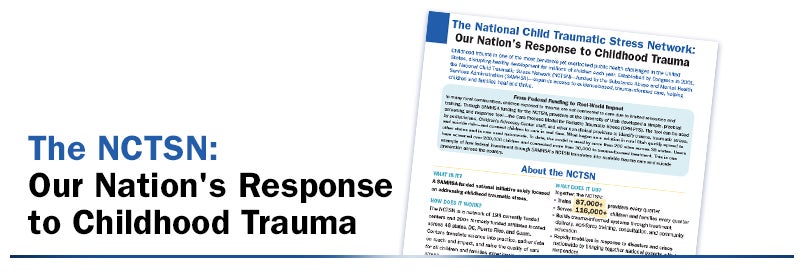
The NCTSN: Our Nation's Response to Childhood Trauma
Highlights the nationwide impact of the NCTSN, showing how federal funding translates into trauma-informed care, workforce development, and crisis response across the country. Demonstrates how the NCTSN connects research, providers, and communities to improve outcomes for children and families affected by trauma.

The 12 Core Concepts for Understanding Child Traumatic Stress Infographic
Introduces the 12 Core Concepts for Understanding Traumatic Stress Responses in Children and Families, a research-based framework developed by the NCTSN to explain how trauma affects children, families, and the systems that support them. Provides an overview of key principles that help professionals, caregivers, and communities understand trauma responses and promote healing, resilience, and recovery.
Practice Makes Progress - Episode 2: Emotional Dysregulation
Discusses trauma, emotional dysregulation, and outbursts with National Center Co-Director Dr. Lisa Amaya-Jackson and Center member Dr. Mia Tankersley.
A Way of Being with Children: A Trauma- and HOPE-Informed Approach to Building Safety, Resilience, and Well-Being
The newly revised PreK Manual from Center for Child Counseling is grounded in trauma-informed care and the HOPE framework (Healthy Outcomes from Positive Experiences). It offers easy-to-use strategies to build emotional safety, strengthen relationships, and respond with compassion to challenging behaviors — helping adults create environments where young children can learn, grow, and thrive, even in the face of adversity.
The Sound off On School Safety: You Don’t Have to Wait for a Crisis to Prevent It with Dr. Kate Rahi
In this episode of The Sound Off on School Safety, Michele Gay sits down with Dr. Kate Rahi, Associate Director of Projects and Training at Safe and Sound Schools, for a powerful conversation about prevention, early intervention, and the teams behind effective school safety.
ACEs hub
The redesigned ACEs hub is a free, evidence-based platform created to support researchers, practitioners, policymakers, and organizations working in the field of adverse childhood experiences (ACEs). ACEs hub is designed to help you quickly find high-quality evidence to support your research and initiatives related to the prevalence and consequences of ACEs.
RECENT JOURNAL PUBLICATIONS
Examining the Relative Impact of Adverse and Positive Childhood Experiences on Adolescent Mental Health: A Strengths-Based Perspective, authored by Carolyn M Scholtes and Julie A Cederbaum, sought to identify the relative impact of ACEs and PCEs on mental health outcomes for youth. It is well-documented that Adverse Childhood Experiences (ACEs) have a negative impact on mental health outcomes across the lifespan, while Positive Childhood Experiences (PCEs) act as a protective factor. Less is known about the relative impact of ACEs and PCEs on mental health outcome for adolescents. In this study, data were drawn from a state-wide, cross-sectional health survey of 12-17 year-olds (n = 1169) conducted on a continuous basis throughout 2021, following the height of the COVID-19 pandemic. Adolescents completed ACEs and PCEs screeners and the Kessler 6-item Psychological Distress Scale to assess current mental health symptoms. A multiple regression analysis was conducted to examine the relative impacts of ACEs and PCEs on mental health outcomes. Male, younger age, lower family poverty level (e.g., more financial hardship), absence of ACEs, and experiencing more PCEs were significantly associated with better mental health outcomes for adolescents [F(5, 1163) = 104.48, p < .001]. Notably, ACEs were found to account for only 9 % of variance in mental health outcomes (ΔR2 = 0.09), while PCEs accounted for 18 % of variance (ΔR2 = 0.18). PCEs explained approximately double the variance in mental health outcomes for adolescents compared to ACEs. Results indicate promoting youths' exposure to PCEs in childhood and adolescence may offer a meaningful pathway for supporting adaptive mental health outcomes.
The Influence of Trauma Screenings on Scheduling Assessment of Children Referred to Community Based Mental Health Services, authored by Bibhuti K Sar, Linda K. Bledsoe, Anita P. Barbee, Emma Sterrett-Hong, Becky F. Antle, Melissa J. King, and Jennifer Bobo, examined trauma screenings conducted at intake retrospectively to determine the relationship between screenings of children’s exposure to traumatic events and symptoms as reported by caregivers/legal guardians and subsequent scheduling of assessment by intake workers at community agencies providing mental health services in a metropolitan city in a Midwest bordering southern state. Two thirds of children in the United States report having experienced at least one traumatic event by age 16 (SAMHSA, 2026, March 27). Unchecked, exposure to traumatic events or adverse childhood experiences (ACEs) can have acute, short-term, and long-term deleterious effects on functioning and overall wellbeing. Screening for exposure to and effects of traumatic events is widely endorsed and considered essential to the treatment of traumatized children but the extent to which it informs scheduling of assessments has not been fully investigated. In this study, descriptive, bivariate, and multivariate analysis revealed the group of children that screened eligible (experienced ≥1 traumatic event and had a trauma symptomology score of ≥3) and was scheduled for an assessment (n = 367) were exposed to more traumatic events, rated higher on trauma symptomology, and differed on type of trauma event experienced from those Not Eligible/Not Scheduled (n = 983), Eligible/Not Scheduled (n = 116), Not Eligible/Scheduled (n = 71, and Eligibility Undetermined/Scheduled (n = 51). The type of traumatic events experienced appear to have carried greater weight in decision to schedule an assessment, especially when trauma symptomology scores were similar, low, or were not available. Being military connected was a significant predictor of being scheduled for an assessment more than experiencing traumatic events or symptoms. These findings add to our understanding of characteristics of children who are screened and are designated as needing assessment and trauma-based interventions. They provide important information about the process and resulting referrals from trauma screening of children in community based mental health services organizations.
Looking for Trainings?
Visit the NCTSN Training Page on LinkedIn
Not on our mailing list? Click here to sign up.
This project was funded by the Substance Abuse and Mental Health Services Administration (SAMHSA), US Department of Health and Human Services (HHS). The views, policies, and opinions expressed are those of the authors and do not necessarily reflect those of SAMHSA or HHS.