


What is Child Trauma?
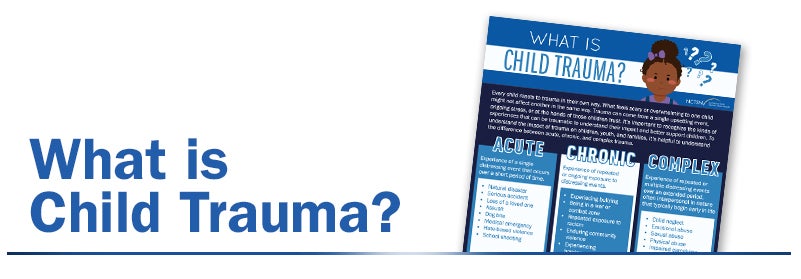
Discusses the differences between acute, chronic, and complex trauma and how each trauma type uniquely affects children. Emphasizes the importance of recognizing their overlap to provide effective trauma-informed care.

Program Spotlight the Steven A. Cohen Military Family Clinic
Provides a focus on the Steven A. Cohen Miliary Family Clinic at Centerstone. This program spotlight offers an overview of Centerstone, the Cohen Veterans Network (CVN), trauma-focused treatment and interventions for military children, prevention services, reducing barriers to care, the NCTSN Military and Veteran Families Program, as well as resources from the NCTSN, Centerstone, and the CVN.
New Video Series! Best Practices for Working with Refugee and Immigrant Youth and Families for Medical Providers
This series, created in partnership with the Trauma and Community Resilience Center at Boston Children's Hospital, discusses best practices for medical providers working with refugee and immigrant youth and families.


Emergency Preparedness Manual for Early Childhood Programs
The Emergency Preparedness Manual for Early Childhood Programs guides early childhood programs to make plans that keep their program safe in an emergency. Emergency preparedness is taking steps to make sure your early childhood program is safe before, during, and after an emergency. It includes assessing the environmental risks most likely to affect the safety of your facilities, preparing for other emergencies that could affect your program, and finding helpful resources in your community. This manual will help you create a plan that is specifically designed for your program’s geographic location and local emergency response resources. It can also help you support the mental health and well-being of children and adults as you prepare, respond, and recover from an emergency or disaster.

New Online Course - Trauma ScreenTIME Child Welfare Course
The Trauma ScreenTIME Child Welfare Course is a free online training course on how to screen children in the child welfare system for trauma. The course is intended for anybody who works in the child welfare system, including caseworkers, clinical staff members, residential program staff members, and others. It was developed by the Child Health and Development Institute in collaboration with families and national experts based on current research and best practices, and shows how to develop a screening process, conduct brief trauma screening, and connect families with their preferred supports and services.
RECENT JOURNAL PUBLICATIONS
Caregiver Representations in a High-Risk Sample: Factor Analysis of the Working Model of the Child Interview (WMCI), authored by Adrienne Whitt, Ginny Sprang, Stephanie Gusler, and Jessica Eslinger, aimed to explore the factor structure, reliability, and validity of the WMCI among a large sample of high-risk caregivers to examine its clinical utility. Caregivers’ internal working models represent their thoughts, expectations, feelings, and behaviors in relation to their child. Internal working models have been associated with parenting behaviors, child attachment, intergenerational patterns in relationships, and severity of maltreatment. However, it can be challenging to assess this internal process, in a reliable and valid way. The Working Model of the Child Interview (WMCI) is a method frequently used clinically and in research, but additional information is needed on its psychometric properties when used with different populations. Data were collected from 1227 caregivers as part of a comprehensive, court-ordered assessment, due to caregivers’ child welfare involvement. An exploratory factor analysis was conducted on the WMCI. Reliability analysis of the identified factors was then conducted, and logistic regressions and correlational analyses were used to examine validity. Two factors were identified: Balanced and Disrupted. The reliability for the Balanced factor was high, but only moderate for the Disrupted factor. Validity was established with the two factors predicting the original WMCI classifications and being associated with caregiver trauma recovery, child abuse potential, and one domain of parenting difficulties. Results suggest that the Balanced factor of the WMCI is a valid and reliable tool for assessing the internal working models of high-risk caregivers. However, the Disrupted factor may have clinical utility given support for its validity, but concerns about reliability suggest the need for more research.
Who Gets Referred to School-Based Trauma Treatment? A Descriptive Analysis of Bounce Back and Support for Students Exposed to Trauma, authored by Yourdanos Bekele, Kristin Scardamalia, Sharon A. Hoover, and Cindy M. Schaeffer, describes one district's experience having counselors deliver, for the first time, a school-based treatment to address student trauma symptoms. After their initial training, school counselors rated Bounce Back (K-5th grade) and Support for Students Exposed to Trauma (5th−12th grade) as highly acceptable and anticipated a positive impact on student functioning (i.e., reduced trauma symptoms, improved coping skills). All 56 counselors identified students clinically appropriate for the intervention, and all initiated at least one treatment group within 6 months. Among secondary schools, far fewer boys were screened for eligibility, and there was a trend (p = 0.064) towards a greater propensity to screen White students than nonwhite students. Across both school levels, students screened for trauma treatment had more disciplinary concerns relative to their peers; screened secondary school students also had worse school attendance and lower ratings of school climate. Study limitations include a largely White sample, unequal cell sizes for comparisons, and a narrow range of variables available for examination. Findings suggest that school counselors, in partnership with the broader school community, can readily identify students who could benefit from trauma treatment and can play an important role in expanding access to evidence-based interventions for trauma.
Looking for Trainings?
Visit the NCTSN Training Page on LinkedIn
Not on our mailing list? Click here to sign up.
This project was funded by the Substance Abuse and Mental Health Services Administration (SAMHSA), US Department of Health and Human Services (HHS). The views, policies, and opinions expressed are those of the authors and do not necessarily reflect those of SAMHSA or HHS.


