


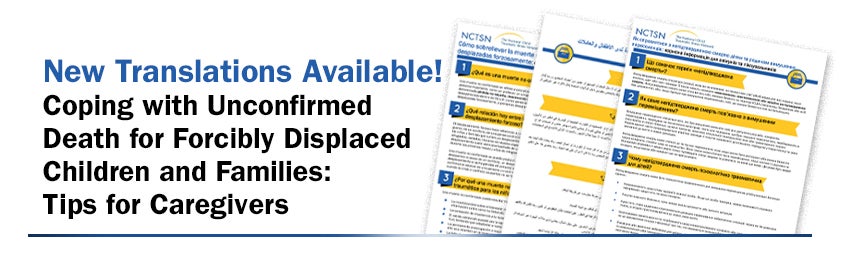
New Translations Available!
Offers information for caregivers on unconfirmed death, how it relates to forced displacement, how it is traumatic for children, and how children might respond. This fact sheet also provides information on how you can help a child cope with unconfirmed death, and includes additional resources for caregivers. Now available in Ukrainian, Spanish, Arabic, Dari, and Pashto.Coping with Unconfirmed Death for Forcibly Displaced Children and Families:
Tips for Caregivers (in Ukrainian)
Cómo sobrellevar la muerte no confirmada de niños y familias desplazadas forzosamente:
consejos para cuidadores
Coping with Unconfirmed Death for Forcibly Displaced Children and Families:
Tips for Caregivers (in Arabic)
Coping with Unconfirmed Death for Forcibly Displaced Children and Families:
Tips for Caregivers (in Dari)
Coping with Unconfirmed Death for Forcibly Displaced Children and Families:
Tips for Caregivers (in Pashto)


The Breakthrough Parent Curriculum: Navigating Trauma Across Generations
The Breakthrough Parent Curriculum: Navigating Trauma Across Generations, or BPC, is a 10-module in-person training based on the NCTSN's Caring for Children Who Have Experienced Trauma: A Workshop for Resource Parents. It is designed for parents involved with or at risk of involvement with the child welfare system. The BPC educates parents about the impact of trauma on themselves and their children, while providing information, skills and strategies for understanding, healing, hope and growth. This curriculum is intentionally designed to be delivered by two co-facilitators: a Parent Facilitator and a Non-Parent Facilitator.


New Webinar! Coping with Unconfirmed Death for Forcibly Displaced Children and Families
Currently, more than 110 million people are experiencing forced displacement worldwide due to “persecution, conflict, violence, human rights violations and events seriously disturbing public order”... an estimated 40% account for children below 18 years of age (UNHCR). The Center for Adjustment, Resilience, and Recovery (CARRE) has partnered with the NCTSN Child Traumatic Grief/Traumatic Separation Committee to create a webinar on the impact of unconfirmed death on forcibly displaced children and families in the U.S. This webinar covers trauma in the context of forced displacement, coping with unconfirmed death and loss in various forcibly displaced communities, and the adaptation and development of “Coping with Unconfirmed Death for Forcibly Displaced Children and Families: Tips for Caregivers,” a new NCTSN resource.

Evidence-Based Policymaking and Advocacy: A Toolkit to Inform Practice
This toolkit from the Baker Center for Children and Families defines and explores an array of perspectives and skillsets needed to affect meaningful change through evidence-based advocacy. It also helps you build active partnerships across the policy, systems and community levels, and helps you learn how to craft actionable strategies to educate and advocate for more effective, inclusive supports and services.
Better Supporting LGBTQIA2S+ Youth Survivors of Commercial Sexual Exploitation
Young people who are LGBTQIA2S+ are among the most at risk of being victimized through sex trafficking and commercial sexual exploitation. To improve services and understanding to better support these youth, the National Center for Youth Law has created "Understanding the Commercial Sexual Exploitation of LGBTQIA2S+ Youth." Developed in partnership with Los Angeles LGBT Center RISE Program, Saving Innocence, and the Young Women's Freedom Center, this guide provides an overview of available data and case studies to highlight vulnerabilities and pathways to commercial sexual exploitation for youth who are LGBTQIA2S+, barriers this population faces, and recommendations — based on the experiences of young people — for providers to improve services.
Psychiatry’s New Frontiers: Hope Amid Crisis
This new issue of Stanford Medicine magazine reports on emerging research and innovative treatments to improve mental health. Topics from this issue include empowering community-based mental health for youth, how caregivers can provide mental health care, insights into resilience, and more.

RECENT JOURNAL PUBLICATIONS
Service Utilization Among Adolescents Seeking Trauma-Related Care: Differences By Risk For Suicide and Ethnoracial Background, authored by Lilian G. Bravo, Julian D. Ford, Cheryl Woods Giscombe, Alison N. Cooke, Gabriela Livas Stein, Rosa M. Gonzalez-Guarda, Cheryl B. Jones, and Ernestine C. Briggs, examines the associations and interactions between self-injurious thoughts and behaviors (SITBs), race/ethnicity, and service sector utilization among a sample of trauma-exposed and treatment-seeking adolescents. Participants were treatment-seeking adolescents (N = 4406) ages 12–17 from the National Child Traumatic Stress Network Core Data Set. Mixed effects logistic regression was used to examine main and interactive effects for whether adolescents' race/ethnicity and SITBs were associated with service utilization in each of the identified service sectors. SITBs were associated with adolescents' utilization of mental healthcare, general healthcare, and school services. NH Black adolescents reporting SITBs were less likely to use mental health services than other NH Black youths. Hispanic adolescents reporting SITBs were more likely to utilize healthcare services than other Hispanic youths. Trauma-exposed adolescents reporting SITBs are more likely to utilize mental healthcare, general healthcare, and school-based services than other trauma-exposed adolescents. However, NH Black adolescents experiencing SITBs may face additional barriers to utilizing mental healthcare services. Findings can be used to develop nursing practices and policies to address barriers faced by adolescents reporting SITBs.

Caring for Caregivers Experiencing Secondary Trauma: A Call to Action, authored by Heather C. Forkey, Elaine Schulte, and Luanne Thorndyke, describes how opportunities for those in health care to address STS can be found among colleagues and within their own settings, and may provide a meaningful source of support if accessed effectively. Secondary traumatic stress (STS) is the emotional duress caused by indirect exposure to distressing events experienced by others. Health care providers are particularly susceptible to secondary stress due to regular exposure to difficult and painful clinical situations that evoke intrinsic empathy necessary to provide effective care. Understanding STS as a normal stress response not only helps to make sense of the symptoms but also suggests a way forward.
Looking for Trainings?
Visit the NCTSN Training Page on LinkedIn
Not on our mailing list? Click here to sign up.
This project was funded by the Substance Abuse and Mental Health Services Administration (SAMHSA), US Department of Health and Human Services (HHS). The views, policies, and opinions expressed are those of the authors and do not necessarily reflect those of SAMHSA or HHS.


