


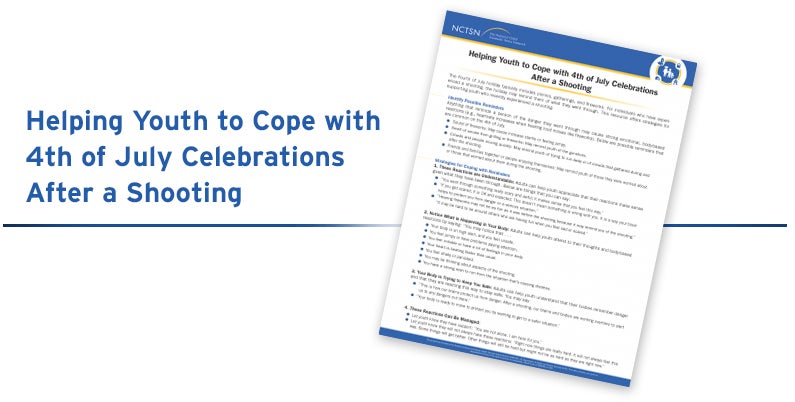
Helping Youth to Cope with 4th of July Celebrations After a Shooting
Offers strategies for supporting youth who recently experienced a shooting on how to cope with 4th of July celebrations. This fact sheet provides strategies for how to support youth who may be reminded of their trauma experiences while attending 4th of July festivities, including things to say. Also available in Spanish.


New Resource Translations!
Childhood Traumatic Grief: Youth Information Sheet available in Russian
PFA: For Unaccompanied Children available in Italian

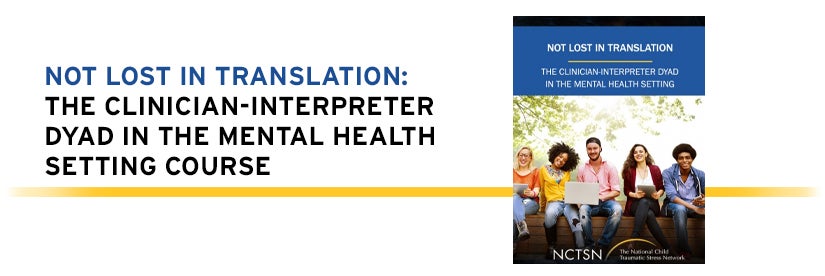
Not Lost in Translation: The Clinician-Interpreter Dyad in the Mental Health Setting Course
Designed to increase the capacity and partnership of professional interpreters and mental health clinicians working together in order to improve quality and access of services for children, adolescents and families with no or limited English proficiency (LEP) and who have experienced trauma and are seeking mental health services. This course is based on the resource, A Socio-Culturally, Linguistically-Responsive, and Trauma-Informed Approach to Mental Health Interpretation, and has lessons for both interpreters and clinicians to better support their work with families and children who have experienced trauma.

Now available on Demand! Assessing and Treating Interpersonal Violence in the Wake of COVID-19
This webinar describes assessment strategies and evidence-based interventions for interpersonal violence in the wake of the COVID-19 pandemic across development, with a focus on 1) how to ask children about their trauma experiences and responses; 2) the use of Child-Parent Psychotherapy (CPP) for young children and their parents/caregivers who experience interpersonal trauma in the wake of COVID-19; 3) features of problematic sexual behaviors (PSB) in children 12 years and younger, the critical role of parents in addressing these, and two evidence-based treatments for this population; and 4) the use of Trauma-Focused Cognitive Behavioral Therapy (TF-CBT) for youth who experience interpersonal trauma including PSB and their non-offending parents/caregivers.
Want reminders for upcoming webinars? Sign up here!

Available in ASL! How To Talk To Your Children About Recent Shootings
ASL translation of the NCTSN Talking To Children About The Shooting resource. Provides information on how to talk to children about mass shootings. It gives tips about how to start the conversation, common reactions children may have, and how to seek help if needed.

New Youth-Led Podcast Series! Not In Isolation: Voices of Youth
Examines how our history and our legal systems impact the youth involved in them, with shocking disparities for youth of color and LGBTQI youth. This podcast series centers on the experiences of young people and family members inside youth prisons and solitary confinement – and their ideas for how to change the system. The podcast series will include five episodes in 2022. Each episode will focus on an important aspect of solitary confinement and youth incarceration. Along with young advocates, our podcast guests will include widely respected experts who will share their research and perspectives on ending solitary confinement and building meaningful supports for young people.

RECENT JOURNAL PUBLICATIONS
Quality Improvement for Acute Trauma-Informed Suicide Prevention Care: Introduction to Special Issue, written by David B. Goldston & Joan Asarnow brings together a series of articles demonstrating and discussing strategies for addressing suicide and suicide attempt prevention in our service systems, with the overall goal of motivating efforts to bring evidence-informed suicide and suicide attempt preventive care into the routine community settings that serve children and families. This Special Issue appears while we are still struggling with the COVID-19 pandemic and public health emergency (J.R. Asarnow & Chung, 2021). During this time, we have shifts in service delivery with online versus in-person schooling, mental health services, and health care. While clinicians and services have mobilized and responded creatively to care for our children, we have seen a 31% increase nationally in the proportion of mental health-related ED visits for adolescents ages 12–17 years relative to 2019, with a particularly strong increase among girls, for whom weekly ED visits for suspected suicide attempts were 50.6% higher during February 2021-March 20, 2021 than the same period in 2019 (Yard et al., 2021). These data underscore the current need for attention to suicide prevention care in our young people.

Authored by Angela M. Tunno, Heather T. Pane Seifert, Shayna Cheek, David B. Goldston, The Intersection of Trauma and Substance Use in Adolescent Populations discusses the intersection of trauma and substance use difficulties among youth. The current statistics, signs, and symptoms of trauma exposure and substance use in adolescent populations are presented, followed by a discussion regarding the interplay between said symptoms. The authors also describe the importance of screening and assessment for this clinical population and then focus on integrated treatment models when working with youth who demonstrate both traumatic stress and substance use difficulties.
Looking for Trainings?
Visit the NCTSN Training Page on LinkedIn
Not on our mailing list? Click here to sign up.
This project was funded by the Substance Abuse and Mental Health Services Administration (SAMHSA), US Department of Health and Human Services (HHS). The views, policies, and opinions expressed are those of the authors and do not necessarily reflect those of SAMHSA or HHS.


