


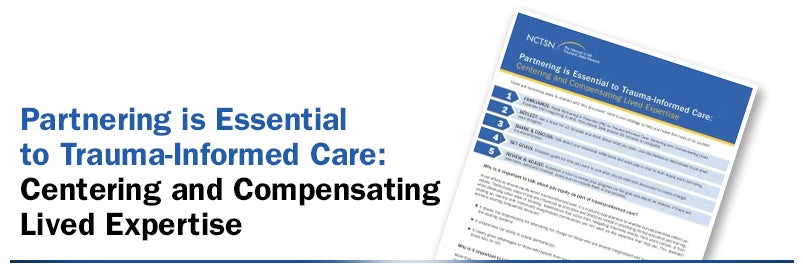
Partnering is Essential to Trauma-Informed Care: Centering and Compensating Lived Expertise
Explores how relationships with people with lived experience are essential to trauma-informed care by emphasizing the importance of shared decision-making, mutual respect, and authentic collaboration. The document highlights practical strategies and guiding principles for centering lived expertise within organizations and systems committed to healing.


The American Art Therapy Association
The American Art Therapy Association (AATA) works to advance art therapy as a regulated mental health profession and building a community that supports art therapists throughout their careers. The AATA provides members with the latest information, resources, and meaningful networking opportunities, and provides opportunities to connect with licensed art therapists. The association advocates for the furtherance of the profession and connects members to the important work of art therapists around the world.


Grooming 101: Red Flags, Abuse Patterns, and Keeping Kids Safe with Michelle Denault
In this episode of The Sound Off, a podcast from Safe and Sound Schools, Michele Gay sits down with Michelle Denault, an advocate and survivor, to discuss the realities of grooming, how predators manipulate trust, and how we can build safer environments for our children. Michelle shares her powerful story and offers practical insights into how communities can recognize and respond to grooming behaviors to protect kids from harm.

RECENT JOURNAL PUBLICATIONS
Effectiveness of a Workforce Stress Intervention Among Providers of Evidence-Based Treatment for Child Traumatic Stress, authored by Katheryn J. Murray, Brian C. Miller, Rebekah Lim, Kelly M, Sullivan, and Mellicent O. Blythe, evaluates the intervention Components for Enhancing Clinician Engagement and Reducing Trauma (Miller, 2022). Despite the well-established risk of secondary traumatic stress and other forms of workforce stress for mental health clinicians providing trauma treatment, there is little research to support interventions to mitigate this stress. Participants in the intervention (n = 60) were recruited from a training project in one state for agencies providing evidence-based treatment for child traumatic stress. Participants showed significant reductions between preintervention and 6-month follow-up in secondary traumatic stress, burnout, and four of the five intervention targets. There were no changes in compassion satisfaction and one target of the intervention. Qualitative evaluation data were also reviewed, which highlighted an overall positive response to the training, the usefulness of the components, and areas for future growth. Overall, the results of the current study, while limited, support the effectiveness of the Components for Enhancing Clinician Engagement and Reducing Trauma intervention in mitigating workforce stress for mental health providers.

Exploring Intersections Between Trauma and Discrimination in Youth of Color Seeking Mental Health Services, authored by Lauren Alvis, Camisha D.M. Kibble, Robyn D. Douglas, Christopher Giang, Tamara Johns, Benjamin Oosterhoff, and Julie B. Kaplow, explores the intersection between trauma and discrimination among Black, Latino/a youth seeking treatment. Specifically, we examine the following: (1) the frequency of various everyday discrimination experiences, averaged across the sample and disaggregated by demographic characteristics; (2) unique associations between exposure to potentially traumatic events (PTEs) and everyday discrimination experiences; and (3) unique associations between everyday discrimination experiences and specific posttraumatic stress symptoms while accounting for demographic characteristics and PTEs. Participants were 573 Black (54.8%) and non-Black Latino/a youth (10-18 years of age, 55.8% female, 25.7% first- or second-generation immigrant) who were treatment-seeking and had exposure at least one traumatic event. Two-thirds of trauma-exposed youth reported having experienced discrimination, with the most common experience being treated as not smart (46%), followed by being treated with less courtesy or respect (40%). Rates of discrimination varied by intersecting demographic characteristics in nuanced ways. Among 11 PTEs, exposure to a natural disaster, experiencing community violence, and witnessing community violence were each positively associated with overall everyday discrimination scores and specific discriminatory encounters. Everyday discrimination experiences were positively associated with posttraumatic stress symptoms after accounting for demographic characteristics and exposure to PTEs. Findings provide important context for understanding experiences of everyday discrimination in Black and Latino/a youth seeking mental health services for trauma. Findings further highlight variability in the types of discrimination youth with different intersecting identities experience, the high rates of co-occurrence between discrimination and other traumatic events, and unique associations between specific discrimination experiences and posttraumatic stress reactions.
Looking for Trainings?
Visit the NCTSN Training Page on LinkedIn
Not on our mailing list? Click here to sign up.
This project was funded by the Substance Abuse and Mental Health Services Administration (SAMHSA), US Department of Health and Human Services (HHS). The views, policies, and opinions expressed are those of the authors and do not necessarily reflect those of SAMHSA or HHS.


