


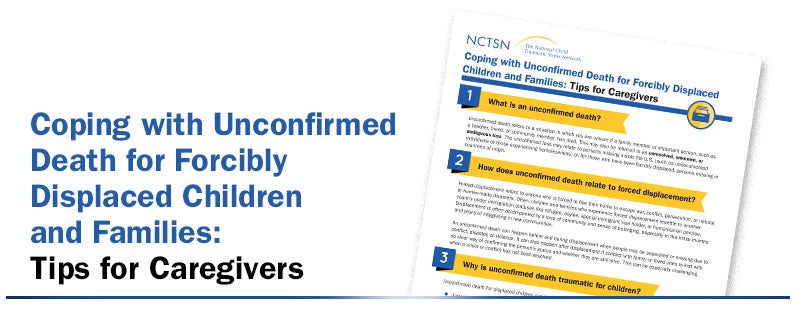
Coping with Unconfirmed Death for Forcibly Displaced Children and Families: Tips for Caregivers
Offers information for caregivers on unconfirmed death, how it relates to forced displacement, how it is traumatic for children, and how children might respond. This fact sheet also provides information on how you can help a child cope with unconfirmed death, and includes additional resources for caregivers.


Q&A For Helping Educators & School Providers To Provide Guidance & Support For Parents & Caregivers Of LGBTQ Students
This partner-in resource from the Family Acceptance Project provides background information for helping school professionals to engage and provide support for parents and caregivers of LGBTQ students.

Trauma-Informed & Affirming Checklist for Practice with LGBTQ+ Children, Youth & Families
From Inform Transform and the Family Acceptance Project, this Trauma-Informed & Affirming Checklist shares best practices for safely engaging and supporting LGBTQ+ youth, children, and families in mental health settings.

Shipwrecked: A Memoir of Widowed Parenting and Life After Loss
Shipwrecked: A Memoir of Widowed Parenting and Life After Loss details Jeanette Koncikowski's personal experience of being widowed at age 36 with two young children, and what her family had to overcome as they navigated those uncharted waters. This book is interwoven with practical tips and strategies for newly widowed parents on surviving and then thriving as a family. It explores themes such as talking with your children about the death of their parent and how to cope and adapt to life after trauma and loss.

Community Outreach and Engagement Toolkit for Mental-Health Serving Agencies
This toolkit aims to help agencies and organizations connect services with the families who need them most, and to effectively communicate with communities and families about evidence-based interventions. Effectively welcoming families and providing accessible information allows for the collaborative treatment planning and informed decision-making that lies at the center of evidence-based care.
The Dialogue: Impact of a Warming Planet
This issue of The Dialogue from the SAMHSA Disaster Technical Assistance Center (DTAC) highlights various community responses to the growing impacts of climate on disaster behavioral health. It features best practices and information from the field to support the development and promotion of mitigation and community resilience strategies.

RECENT JOURNAL PUBLICATIONS
Diversity-Informed Reflective Consultation and Radical Healing: A New Paradigm for Infant and Early Childhood Mental Health Providers Serving Immigrant Families, authored Carmen Rosa Noroña, Elizabeth Raskin, Flores, Ivys Fernández-Pastrana, Sara Anderson-Phou, and Michelle Saulnier, offers an introduction to the creation and implementation of a workforce development project for frontline providers serving mixed-status immigrant families in infant and early childhood programs. The project comprised specialized training and an innovative approach to reflective consultation to provide an in-depth exploration grounded on diversity-informed practice and radical healing principles. This reflective consultation approach was conceptualized as a key tool to facilitate providers’ competencies development, support their critical thinking and reflective capacity, buffer them from the secondary effects of the work, and ultimately serve as a catalyst for practice transformation and their own liberation.

Implementation of A Care Process Model for Pediatric Traumatic Stress in Child Advocacy Centers: A Mixed Methods Study, authored by Kara A. Byrne, Elizabeth A. McGuier, Kristine A. Campbell, Lindsay D. Shepard, David J. Kolko, Brian Thorn, and Brooks Keeshin, describes statewide efforts implementing a standardized screening and referral protocol, the Care Process Model for Pediatric Traumatic Stress (CPM-PTS), in CACs. Child Advocacy Centers (CACs) are well-positioned to identify children with mental health needs and facilitate access to evidence-based treatment. However, use of evidence-based screening tools and referral protocols varies across CACs. Understanding barriers and facilitators can inform efforts to implement mental health screening and referral protocols in CACs. Twenty-three CACs were invited to implement the CPM-PTS, and eighteen CACs adopted the CPM-PTS. Across CACs, screening rates ranged from 10% to 100%. Caregiver ratings indicated high acceptability. Facilitators and barriers were identified within domains of the Consolidated Framework for Implementation Research. Qualitative findings provided insight into adoption, reach, and caregivers’ responses. The findings suggest screening for traumatic stress and suicidality in CACs is valued, acceptable, and feasible. Implementation of mental health screening and referral protocols in CACs may improve identification of children with mental health needs and support treatment engagement.
Looking for Trainings?
Visit the NCTSN Training Page on LinkedIn
Not on our mailing list? Click here to sign up.
This project was funded by the Substance Abuse and Mental Health Services Administration (SAMHSA), US Department of Health and Human Services (HHS). The views, policies, and opinions expressed are those of the authors and do not necessarily reflect those of SAMHSA or HHS.


