


Beyond the ACE Score:
Perspectives from the NCTSN on Child Trauma and Adversity Screening and Impact Key Points
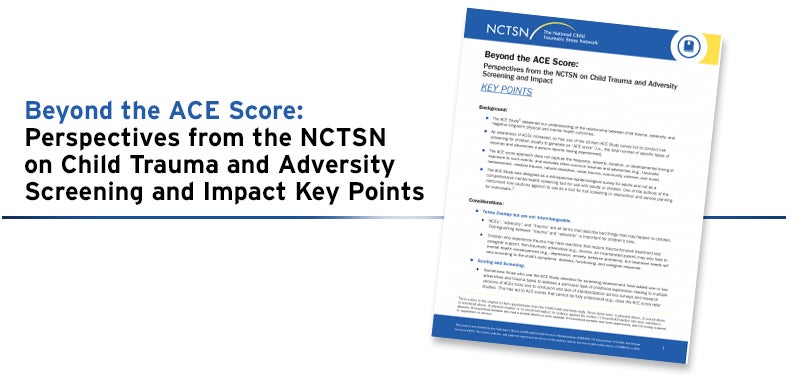
Highlights key points for providers, family advocates, and policymakers to understand about Adverse Childhood Experiences (ACEs) and child trauma. This resource was adapted from Beyond the ACE Score: Perspectives from the NCTSN on Child Trauma and Adversity Screening and Impact.


Now available in Spanish!
● Pausa - Restablecer - Nutrir (PRN)* para promover el bienestar ¡Utilícelo según sea necesario para cuidar su bienestar! (Pause-Reset-Nourish (PRN)* to Promote Wellbeing: Use as Needed to Care for Your Wellness!)
Proporciona información sobre la estrategia específica de autocuidado de Pause-Reset-Nourish (Pausa-Reajuste-Nutrir, PRN, por sus siglas en inglés). La hoja informativa reconoce los niveles de estrés que pueden estar experimentando los profesionales actualmente y ofrece una forma de abordar los síntomas indeseables, promover y restaurar el bienestar y mejorar la resiliencia.● Palabras para hablar del suicidio (Words to Use When Talking About Suicide)
Con qué palabras hablar del suicidio: ofrece información para ayudar a los jóvenes a saber qué vocabulario usar cuando hable del suicidio con amigos y pares. Esta hoja informativa incluye detalles sobre cuándo se debe preguntar, ejemplos de qué decir, cuándo buscar ayuda y qué hacer después. Este recurso es de mayor utilidad para jóvenes de 12 años en adelante.● Hablar Del Suicidio Con Amigos Y Compañeros (Talking About Suicide with Friends and Peers)
Cómo hablar del suicidio con amigos: ofrece información de respaldo para jóvenes que conversan sobre suicidio con amigos y pares. Esta hoja informativa incluye cosas que puede hacer, palabras de acción, habilidades para procurar ayuda, además de los mitos y realidades sobre cómo ayudar como compañero. Este recurso es de mayor utilidad para jóvenes de 12 años en adelante.● Cuidar de ti mismo (Taking Care of You)
Cuidar de uno mismo: ofrece información para ayudar a los jóvenes a cuidarse a sí mismos. Esta hoja informativa incluye información sobre lo que significa cuidarse uno mismo, además de recomendaciones de líneas directas de ayuda y temas para estimular la conversación. Este recurso es de mayor utilidad para jóvenes de 12 años en adelante.
New Partner-In Resources!
Talking to Children When Scary Things Happen
Offers guidance on talking with children and youth when scary things happen. This fact sheet includes information on checking in with yourself, clarifying your goal, providing information, reflecting, asking helpful questions, going slow, labeling emotions, validating, and reducing media exposure. Also available in Spanish here.Well-being Practices: Gentle Reminders for Times of Stress
Offers gentle reminders for well-being practices in times of stress. This fact sheet includes information on welcoming the body's stress response, completing the stress cycle, connection & relationship, emotion skills & practices, and mindfulness & attention. Also available in Spanish here.
Creating Supportive Environments When Scary Things Happen
Offers guidance on creating supportive environments for youth when scary things happen. This fact sheet includes information on routines, rhythm, and rituals. Also available in Spanish here.Talking to Teens When Violence Happens
Offers guidance on talking with teens when violence happens. This fact sheet includes information on checking in with yourself, clarifying your goal, providing information and options, reflection, asking helpful questions, going slow, labeling emotions, validating, and monitoring media and social media exposure. Also available in Spanish here.Children who are Impacted by a Family Member's Death Sentence or Execution:
Information for Mental Health Professionals
Offers guidance for supporting children who have family members on death row or who have been executed after serving a death sentence. This fact sheet provides information on what children may be experiencing and how you can help them.

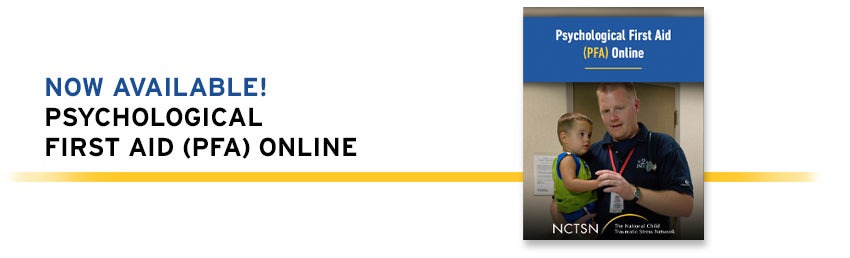
Now available! Psychological First Aid (PFA) ONLINE
Psychological First Aid (PFA) Online is a 5-hour interactive online course that helps participants learn the core actions of PFA and describes ways to apply them in different post-disaster scenarios and with different survivor needs. This course also covers provider well-being before, during, and after disasters. This course is relevant for new providers who are wanting to be oriented to PFA, as well as for seasoned practitioners who want a review of the PFA concepts.

National Child Traumatic Stress Network (NCTSN) 101
Provides information on what makes the NCTSN unique, and why in 2001 SAMHSA established the NCTSN in an effort to pull together expertise nationwide and create a mechanism for intentional collaboration to move scientific gains quickly into practice. This course will outline how the NCTSN was founded, the mission of the NCTSN, the impact the NCTSN has had since its inception, the different categories of centers, the essential components of the Network structure, and its governing bodies.
Want reminders for upcoming webinars? Sign up here!

UCLA Brief Screen for Trauma and PTSD available in Ukrainian
Behavioral Health Innovations, a leader in the evidence-based assessment of trauma and PTSD in children and adolescents, has made a Ukrainian translation of the UCLA Brief Screen for Trauma and PTSD available free of charge to support behavioral health services for children, adolescents, and their families severely traumatized by the war in Ukraine.

The National Native Child Trauma Center Mobile App
Offers information on providing trauma-focused healing for native children, families, and communities and on the impacts, prevention, and mitigation of childhood traumatic stress. The app also provides news, trainings, resources, webinars, videos, and other content.
RECENT JOURNAL PUBLICATIONS
Treatment Recommendations and Barriers to Care for Suicidal LGBTQ Youth: A Qualitiy Improvement Study written by Lucas Zullo, IIana Seager van Dyk, Elizabeth Ollen, Natalie Ramos, Joan Asarnow & Jeanne Miranda, elicits direct feedback from LGBTQ youth themselves to inform quality improvement of suicide-prevention care for this population. Lesbian, Gay, Bisexual, Transgender, and Queer or Questioning (LGBTQ) youth are at elevated risk for suicide. Despite this, there is limited information on how to optimize care for suicidal LGBTQ youth. Qualitative interviews were conducted with LGBTQ youth with a history of mental health treatment to identify treatment recommendations and barriers to care for this vulnerable population through the lens of a quality improvement approach. Individual qualitative interviews (n=20) and focus groups (n=21 participants) were conducted.
Authored by Lauren Alvis, Na Zhang, Irwin N. Sandler & Julie B. Kaplow, Developmental Manifestations of Grief in Children and Adolescents: Caregivers as Key Grief provide a brief overview of the childhood bereavement literature; review of the new DSM-5 and ICD-11 Prolonged Grief Disorder diagnostic criteria through a developmentally-informed lens. It also describes how grief reactions manifest in children and adolescents of different ages through the lenses of multidimensional grief theory and relational developmental systems theory; highlights key moderating factors that may influence grief in youth. Lastly, the article discusses a primary moderating factor, the caregiving environment, and the potential mechanisms through which caregivers influence children's grief.
Looking for Trainings?
Visit the NCTSN Training Page on LinkedIn
Not on our mailing list? Click here to sign up.
This project was funded by the Substance Abuse and Mental Health Services Administration (SAMHSA), US Department of Health and Human Services (HHS). The views, policies, and opinions expressed are those of the authors and do not necessarily reflect those of SAMHSA or HHS.


