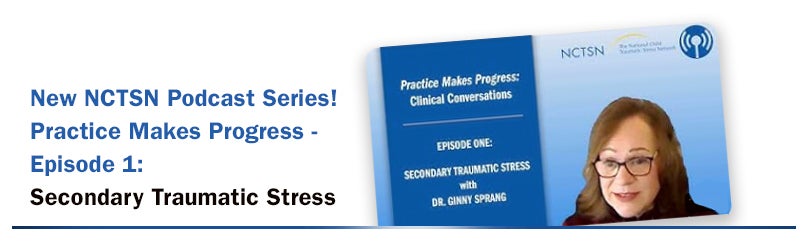
New NCTSN Podcast Series! Practice Makes Progress - Episode 1: Secondary Traumatic Stress
In each episode of Practice Makes Progress: Clinical Conversations, an NCTSN clinical expert joins National Center leadership for focused conversations on topics they've helped shape in the field. In this episode, NCTSN Affiliate Dr. Ginny Sprang and National Center Co-Director Dr. Lisa Amaya-Jackson discuss Secondary Traumatic Stress (STS). Includes ASL translation.

Now Available in Spanish! Disaster Birth Plan
Helps expectant parents and their care teams plan for labor and delivery during hurricanes or severe storms. This tool can be used to outline key contacts, medical details, and backup birth locations so you can stay informed, supported, and safe.
Now Available in Spanish! Hurricane Preparedness for New and Expectant Parents
Helps new and expectant parents prepare for hurricanes by outlining practical steps to protect their health, baby, and birth plan. It includes planning tools, safety tips, and emotional coping strategies to reduce stress before, during, and after a storm.
New Turkish Translations Available!
These new translations offer resources for caregivers and providers on helping children after a shooting.Parent Guidelines for Helping Youth After the Recent Shooting (in Turkish)
Psychological Impact of the Recent Shooting (in Turkish)
Talking to Children about the Shooting (in Turkish)
Tips for Parents on Media Coverage of a Shooting (in Turkish)
Hope in Action: Strengthening Trauma-Informed Suicide Prevention in Communities
In this panel discussion, teams from Los Angeles, Milwaukee, and New Orleans, who participated in a 12-month Change Collaborative, discuss promising approaches for improving a community’s suicide and prevention response system. They also discuss guidance on overcoming barriers, building relationships, and developing partnerships between community partners and care providers, and strategies that were tested to strengthen community- and clinic-based healing, connection, and wellbeing for youth, families, and communities most impacted by trauma and suicide.
Special Issue: Assessing and Treating Children and Adolescents Exposed to Trauma
This special issue of Child and Adolescent Psychiatric Clinics of North America, edited by Lisa Amaya-Jackson, Ruth S. Gerson, and Sarah Y. Vinson, is the first on child trauma, broadening the understanding of traumatic life experiences and far-reaching impacts on youth mental health at both individual and population levels. The focus on trauma rather than PTSD looks beyond a limited, singular diagnosis, placing important attention on the most preventable cause of mental illness. This special issue includes articles such as Trauma-Informed Systems of Care, Assessing Children and Adolescents Exposed to Trauma, Flipping the Script: Addressing Occupational Distress to Sustain Trauma-Informed Care, Behavioral Health Care for Children Exposed to Disaster, and more.
APA Policy Statement: Integrating Psychological Science Into Major Disaster Preparedness, Response, and Recovery and Advancing Disaster Behavioral Health Training and Response for Psychologists
The 2025 American Psychological Association (APA) president commissioned a Task Force on Disaster Preparedness, Response, and Recovery. This policy statement highlights the Task Force’s findings and proposes next steps for the APA to lead a national effort to strengthen disaster behavioral health capacity in the discipline.
Advisory: Peer Recovery Supports for Behavioral Health in Rural Communities
Rural America is facing a behavioral health crisis—marked by high rates of suicide, substance use, and limited access to care. Workforce shortages, transportation barriers, and stigma make it harder for individuals to get the help they need. This SAMHSA advisory highlights peer recovery support as a powerful, community-driven solution.
SMVF Spotlight: Month of the Military Child
SAMHSA’s Service Members, Veterans, and their Families Technical Assistance Center (SMVF TA Center), interviews Dr. Gregory Leskin, a licensed clinical psychologist who serves as Program Director for the National Child Traumatic Stress Network’s (NCTSN) Military and Veteran Families Program at the University of California, Los Angeles-Duke University National Center for Child Traumatic Stress. In this interview, Dr. Leskin reflects on what we’ve learned about childhood trauma, provides guidance for programs and individuals working with military children, and uplifts a wealth of resources for supporting SMVF.
RECENT JOURNAL PUBLICATIONS
Qualitative Analysis of Caregiver Experiences with a Child-Focused Intervention: Trauma-Informed Parenting Skills for Resource Parents (TIPS 4 RP), authored by Adrienne Whitt-Woosley, Ginny Sprang, and Stephanie Gusler, is a qualitative feasibility and acceptability study that follows-up a quantitative pilot study. It utilizes framework analysis to examine 24 caregiver responses to a trauma-focused intervention model, Trauma Informed Parenting Skills for Resource Parents (TIPS 4 RP). Foster care systems in the United States are overwhelmed by demands for care of children who have experienced significant histories of complex trauma. Caregivers to these children are increasingly in need of intervention to support them with their efforts to promote stability and trauma-recovery for children and adolescents impacted by maltreatment. This intervention is for resource parents of children with moderate to severe trauma experiences. Study findings build upon pilot data to establish the feasibility, acceptability, and preliminary effectiveness of the TIPS 4 RP intervention, yet identified a number of difficulties with adherence to the data collection process and opportunities for improvement in the emphasis of program components. Recommendations for implementation modifications are provided.
Looking for Trainings?
Visit the NCTSN Training Page on LinkedIn
Not on our mailing list? Click here to sign up.
This project was funded by the Substance Abuse and Mental Health Services Administration (SAMHSA), US Department of Health and Human Services (HHS). The views, policies, and opinions expressed are those of the authors and do not necessarily reflect those of SAMHSA or HHS.