


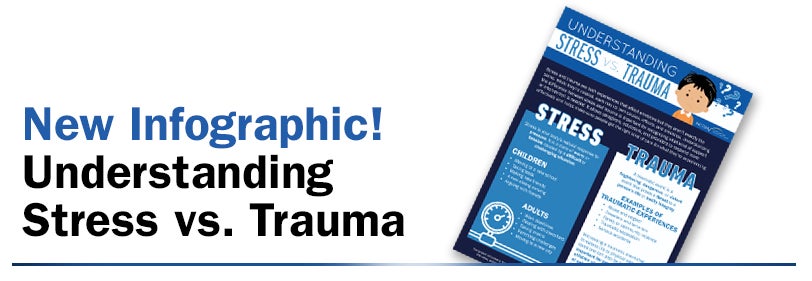
New Infographic! Understanding Stress vs. Trauma
The first infographic in the new NCTSN Trauma Fundamentals series highlights the differences between stress and trauma by explaining their unique causes, effects, and timelines, helping caregivers, educators, and providers respond with the appropriate support.


Video Series: Supporting Military Children and Families
This short video series offers guidance for military families, caregivers, and providers supporting military families.


Reducing Secondary Traumatic Stress: Skills for Sustaining a Career in the Helping Professions
The second edition of Reducing Secondary Traumatic Stress expands the five evidence-informed CE-CERT practices for supporting emotional well-being in workers exposed to the effects of secondary trauma. This edition adds new insights, additional research support, and fresh examples, with a readable, conversational tone.

Roadmap for Change Podcast
Roadmap for Change offers inspiration, evidence, and guidance for transformation of the juvenile justice system. Through the voices of youth and their families, this podcast explores the changes they believe would truly support healing and growth. Alongside, experts share the latest insights on trauma-informed practices, along with actionable strategies to implement them.

RECENT JOURNAL PUBLICATIONS
Posttraumatic Stress in Infancy: The Roles of Cumulative Trauma and Caregiving Context, authored by Ann T. Chu, Melissa H. Bond, Belén Rogowski, Nicole V. Leba, Chandra Ghosh Ippen, Alagia Cirolia, and Alicia F. Lieberman, investigates the responses of infants aged 3–18 months after exposure to a range of traumatic events. Infants are exposed to traumatic events at higher rates than older children, potentially leading to posttraumatic stress symptoms. Despite this higher prevalence, posttraumatic stress responses in infancy have not been well researched due to conceptual, developmental, and methodological challenges. Caregivers reported on their infants’ trauma exposure and posttraumatic stress symptoms using the UCLA PTSD Reaction Index for DSM-5 for Children Age 6 and Younger and reported on their own posttraumatic symptoms on the PTSD Diagnostic Scale for DSM-5 (PDS-5). Of 116 racially and ethnically diverse infants, 96 (82.8%) were exposed to at least one traumatic event (M = 1.6; SD = 1.2; range = 0–7). Infant trauma exposure and caregiver symptoms were significant predictors of the number and severity of caregiver-endorsed infant symptoms. These findings indicate that infants as young as 3 months of age may manifest posttraumatic stress symptoms after trauma exposure. Developmental context and caregiver functioning should be considered when assessing for posttraumatic stress symptoms in infants.

An Investigation of Burnout and Secondary Traumatic Stress Over Time in School Personnel Involved in a Trauma-Informed Initiative, authored by Ginny Sprang, Antonio Garcia, Audrey Schnell, Shelby Clark, and Caitlin Lau, investigates the role that individual, leadership and organizational characteristics play in producing potential changes in burnout and secondary trauma in K -12 school personnel from baseline to post trauma informed care initiative. Indirect exposure to trauma can negatively impact the well-being of school personnel and students. In this study, data from the Professional Quality of Life-5 (ProQOL-5), the STS Scale (STSS) and the STS Informed Organizational Assessment (STSI-OA) was collected from 205 school personnel (e.g. teachers, counselors, school leaders and other staff) at two time points. General Linear Mixed Modeling indicates that mean scores on measures improved over time. Participants with lower STSS arousal showed an increase in burnout over time while participants with high levels of STSS arousal showed a decrease. The findings highlight the relationship between constructs and that leadership efforts can be harnessed to improve well-being in school personnel.
Looking for Trainings?
Visit the NCTSN Training Page on LinkedIn
Not on our mailing list? Click here to sign up.
This project was funded by the Substance Abuse and Mental Health Services Administration (SAMHSA), US Department of Health and Human Services (HHS). The views, policies, and opinions expressed are those of the authors and do not necessarily reflect those of SAMHSA or HHS.


