


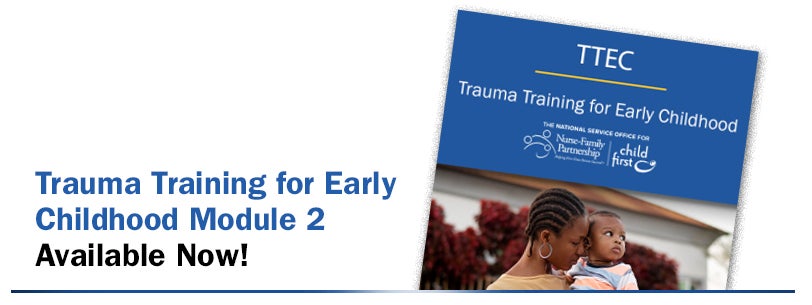
Trauma Training for Early Childhood Module 2 Available Now!
This module - Attachment, Development, and Trauma in Early Childhood - focuses on defining attachment as well as the purpose it serves. It explains how attachment relates to development. It also defines trauma, categories of trauma, and frequency or incidences of trauma; explores the effects of trauma exposure on the body and mind, as well as risk and resilience factors related to experiences of trauma and stress as well as explores how trauma impacts a child’s development, how attachment impacts a child’s experience of trauma and clarifies the relationship between trauma and attachment and discusses behaviors that suggest a child has been exposed to or impacted by trauma. And so much more!


NCTSN Responses to Disasters: July 2017 to September 2021
Provides information about the NCTSN Response activities from July 2017 to September 2021. This infographic includes how many and the types of responses the Network was involved in, what resources were shared, how many people were trained, how the Network partnered, and how the NCTSN brought awareness to those experiencing disasters.


Trauma-Informed & Affirming Checklist for Practice with LGBTQ+ Children, Youth & Families
From Inform Transform, this Trauma-Informed & Affirming Checklist shares best practices for safely engaging and supporting LGBTQ+ youth, children, and families in mental health settings.
Center of Excellence on Social Media & Youth Mental Health: Research-Based Tips from Pediatricians for Families
SAMHSA’s Center of Excellence on Social Media & Youth Mental Health has some research-based tips from pediatricians to help children and families build healthy digital habits that can make a big difference.

Resilience Research Group: Resilience in Grief and Bereavement
In this podcast from The Resilience Research Group and University College London, Chris Layne (Nova Southeastern University) discusses the topic of resilience in grief and bereavement.

Applied Frameworks: Integrating Social-Emotional Perspectives in Learning Experience Design
In this keynote presentation at the e-Learning Consortium of Colorado, Dr. Hannah M. Grossman discusses the practical application of social-emotional perspectives in learning experience design. Focusing on three key frameworks – SAMHSA Trauma-Informed Approaches, the Integrative Trauma and Healing Framework, and the Radical Healing Framework – Dr. Grossman illustrates how these frameworks inform the creation of experiential learning situations that are trauma-informed and healing-centered.

RECENT JOURNAL PUBLICATIONS
The Relationship Between Secondary Traumatic Stress and Compassion Satisfaction: A Systematic Literature Review, authored by Ginny Sprang, Stephanie Gusler, Jessica Eslinger, and Ruth Gottfried, examines the relationship between secondary traumatic stress (STS) and compassion satisfaction (CS) to identify the state of the science and directions for future research. Eight academic databases were systematically searched between July and December of 2022 to identify articles and dissertations published in English or Hebrew between 2000 and 2022. Findings of this review suggest experiences of high levels of STS can coexist with high levels of CS indicating that people can gain satisfaction from their work and experience STS. Most studies examined the relationship between STS and CS using bivariate analyses with variability found in the direction of the relationship. This variability was also found in multivariate studies included in this review. These findings suggest the need for interventions to address both STS and CS with attention paid to the potential negative impact of emotional contagion and the vulnerability of younger female practitioners. Future research should pay attention to the rigor of the analysis of STS and CS and the exploration of mediating or moderating mechanisms between these constructs.

Screening for and Responding to Suicidality Among Youth Presenting to a Children’s Advocacy Center (CAC), authored by Lindsay D. Shepard, Kristine A. Campbell, Kara A. Byrne, Brian Thorn, and Brooks R. Keeshin, describes the prevalence of suicidality among youth seen in CACs for a forensic interview, including demographic and clinical characteristics associated with increased risk of suicidality. Youth presenting to a Children’s Advocacy Center (CAC) for a forensic interview are at increased risk for suicidality, but no data exist for suicidality or suicide screening and response at the time of the forensic interview. The current study applied a suicide and traumatic stress screening and response protocol, the Care Process Model for Pediatric Traumatic Stress (CPM-PTS), with youth (11–18 years) presenting for a forensic interview to one of 16 participating CAC locations, 2018–2020. 46.2% of youth screened for traumatic stress and suicidality (N = 1651) endorsed thoughts of suicide or self-harm in the past two weeks, and 13.6% were assessed as high risk for suicide. High symptoms of traumatic stress increased the risk of suicidal thinking as well as of high risk suicidality. CAC workers, both clinicians and non-clinicians, facilitated screening and provided prevention response. Suicide screening and response at the CAC at the time of the forensic interview appears important and feasible.
Looking for Trainings?
Visit the NCTSN Training Page on LinkedIn
Not on our mailing list? Click here to sign up.
This project was funded by the Substance Abuse and Mental Health Services Administration (SAMHSA), US Department of Health and Human Services (HHS). The views, policies, and opinions expressed are those of the authors and do not necessarily reflect those of SAMHSA or HHS.


