


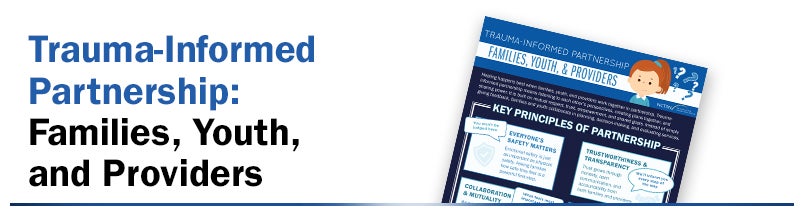
Trauma-Informed Partnership: Families, Youth, and Providers
Highlights how healing is strengthened through trauma-informed partnerships between families, youth, and providers. Outlines key principles like trust, collaboration, empowerment, and shared decision-making to support meaningful, respectful care.


MHub: New Learning Platform from NCA Institute for Better Mental Health Outcomes
The NCA (National Children’s Alliance) Institute for Better Mental Health Outcomes is pleased to announce the launch of the new learning platform, MHub. Through this platform, the Institute offers high quality training in evidence based practices for victim advocates—covering mental health screenings and strategies for engaging caregivers in mental health services—as well as training for clinicians in Trauma-Focused Cognitive Behavioral Therapy (TF-CBT), advanced TF-CBT training topics, Child and Family Traumatic Stress Intervention (CFTSI), Evidence-Based Assessments, and more. Create a free account to receive notifications when new training opportunities are added.


I Remember You: Helping Children Think About People Who Aren’t Present
Supporting children in expressing feelings about meaningful people who come in and out of their lives. This children’s book, written by Christine Lin & Elizabeth Waldrum, helps young children address complex emotions about people they may not be able to spend time with.
Coping After Trauma – Understanding Child Trauma with Rio May del Rosario
Most military families adjust well to the challenges that accompany military life. Although military children are raised in a culture of strength and resiliency, military families may experience mental health issues or challenges due to traumatic events and unique stressors. This webinar created in partnership with the Military Child Education Coalition (MCEC), includes essential information to address these specific issues. It also provides ways to help your military child(ren) cope with military-related stressors, traumas, and losses. Access webinar Part 1 and Part 2.
MCEC Podcast: Talking with Children about Trauma
In partnership with the Military Child Education Coalition (MCEC), Dr. Gregory Leskin, Rio May del Rosario, and Irene Ohsaka discuss trauma events, child traumatic stress, and what support looks like after experiencing trauma.
RECENT JOURNAL PUBLICATIONS
The See It to Stop It Indicator Tool to Identify Child Sex Trafficking: Acceptability, Feasibility, Utility, and Outcomes, authored by Ginny Sprang, Ann L. Coker, Annelise Mennicke, Candace Brancato, Colleen M. Ray, and Evelyn Thorne, describes the development, feasibility, acceptability, utility, and outcomes of the See It to Stop It Indicator (SITSII) tool for middle school staff (MSS), developed as part of a Cluster Randomized Control Trial of a bystander intervention, to prevent child sex trafficking (CST) in students. Adolescents involved in sex trafficking may not engage in help-seeking behavior due to fear, stigma, and lack of awareness about available resources. Likewise, professionals interacting with these youth may have little guidance on how to identify risk or respond when trafficking concerns are detected. The SITSII contains 17 items categorized into three tiers of concern (Probable Concern Tier 3; Potential Concern Tier 2; Emerging Concern Tier 1) that map onto bystander actions based on a risk stratification model. Mixed-method data from 63 MSS were analyzed to determine screening outcomes, intentions to act, barriers to action, and assessments of feasibility, acceptability, and utility. Outcomes indicate that running away (Tier 3) and truancy (Tier 2), followed by a history of child maltreatment (Tier 2), were the most prevalent student behaviors, while 21% had no identifiable risk factors. This suggests a lack of bias toward over- or under-identification. Users rated the acceptability and utility of the tool favorably, and 91.5% endorsed confidence in taking the recommended bystander actions. The SITSII establishes a continuum of risk factors for CST that map onto actionable items. There is evidence of successful SITSII implementation as well as enhanced confidence in intent-to-act to protect identified students.
A Multi-Site Consortium on Familial Sex Trafficking Prevention: A Brief Report on Lessons Learned and Future Directions, authored by Ginny Sprang, Annelise Mennicke, Colleen M. Ray, Emily R. Clear, and Ann L. Coker, harnessed the collective experience and expertise of a multidisciplinary group of scholars to inform and advance the research agenda of the field. In May 2025, an in-person multi-site consortium of 28 scholars was convened to focus on child sex trafficking (CST) prevention broadly, and familial sex trafficking (FST) specifically. The scientific study of the trafficking of children by family members is rapidly emerging, necessitating the evaluation of current knowledge and setting the agenda for the next decade of research for this form of family violence. For discussions regarding key findings, gaps in knowledge, innovations from other fields that can be applied to the prevention of family violence, and action planning, attendees worked in small teams with a facilitator and reported out their recommendations and observations to the larger group. Two scribes made a written record of these remarks, which was synthesized by a coauthor. Polling via REDCap was used to capture the larger group sentiment during discussions regarding recommendations for future action and key takeaways. This brief report outlines the outcomes of these deliberations as gaps, recommendations, and innovations from other fields that could be applied to improve research in FST. Research on FST requires a trauma-informed, developmental lens as well as specific tailoring to address vulnerable groups. The approach should be multifaceted, building incrementally from innovations in other fields.
Looking for Trainings?
Visit the NCTSN Training Page on LinkedIn
Not on our mailing list? Click here to sign up.
This project was funded by the Substance Abuse and Mental Health Services Administration (SAMHSA), US Department of Health and Human Services (HHS). The views, policies, and opinions expressed are those of the authors and do not necessarily reflect those of SAMHSA or HHS.


