


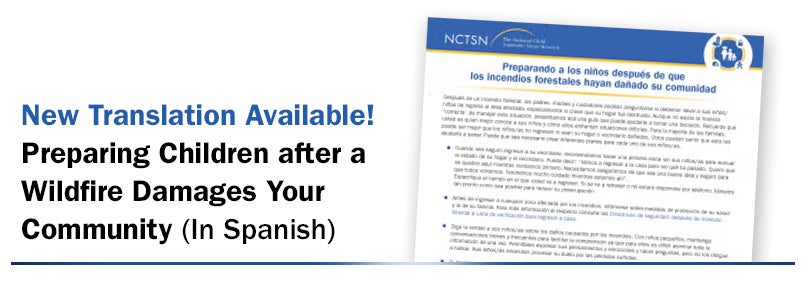
New Translation Available! Preparing Children after a Wildfire Damages Your Community (In Spanish)
Offers guidance to parents and caregivers on deciding whether or not a child should return to their home or neighborhood after it was damaged in a wildfire. Now available in Spanish.


Start Your Recovery
StartYourRecovery.org provides helpful information for people who are dealing with substance use issues —their family members, friends, and co-workers, too. This website offers people who are dealing with substance use challenges a single source of reputable, objective information about signs, symptoms, conditions, treatment options, and resources — presented in a user-friendly format and in language that’s easy to understand.


Creating and Sustaining Youth Advisory Boards (YABs): A Toolkit for Health and Human Services
This toolkit is designed to assist organizations in developing and sustaining Youth Advisory Boards (YABs) for youth and young adults (ages 14-30). This toolkit is designed and tested to be adaptable to the unique population your organization serves. By incorporating young adult expertise into the design and delivery of mental health services, these boards ensure services are more relevant and accessible to young adults.

Babies on the Homefront App
Babies on the Homefront provides military and veteran parents ideas for enhancing everyday moments with their baby or toddler. Parents will find lots of material to add to their toolbox of strategies, including behavior tips, fun and soothing activities, self-care ideas, information on child development, and private messaging with your co-parent to share your family’s experiences.
RECENT JOURNAL PUBLICATIONS
The Trauma of Bullying: Evaluating the Impact of a Trauma-Informed Therapeutic Intervention to Support Children Who Have Been Chronically Bullied in School, authored by Nathalie Noret, Husna Hejazi, Katelynn Wilson, Paula Timms, Kat Fuller, and Yvette Lambe, examines the traumatic impact of being chronically bullied in school and evaluates the use of a pilot trauma-informed therapeutic intervention. The poor mental health outcomes associated with being bullied in school are well documented in the research literature. Trauma-informed approaches offer one possible avenue of support. In this study, 18 parents in England whose child was receiving a new bullying-focused trauma-informed therapy completed an online questionnaire about their child’s experiences of bullying and their trauma symptoms. Their children were aged between 8 and 16 years old, 9 (50%) young people were male, and 9 (50%) were female. The questionnaire was completed before and after the 12-week therapeutic intervention. The findings of the study highlight the negative impact being bullied has on poor mental health, particularly on symptoms of trauma. The results of the small-scale evaluation also highlight how the trauma-informed therapeutic intervention reduced symptoms of trauma and supported children and young people to cope with their experiences of bullying. While a pilot study, the findings offer a potential avenue for helping young people being chronically bullied in school.
A Hospital and Community-Based Violence Intervention Program for Black & Latino Youth and Their Caregivers, authored by Arturo Zinny, Judith A Cohen, Randall L Sell, Edward Gracely, John A Rich, and Theodore J Corbin, describes the experiences of 50 children and adolescents (ages 8–18) who participated in a hospital and community-based violence intervention program in Philadelphia that pilot tested the integration of home and community-based Trauma-Focused Cognitive Behavioral Therapy (TF-CBT) with peer services and case management for youth impacted by community violence. This study describes the implementation of this intervention. Mental health research is needed to evaluate how to engage Black and Latino youth in mental health services and provide effective and relevant trauma treatment. Services delivered consisted of the integration of Trauma-Focused Cognitive Behavioral Therapy (TF-CBT) with peer services and case management for youth impacted by community violence. Services were provided by licensed social workers and certified peer specialists at a hospital and community-based (i.e., youth’s home, school) violence intervention program (HVIP). The results of this study indicate that this intervention shows preliminary efficacy for decreasing post-traumatic stress disorder (PTSD) and depression symptoms for Black & Latino youth.
Looking for Trainings?
Visit the NCTSN Training Page on LinkedIn
Not on our mailing list? Click here to sign up.
This project was funded by the Substance Abuse and Mental Health Services Administration (SAMHSA), US Department of Health and Human Services (HHS). The views, policies, and opinions expressed are those of the authors and do not necessarily reflect those of SAMHSA or HHS.


