



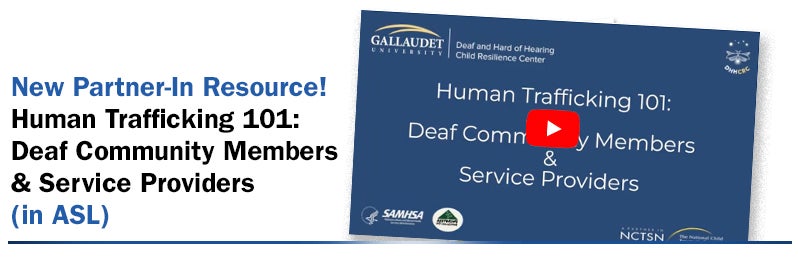
New Partner-In Resource! Human Trafficking 101: Deaf Community Members & Service Providers (in ASL)
Discusses what human trafficking is, signs a person might be experiencing trafficking, what to do when you think someone is being trafficked and more. This video is a partner-in resource with Gallaudet University.

APA Policy Statement on Affirming Evidence-Based Inclusive Care for Transgender, Gender Diverse, and Nonbinary Individuals, Addressing Misinformation, and the Role of Psychological Practice and Science
The American Psychological Association approved a historic new policy statement in February 2024 expressing the APA’s support for access to evidence-based gender affirming care for transgender, gender diverse, and nonbinary people, including children and adolescents. The policy, which was passed 153-9, affirms gender affirming care as medically necessary and represents a major consensus among leading psychologists on the evidence base and importance of this care. The policy also warns of the negative impacts on the mental health of transgender, gender diverse, and nonbinary youth caused by the spread of false information and obstructions to care. Through the approval of this policy, the APA is urging mental health systems and providers to preserve and expand access to gender affirming care as best practice. Comprehensive, evidence based, inclusive care for transgender, gender diverse, and nonbinary youth is life-saving care that positively impacts the mental health and wellness of young people.Prepare with Pedro: An Adventure in Emergency Preparedness Game
As a companion to the popular publication Prepare with Pedro: Disaster Preparedness Activity Book, FEMA and American Red Cross partnered to create a new game “Prepare with Pedro: An Adventure in Emergency Preparedness” and “Super-Prepared Penguin Expansion Pack.” Children can play this fun game on their own, with a friend, with a grown-up or at school! As they play, they will learn how to identify different disasters, including disasters in their area, and how to prepare before and stay safe during a disaster.
Vital Signs: Health Care Access for Deaf, DeafBlind, and Hard of Hearing Patients
This is a tool to teach healthcare providers how to effectively work with diverse Deaf patients via a series of clinical scenarios and narration by Deaf professionals. The clinical scenarios were designed based on real-life experiences of Deaf people in the healthcare system.
Children with Sexual Behavior Problems (2nd Edition)
From the Association for the Treatment and Prevention of Sexual Abuse (ATSA), this publication represents an update to the 2006 Report of the ATSA Task Force on Children with Sexual Behavior Problems. Pertinent information from the 2006 report has been integrated into this report, along with the results of more recent research conducted and information learned.
RECENT JOURNAL PUBLICATIONS
Forced Displacement, authored by Hopewell Hodges and Saida Abdi, explores how the stressors of forced displacement impact adolescents and provides steps that adults in resettlement societies can take to support positive development for forcibly displaced youth and their families. Forced displacement results from complex and intersecting risks, such as armed conflict, climate crises, and economic downturns. Globally, most of those who are forced to flee their homes are children. The stressors of forced displacement—which include adversities before, during, and after the migration process—impact adolescents both directly and indirectly, through disturbance in the physical and social environments around them. Importantly, though, most adolescents exposed to forced displacement go on to do fairly well in life and function in their communities. Steps that adults in resettlement societies can take to support this positive development includes identifying and reducing the risks they face before, during, and after resettlement; promoting helpful resources in their environments; and fueling powerful adaptive systems that can support positive development for years into the future. These resources are likely to be maximally acceptable and effective when they are carefully tailored to families’ developmental, cultural, and contextual needs.
Utilizing Screening as a Trauma-Responsive Approach in Pediatric Health Care Settings, authored by Shannon D. Chaplo, Lindsay D. Shepard Abdulahad, and Brooks R. Keeshin, discusses the importance of pediatric physicians adopting trauma-informed care. The paper explores how the use of evidence-based screening practices in pediatric settings is a trauma-responsive approach with great potential for meeting unmet needs among trauma-exposed children and families. Given the widespread impact of child trauma, it is important that child- and family-serving systems adopt trauma-informed care. Because of their integral relationships with families, pediatricians and family medicine physicians play critical roles in disrupting negative societal and developmental cascades for trauma-exposed youth through their potential for early identification and intervention. When implemented alongside organization-wide trauma-informed care practices, trauma screening is one concrete trauma-informed care practice that has shown both feasibility and positive impacts on pediatric healthcare. In support of this practice, the Care Process Model for Pediatric Traumatic Stress (CPM-PTS) helps pediatric care providers to identify and respond to children and adolescents who may need trauma-focused supports.





Looking for Trainings?
Visit the NCTSN Training Page on LinkedIn
Not on our mailing list? Click here to sign up.
This project was funded by the Substance Abuse and Mental Health Services Administration (SAMHSA), US Department of Health and Human Services (HHS). The views, policies, and opinions expressed are those of the authors and do not necessarily reflect those of SAMHSA or HHS.


