


What Is Trauma-Informed Care?
Introduces trauma-informed care and explains how recognizing the impact of trauma helps create safe, supportive environments for children, families, and providers. Highlights key elements like screening, cultural responsiveness, and strong family-youth-provider partnerships that promote healing and resilience.
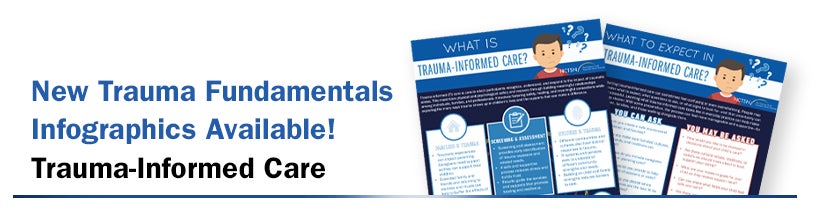


What to Expect in Trauma-Informed Care
Helps families understand what trauma-informed care looks like in practice and supports caregivers in preparing for conversations that center safety, collaboration, and their child’s strengths.

Trauma-Informed and Culturally Responsive Practices in Schools: Building a Climate of Compassion
In order to succeed in school, students fundamentally need to feel safe and connected—particularly when chronic stress at home, in the community, or at school makes it difficult to learn. This book, authored by Dr. Isaiah B. Pickens, explains practical ways to infuse schools with trauma-informed and culturally responsive (TICR) practices that can foster compassionate relationships, promote the well-being of students and educators alike, and unlock students’ academic and social–emotional potential.

The Role of Certified Community Behavioral Health Clinics in Improving Outcomes for Children and Families Using the System of Care Approach
This brief, developed by the Center for Health Care Strategies in partnership with the National Training & Technical Assistance Center for Child, Youth, & Family Mental Health (NTTAC) and the Center for Applied Research Solutions, outlines how Certified Community Behavioral Health Clinics (CCBHCs) can support children’s behavioral health services within a System of Care (SOC) framework and provides recommendations for policymakers and community providers on aligning CCBHC certification criteria with SOC values and principles.
Before, During and After: Rethinking Crisis Response with Ben Fernandez
In this episode of The Sound Off on School Safety, a podcast from Safe and Sound Schools, Michele Gay and Ben Fernandez unpack the before, during, and after of crisis intervention: how schools can strengthen psychological safety, prepare multidisciplinary teams, and understand the evolving needs of today’s students. Ben shares what he’s learned from decades of leading crisis teams, empowering school-based responders, and helping districts navigate some of their hardest days. Together, they explore what it really takes to support students, staff, and families through acute events — and how communities can build systems that care for the people who care for others.
RECENT JOURNAL PUBLICATIONS
Providers' Perceptions of Trauma-Focused EBT/EBP Implementation Fidelity: Implementation Process and Individual Influences, authored by Stephanie Gusler, Ginny Sprang, Jessica Eslinger, and Adrienne Whitt, used the Consolidated Framework for Implementation Research (CFIR) to examine implementation process and individual characteristics, as well as interactions among these factors in impacting provider's perceptions of implementation fidelity. Implementation fidelity is the extent to which an intervention is delivered in the manner in which it was designed. Within randomized-controlled trials (RCTs), fidelity is often rigorously ensured through strategies out of reach for most organizations. This limitation may be of particular concern for trauma-focused evidence-based treatments/evidence-based practices (EBT/EBPs), as the needs of individuals and families seeking trauma-based treatment are often complex, with existing comorbidities that can complicate recovery. Data came from 598 primarily child serving mental health providers, who completed an online survey regarding provider demographics, perceptions of personal effectiveness, work experiences such as secondary traumatic stress (STS) and compassion satisfaction, and organizational implementation strategies used for a trauma-focused EBT/EBP. Significant positive associations were found between perceptions of implementation fidelity and compassion satisfaction, implementation strategy use, and personal effectiveness. Further, STS was significantly negatively associated with implementation fidelity. Significant differences were found based on population served and use of consultation calls and in-person supervision. Within a regression model, a significant two-way interaction between STS and implementation strategy use was significant, along with a three-way interaction between STS, implementations strategy use, and personal effectiveness. This study advances our understanding of how fidelity is created, maintained and understood in implementation settings that provide EBT/EBPs to individuals exposed to trauma.
Trauma and Mental Health: Examining Psychosocial Changes for Latin American Immigrant Mothers and Young Children Participating in Child–Parent Psychotherapy, authored by Ruth Paris, Mihoko Maru, Yibin Yang, and Karen Garber, aimed to assess clinical outcomes of trauma-focused child–parent psychotherapy (CPP) for Latin American immigrant mothers with young children living in the northeastern United States. Latin American immigrant families with young children may endure traumas in home countries and throughout their journey to the United States. Current evidence suggests that unresolved traumas adversely affect both parents and children in relation to parenting capacities, positive relationships, and healthy child development, necessitating culturally responsive interventions. In this study, eighty-three parent–child dyads participated in the community-based intervention and baseline evaluation. Participants enrolled in an application of CPP that addressed child trauma and development, parental trauma symptoms, and enhancing parent–child relationships. Fifty-five parents completed pre- and post-assessments concerning both parental and child outcomes. We conducted paired t tests to assess changes in outcomes between pre- and postintervention among participants and applied repeated-measures linear effects models to examine whether changes in outcomes varied by participants’ baseline posttraumatic stress disorder risk. Results from paired t test demonstrated significant decrease in maternal mental health symptoms and trauma-related stress, as well as improvements in parental reflective functioning, family protective factors, and child socioemotional development. Subgroup analysis based on posttraumatic stress disorder risk groups suggested that participants who were at risk for posttraumatic stress disorder showed greater improvements in psychosocial outcomes and parenting capacities, in contrast to their counterparts. Results from this study indicate the feasibility and efficacy of an application of CPP for Latin American immigrant families with young children. Future research is needed to better understand the implementation of interventions to support mental health and parenting for immigrant populations.
Looking for Trainings?
Visit the NCTSN Training Page on LinkedIn
Not on our mailing list? Click here to sign up.
This project was funded by the Substance Abuse and Mental Health Services Administration (SAMHSA), US Department of Health and Human Services (HHS). The views, policies, and opinions expressed are those of the authors and do not necessarily reflect those of SAMHSA or HHS.


