


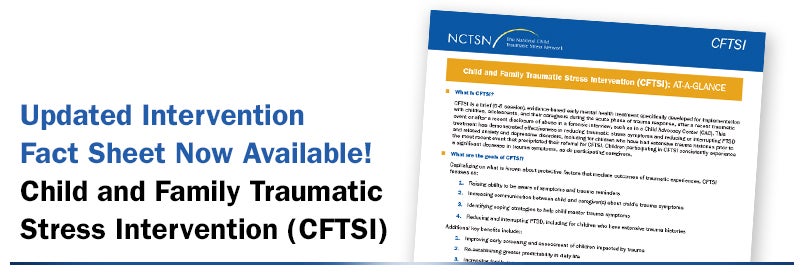
Updated Intervention Fact Sheet Now Available! Child and Family Traumatic Stress Intervention (CFTSI)
CFTSI is an evidence-based early mental health treatment specifically developed for implementation with children, adolescents, and their caregivers during the acute phase of trauma response or after a recent traumatic event. The new format for this fact sheet includes information about the model, its evidence, adaptability and accessibility, and providing, supervising, training, and sustaining the model.


2024 Virtual Summit: Fundamentals of Mass Violence Preparedness, Response, Recovery, and Resilience
This virtual summit to learn evidence-based fundamentals of mass violence preparation, response, recovery, and resilience was sponsored by the National Mass Violence Center and the National Center for Victims of Crime. You’ll hear the power of the personal stories of survivors; lessons learned from civic, community and state leaders who’ve experienced the devastation of a mass violence incident; and practical tips to collaborate and create effective mass violence plans that are survivor-centered and address the behavioral and mental health needs of victims and communities


Mental Health in Rural Communities Toolkit
The toolkit compiles evidence-based and promising models and resources to support organizations implementing mental health programs in rural communities across the United States. The modules in the toolkit contain resources and information focused on developing, implementing, evaluating, and sustaining rural mental health programs.

Improving Supports for Male Survivors of Sexual Exploitation
Youth who have experienced, or are currently experiencing, commercial sexual exploitation endure intense and complex trauma, with many encountering untold challenges in getting the support they need. For boys and young men, sexual exploitation and trafficking has long been underrecognized and underreported. This guide from the National Center for Youth Law seeks to help service providers better identify boys and young men and help them recover and prosper.
RECENT JOURNAL PUBLICATIONS
The Impact of Trauma and How to Intervene: a Narrative Review of Psychotraumatology Over the Past 15 Years, authored by Miranda Olff, Irma Hein, Ananda B Amstadter, Cherie Armour, Marianne Skogbrott Birkeland, Eric Bui, Marylene Cloitre, Anke Ehlers, Julian D Ford, Talya Greene, Maj Hansen, Nathaniel G Harnett, Debra Kaminer, Catrin Lewis, Alessandra Minelli, Barbara Niles, Nicole R Nugent, Neil Roberts, Matthew Price, Anthony N Reffi, Soraya Seedat, Antonia V Seligowski, and Anka A Vujanovic, reviews the past 15-year years of research on trauma exposure and its consequences, as well as developments in (early) psychological, pharmacological and complementary interventions. Globally, the majority of people experience stressful events that may be characterized as traumatic. However, definitions of what is traumatic are not necessarily straightforward or universal. Traumatic events may have a wide range of transdiagnostic mental and physical health consequences, not limited to posttraumatic stress disorder (PTSD). Research on genetic, molecular, and neurobiological influences show promise for further understanding underlying risk and resilience for trauma-related consequences. Early interventions have the potential to prevent acute posttraumatic stress reactions from escalating to a PTSD diagnosis whether delivered in the golden hours or weeks after trauma. However, research on prevention is still scarce compared to treatment research where several evidence-based psychological, pharmacological and complementary/integrative interventions exist, and novel forms of delivery have become available. Here, this review focuses on how best to address the range of negative health outcomes following trauma, how to serve individuals across the age spectrum, including the very young and old. It concludes with providing directions for future research aimed at improving the well-being of all people impacted by trauma around the world. The 15 years EJPT webinar provides a 90-minute summary of this paper and can be downloaded here [http://bit.ly/4jdtx6k].
Looking for Trainings?
Visit the NCTSN Training Page on LinkedIn
Not on our mailing list? Click here to sign up.
This project was funded by the Substance Abuse and Mental Health Services Administration (SAMHSA), US Department of Health and Human Services (HHS). The views, policies, and opinions expressed are those of the authors and do not necessarily reflect those of SAMHSA or HHS.


