


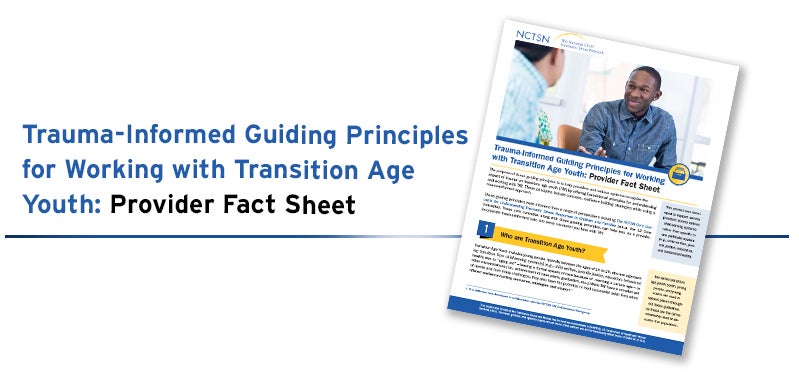
Trauma-Informed Guiding Principles for Working with Transition Age Youth: Provider Fact Sheet
Offers information for providers supporting transition age youth with trauma-informed guiding principles to inform their work. This fact sheet describes transition age youth and their unique experiences and six trauma-informed guiding principles to better support youth in their journey and recovery.


Being Culturally and Trauma-Informed While Assisting Displaced Afghan Families
Offers providers guidance on being culturally- and trauma-informed while assisting displaced Afghan families. This tip sheet provides ways to build connection and trust, help maintain and strengthen family relationships, and align the work with child and family goals while using a strength-based approach. It also includes several practical strategies to keep in mind while assisting displaced Afghan families.
The Rhythm Is My Blanket
Viewers meet Fareed Rogers, a 17-year-old patient at a psychiatric hospital, who has a history of violent behavior. Dr. Samuels, a child and adolescent psychiatrist with expertise in violence and trauma, has been brought in to evaluate Fareed and determine if he should be transferred to a high risk unit for adults. Excerpts from this session will be shared in an audio format, followed by a panel discussion of experts, another audio expert, and a final round table discussion that includes audience questions.


New Game for Families! Fam-Lingo
Created by the Center for Strengthening Family Coping Resources, Fam-Lingo is an interactive family board game designed to create moments of learning and laughter between families. This game can be played with one’s own family, gifted to families, or bought for any therapeutic setting in order to inspire connection and closeness.

Cognitive Behavioral Intervention for Trauma in Schools (CBITS) for American Indian Youth
Weaves in culturally appropriate and meaningful concepts about resilience and healing while maintaining CBITS' core cognitive-behavioral skill-building techniques. In this new adaptation, a team of experts convened by the University of Montana adapted the CBITS program for American Indian youth.

Toolkit: Supporting Afghan Students in Schools & Youth Programs in the United States
Helps educators develop a well-rounded understanding of the circumstances of newly arrived Afghan students and their families, including the challenges they may face as they seek to adapt to the American education system. This toolkit also includes core considerations for working with Afghan students and their families along with skills and strategies educators may find helpful.

RECENT JOURNAL PUBLICATIONS
Examining Housing Instability Among Females Who Are System-Involved: Comparing Females with and Without Histories of Commercial Sexual Exploitation written by Carly B. Dierkhising, Andrea L. Eastman, & Kate Walker Brown, highlights the extremely unstable living situations for females with histories of child sexual exploitation recommendations align with new federal policy, which aims to reduce reliance on group homes.

Authored by Adrienne Whitt-Woosley, Ginny Sprang, & Jessica Eslinger, Foster Care during the COVID-19 Ppandemic: A Qualitative Analysis of Caregiver and Professional Experiences addresses how professionals and caregivers in foster care described being affected by COVID-19 in order to support future research and planning for foster care systems in this pandemic context. The coding process resulted in the identification of 15 distinct themes: Isolation & Loss of Social Support, Work Changes/Stressors, School Issues, Childcare Issues, No Impact/Positive Changes, Financial Problems, Fear of Contagion, Negative Child Welfare Impacts, Mental Health Problems/Stress, Loss of Faith/Trust & Societal Frustrations, Health & Mental Healthcare Access Issues, PPE & Testing Issues, Grief & Loss, and Marital Problems. Secondary impacts rather than direct physiologic effects of the virus were primarily reported. This study underscores the various challenges facing foster care systems, and how the pandemic context is exacerbating many of these issues. Further research is needed to ensure the implementation of adequately complex and nuanced responses that target needs and avoid creating further problems for foster care.
Looking for Trainings?
Visit the NCTSN Training Page on LinkedIn
Not on our mailing list? Click here to sign up.
This project was funded by the Substance Abuse and Mental Health Services Administration (SAMHSA), US Department of Health and Human Services (HHS). The views, policies, and opinions expressed are those of the authors and do not necessarily reflect those of SAMHSA or HHS.


