


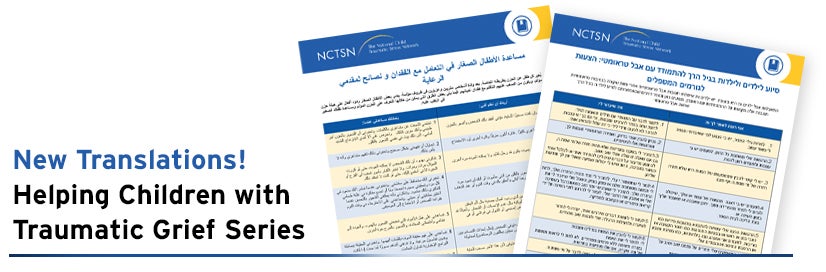
New Translations! Helping Children with Traumatic Grief Series
Helping Young Children with Traumatic Grief: Tips for Caregivers
Outlines the feelings of young children struggling with the death of someone meaningful and offers suggestions on what caregivers can do to help. Available in Arabic and Hebrew.Helping School-Age Children with Traumatic Grief: Tips for Caregivers
Describes how school-age children may feel when struggling with the death of someone close and offers tips on what caregivers can do to help. Available in Arabic and Hebrew.Helping Teens with Traumatic Grief: Tips for Caregivers
Describes how teens may feel when struggling with the death of someone close and offers tips on what caregivers can do to help. Available in Arabic and Hebrew.
New Translation: Age-Related Reactions to a Traumatic Event
Describes how young children, school-age children, and adolescents react to traumatic events and offers suggestions on how parents and caregivers can help and support them. Available in Arabic.New Translation: Helping Youth After a Community Trauma: Tips for Educators
Lists common reactions educators might see in the students with whom they work and suggestions on how they may help after community trauma. This tip sheet describes how traumatic events, such as a natural disaster, school violence, or the traumatic death of a peer or educator, can affect students’ learning, behavior, and relationships. Now available in Hebrew.Children’s Advocacy Centers Page on NCTSN.org
Children’s Advocacy Centers (CAC) are the predominant national model for addressing the impact of child abuse by coordinating the investigation, treatment, and prosecution of such cases via a multidisciplinary approach. This NCTSN webpage displays resources for building skills and increasing knowledge about childhood trauma to help CAC multidisciplinary teams including advocates, caseworkers, medical professionals, forensic interviewers, law enforcement, child welfare, prosecuting agencies, and mental health personnel to better understand and respond to the needs of traumatized children.
Stress in America 2023
The COVID-19 pandemic, global conflicts, racism and racial injustice, inflation, and climate-related disasters are all weighing on the collective consciousness of Americans. The national public health emergency around COVID-19 officially ended on May 11, 2023, and results from the most recent APA Stress in America survey show mounting evidence that our society is experiencing the psychological impacts of a collective trauma.New Online Course! Trauma ScreenTIME Pediatric Primary Care Course
The Trauma ScreenTIME Pediatric Primary Care Course is a free online training course on how to screen children for trauma in pediatric primary care settings. This training was developed by the Child Health and Development Institute in collaboration with families and national experts from the NCTSN based on current research and best practices. The course is appropriate for child-serving staff in various roles within a pediatric primary care setting, including leadership, frontline clinical staff, and administrative staff. The course shows how to develop a screening process, conduct brief trauma screening, and connect families with their preferred supports and services.
The Center for Trauma Recovery and Juvenile Justice Website Launch
The Center for Trauma Recovery and Juvenile Justice (CTRJJ) supports a comprehensive framework for developing, adopting, implementing, and sustaining evidence-based, trauma-informed services for youth in, or at risk for, juvenile justice involvement, and their families.
Healthcare Toolbox
This toolbox helps children and families cope with illness and injury. It provides information on trauma-informed care with a focus on reducing distress, providing emotional support, and gauging family stressors and resources. The toolbox includes resources for healthcare, child welfare, and mental health professionals, as well as for families and caregivers.
RECENT JOURNAL PUBLICATIONS
Promoting Positive Development Among Refugee Adolescents, authored by Saida Abdi, Adeyinka M. Akinsulure-Smith, Anna Sarkadi, Mina Fazel, B. Heidi Ellis, Sarah Gillespie, Linda P. Juang, and Theresa S. Betancourt, examines research on refugee adolescents' developmental tasks, acculturative tasks, and psychological adjustment. Of the estimated 35.3 million refugees around the world (UNHCR, Figures at a Glance, 2022), approximately 50% are children under the age of 18. Refugee adolescents represent a unique group as they navigate developmental tasks in an unstable and often threatening environment or in resettlement contexts in which they often face marginalization. In addition to physiological, social, and psychological changes that mark adolescence, refugee youth often face traumatic experiences, acculturative stress, discrimination, and a lack of basic resources. This consensus statement explores research on refugee adolescents using Suárez-Orozco and colleague's integrative risk and resilience model for immigrant-origin children and youth proposed by Suárez-Orozco et al. It also discusses recommendations—moving from proximal to more distal contexts.
A Conceptual Analysis of System Responses to the Issue of Problematic Sexual Behaviors in Children and Recommendations for Future Work in Children’s Advocacy Center Multidisciplinary Teams, authored by Mary Harris, Diane Lanni, and Sasha Svendsen, identifies five key themes in the literature covering problematic sexual behavior (PSB) in children that influence barriers to treatment, and proposes an interdisciplinary approach for CAC multidisciplinary teams (MDTs) to better support this vulnerable population. Because of the intersection of children both causing harm and being harmed from PSB in children, societies across the globe struggle with whether to punish or support during these times. Children’s Advocacy Centers (CACs) have historically relied on identifying a “perpetrator” and “victim” when providing their services, however PSB displaying youth do not fit this classic dichotomy. Compared with other children, PSB displaying youth are more likely to experience greater incidents of violent childhood trauma, have decreased familial support, and struggle with co-occurring mental health diagnoses. Due to the stigma and fear surrounding sexual behaviors in children and systemic barriers including varied definitions of PSB, uncertainty regarding how to respond within the context of child-serving roles, and the criminalization of children’s behaviors, access to supportive services is complicated and challenging. Treatment completion rates for this population are as low as 13%, despite most methods being short-term, non-invasive, and community based. This conceptual analysis paper reviews the historical ways in which communities have responded to PSB, discusses five key concepts identified in the literature which have facilitated harmful or ineffective practice, and offers considerations for future PSB response in communities, highlighting the unique role of CACs as a critical, interdisciplinary team that is well-positioned to address and respond to this complex issue.




Looking for Trainings?
Visit the NCTSN Training Page on LinkedIn
Not on our mailing list? Click here to sign up.
This project was funded by the Substance Abuse and Mental Health Services Administration (SAMHSA), US Department of Health and Human Services (HHS). The views, policies, and opinions expressed are those of the authors and do not necessarily reflect those of SAMHSA or HHS.


