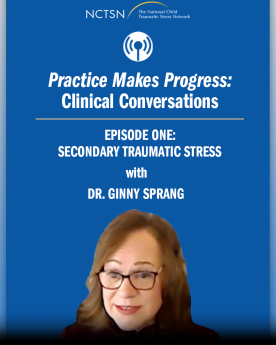
Practice Makes Progress - Episode 1: Secondary Traumatic Stress
NCTSN Affiliate Dr. Ginny Sprang from the University of Kentucky and National Center Co-Director Dr. Lisa Amaya-Jackson discuss Secondary Traumatic Stress (STS).

The following resources on child trauma were developed by the NCTSN. To find a specific topic or resource, enter keywords in the search box, or filter by resource type, trauma type, language, or audience.
NCTSN Affiliate Dr. Ginny Sprang from the University of Kentucky and National Center Co-Director Dr. Lisa Amaya-Jackson discuss Secondary Traumatic Stress (STS).

Date: January 15, 2026

Author: Sameena Siddiqui

Time: 3 minute read

Date: October 27, 2025
Author: Cambria Rose Walsh
Time: 5 minute read

Date: October 13, 2025
Authors: Brian C. Miller, Kalila Papanikolas

Time: 6 minute read
Date: 09/09/2025
Authors: Alison Hendricks, Kalila Papanikolas
Time: 4 minute read
Using her specific work in the area of Secondary Traumatic Stress, Dr. Ginny Sprang of the University of Kentucky has explored what it is that champions do to make an initiative successful.

Provides information for supporting the staff in a children’s advocacy center (CAC) setting who have been exposed to critical incidents and may have concerns about their physical or psychological safety.

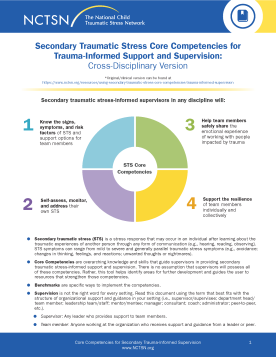
Identifies the core competencies that STS-informed supervisors in any discipline should have. This fact sheet defines terms, outlines benchmarks for each competency, and offers supervisors guidance on ways...

Is a companion document to the Secondary Traumatic Stress Core Competencies for Trauma-Informed Support and Supervision: Cross-Disciplinary Version offers further explanation, examples...

Offers guidance to help those working with youth involved in multiple systems (YIMS) and their families to use a traumatic stress perspective and provide trauma-informed care.
Is for all child-serving professionals who are exposed to details of traumatic events and/or individuals suffering from post-traumatic distress in the context of their work.