The National Child Traumatic Stress Network
Published on The National Child Traumatic Stress Network (https://www.nctsn.org)

Home > What is Child Trauma? > Trauma Types > Terrorism and Violence > School Shooting Resources

The following resources on School Shootings were developed by the NCTSN.

NCTSN Resource

Parent Guidelines for Helping Youth After the Recent Shooting [1]

Type: Fact Sheet

Offers parents guidance on helping their children after a shooting. This fact sheet describes common reactions children may have, how parents can help them, and self-care tips after an event.
view [1]
NCTSN Resource

Age-Related Reactions to a Traumatic Event [2]

Type: Fact Sheet

Describes how young children, school-age children, and adolescents react to traumatic events and offers suggestions on how parents and caregivers can help and support them.

view [2]
NCTSN Resource

Psychological First Aid (PFA) Online [3]

Type: eLearning Course

Includes a 5-hour interactive course that puts the participant in the role of a provider in a post-disaster scene. This course is for individuals new to disaster response who want to learn the core goals of PFA, as well as for seasoned practitioners who want a review.

view [3]
NCTSN Resource

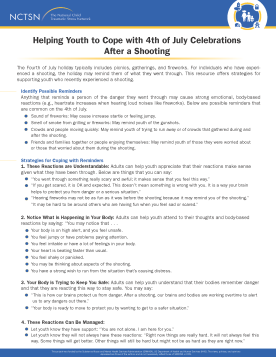
Helping Youth to Cope with 4th of July Celebrations After a Shooting [4]

Type: Fact Sheet

Offers strategies for supporting youth who recently experienced a shooting on how to cope with 4th of July celebrations.

view [4]
NCTSN Resource

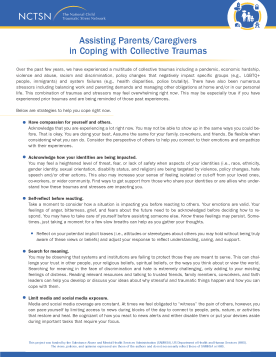
Assisting Parents and Caregivers in Coping with Collective Traumas [5]

Type: Tip Sheet

Offers strategies to help parents and caregivers cope with collective traumas. This fact sheet also provides guidance on what parents and caregivers can do to care for their children as they cope. Updated May 2024. 

view [5]
NCTSN Resource

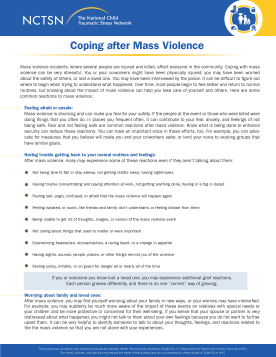
Coping After Mass Violence [6]

Type: Fact Sheet

Offers information on coping after mass violence. This fact sheet provides common reactions children and families may be experiencing after a mass violence event, as well as what they can do to take care of themselves. 

view [6]
NCTSN Resource

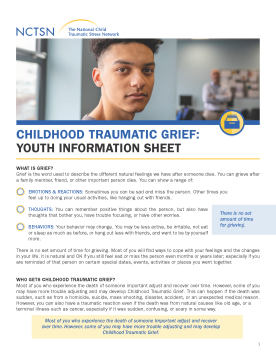
Childhood Traumatic Grief: Youth Information Sheet [7]

Type: Fact Sheet

Offers information for youth to help them understand the differences between grief and traumatic grief, the signs and symptoms of traumatic grief in children and youth, and what to do to feel better.

view [7]
NCTSN Resource

Skills for Psychological Recovery (SPR) Online [8]

Type: eLearning Course

Aims to help survivors gain skills to manage distress and cope with post-disaster stress and adversity. This course utilizes skills-building components from mental health treatment that have been found helpful in a variety of post-trauma situations.

view [8]
NCTSN Resource

Childhood Traumatic Grief: Information for Mental Health Providers [9]

Type: Fact Sheet

Offers information on why mental health providers are important for grieving children. This fact sheet outlines how children grieve, what Childhood Traumatic Grief is...

view [9]
NCTSN Resource

Childhood Traumatic Grief: Information for Parents and Caregivers [10]

Type: Fact Sheet

Provides information to parents and caregivers on Childhood Traumatic Grief.

view [10]
NCTSN Resource

Childhood Traumatic Grief: Information for School Personnel [11]

Type: Fact Sheet

Offers information on why school personnel are important for grieving students. This fact sheet outlines how children grieve, what Childhood Traumatic Grief is, who develops Childhood Traumatic Grief, what traumatic stress reactions in Childhood Traumatic Grief can look like, the signs a student

view [11]
NCTSN Resource

Childhood Traumatic Grief: Information for the Media [12]

Type: Fact Sheet

Provides information to the media on what to know about covering traumatic deaths for children and families.

view [12]

Pages

  • 1
  • 2 [13]
  • 3 [14]
  • 4 [15]
  • 5 [16]
  • NEXT [13]
  • LAST [16]

Source URL:https://www.nctsn.org/what-is-child-trauma/trauma-types/terrorism-and-violence/school-shooting-resources

Links
[1] https://www.nctsn.org/resources/parent-guidelines-helping-youth-after-recent-shooting [2] https://www.nctsn.org/resources/age-related-reactions-traumatic-event [3] https://www.nctsn.org/resources/psychological-first-aid-pfa-online [4] https://www.nctsn.org/resources/helping-youth-cope-with-4th-of-july-celebrations-after-a-shooting [5] https://www.nctsn.org/resources/assisting-parents-caregivers-in-coping-with-collective-traumas [6] https://www.nctsn.org/resources/coping-after-mass-violence [7] https://www.nctsn.org/resources/childhood-traumatic-grief-youth-information-sheet [8] https://www.nctsn.org/resources/skills-psychological-recovery-spr-online [9] https://www.nctsn.org/resources/childhood-traumatic-grief-information-for-mental-health-providers [10] https://www.nctsn.org/resources/childhood-traumatic-grief-information-for-parents-and-caregivers [11] https://www.nctsn.org/resources/childhood-traumatic-grief-information-for-school-personnel [12] https://www.nctsn.org/resources/childhood-traumatic-grief-information-for-the-media [13] https://www.nctsn.org/print/920?page=1 [14] https://www.nctsn.org/print/920?page=2 [15] https://www.nctsn.org/print/920?page=3 [16] https://www.nctsn.org/print/920?page=4